
European
The spiritual family
0:05 - 0:56 (51 min)
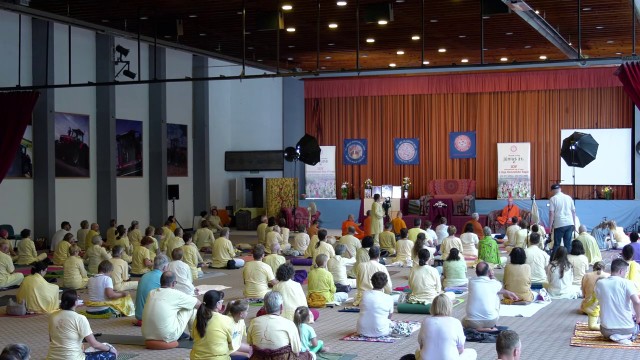
An opening talk at a spiritual seminar addressing the absence of the guru and the purpose of gathering.
"People are always complaining, 'Oh, Kali Yuga is not good, Kali Yuga is a terrible time.' But if you know how to utilize it, Kali Yuga is also excellent."
"We need to be like a Paramahaṁsa... We should be like that. In this world, we have so many things... we should be like the Haṁsa: take the pearls, take the milk, and leave the water."
A senior disciple addresses the assembled spiritual family at the Vép seminar, acknowledging the physical absence of Viśvagurūjī. He reframes the gathering as a vital opportunity to recharge, strengthen spiritual family bonds, and deepen personal practice. Key themes include extracting the essence from the Kali Yuga, the necessity of a supportive community for sādhanā, and using the seminar for introspection, mauna (silence), and focused practice of āsana and prāṇāyāma to calm the mind.
Filming location: Vép, Hungary
Around the world - Opening of new YIDL center in Nadlac, Romania
1:00 - 1:40 (40 min)
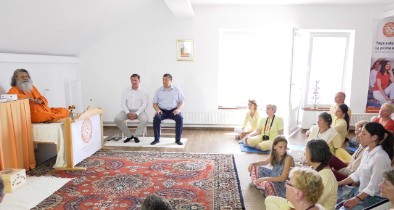
Morning satsang with Vishwaguruji from Nadlac, Romania.
About the thousand names of Vishnu
1:45 - 2:15 (30 min)
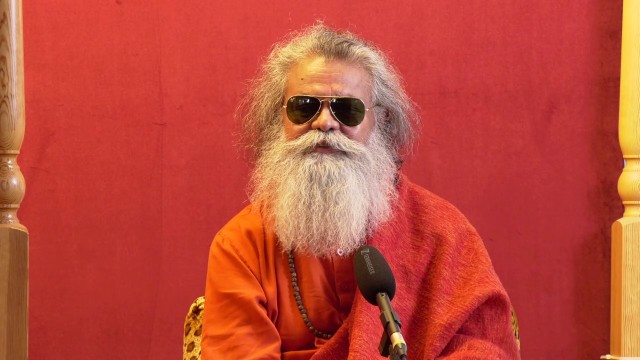
Evening satsang with Vishwaguruji from Guruji Ashram, Vienna, Austria.
The spiritual family
2:20 - 3:11 (51 min)
An opening talk at a spiritual seminar addressing the absence of the guru and the purpose of gathering.
"People are always complaining, 'Oh, Kali Yuga is not good, Kali Yuga is a terrible time.' But if you know how to utilize it, Kali Yuga is also excellent."
"We need to be like a Paramahaṁsa... We should be like that. In this world, we have so many things... we should be like the Haṁsa: take the pearls, take the milk, and leave the water."
A senior disciple addresses the assembled spiritual family at the Vép seminar, acknowledging the physical absence of Viśvagurūjī. He reframes the gathering as a vital opportunity to recharge, strengthen spiritual family bonds, and deepen personal practice. Key themes include extracting the essence from the Kali Yuga, the necessity of a supportive community for sādhanā, and using the seminar for introspection, mauna (silence), and focused practice of āsana and prāṇāyāma to calm the mind.
Filming location: Vép, Hungary
Live webcast from Rijeka
3:00 - 4:30 (90 min)
Evening satsang from Rijeka Ashram, Croatia.
Only wisdom can digest ego
3:15 - 4:13 (58 min)
Lecture from Vep, Hungary
Bhaktas are longing for Satsang
4:20 - 5:08 (48 min)
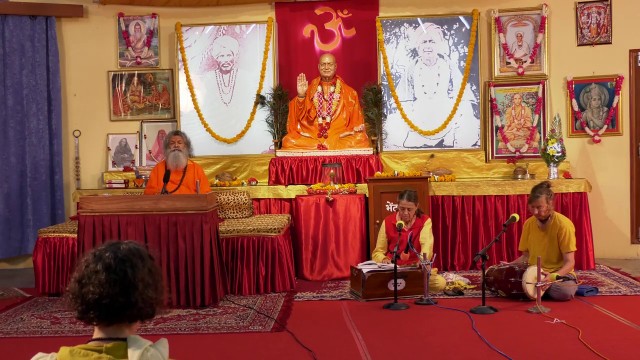
Evening satsang from Jadan Ashram, Rajasthan, India. Bhajan singing. Swami Umapuri says some words about her spiritual development in the Jadan Ashram. She spoke about her experiences with Yoga Nidra. She explains the bhajans of Swami Sivananda and Bhagwan Sri Deep Mahaprabhuji.
A Warm Welcome and the Three Books
5:15 - 5:23 (8 min)
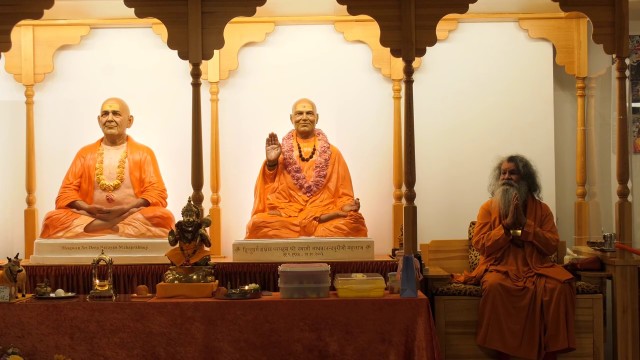
A welcome address and discourse upon a spiritual teacher's return.
"You only have to look in those three books. Everything is explained there."
"When the Guru's kṛpā is upon you, you have nothing to worry about."
A devotee offers a warm welcome to Swāmījī upon his arrival at the airport after a long journey. The speaker emphasizes that all spiritual guidance is contained within three key books: a yoga book, a chakra book, and the Līlā Amṛt. Following this, another speaker chants a Maṅgalācaraṇ, explains its meaning as a salutation to the guru lineage from Sadāśiva to their current Gurudev, and expresses gratitude for the blessing of being in the Guru's service.
Filming location: Vienna, Austria
The 3rd Sri Swami Maheshwarananda Festival (1/4)
5:30 - 6:41 (71 min)
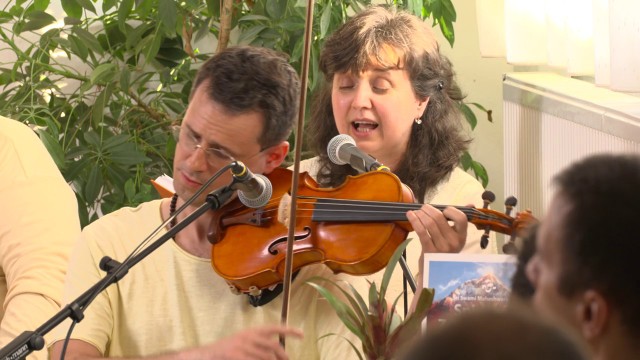
Welcome to the third Sri Swami Maheshwarananda Festival of Spiritual Music, Debrecen, Hungary.
The 3rd Sri Swami Maheshwarananda Festival (2/4)
6:45 - 7:54 (69 min)
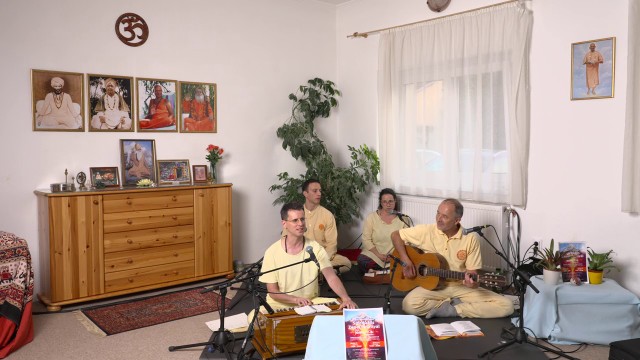
Welcome to the third Sri Swami Maheshwarananda Festival of Spiritual Music, Debrecen, Hungary.
The 3rd Sri Swami Maheshwarananda Festival (3/4)
8:00 - 9:07 (67 min)
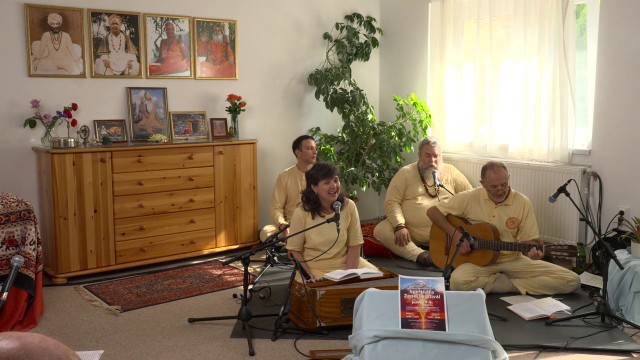
Welcome to the third Sri Swami Maheshwarananda Festival of Spiritual Music, Debrecen, Hungary.
Maya can destroy everything
9:15 - 9:57 (42 min)
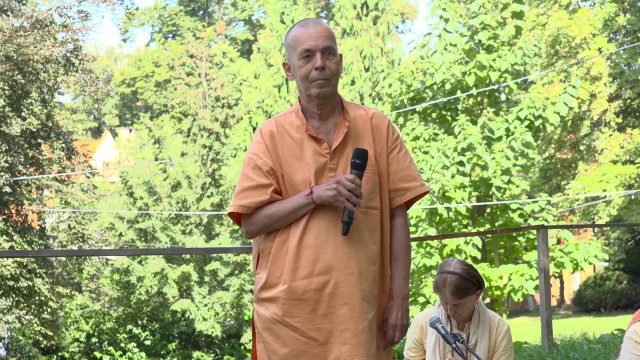
A spiritual discourse warning against greed and emphasizing correct devotional practice.
"Kāma, krodha, mada, lobha, ahaṅkāra. These are all important factors in the downfall of any spiritual seeker."
"For us, our Māyā should be Gurudev. We should run behind him. We should remember Him all the time."
A swami leads a satsang, using parables and a personal anecdote to illustrate the destructive power of greed (lobha). He stresses constant devotion to the Guru over material illusion. The talk concludes with detailed instructions for performing mantra japa correctly, including how to hold a mala and the significance of different rudrākṣa beads, while ultimately pointing to pure devotion as the supreme principle.
Filming location: Strilky, Czech Republic
How do we practice Bhramari?
10:05 - 10:24 (19 min)
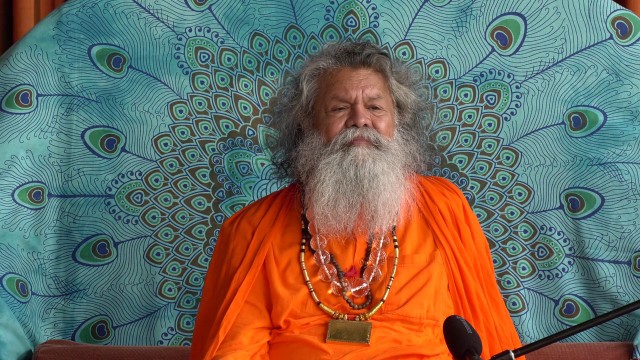
A teaching session on breathwork and the Brahmari technique.
"You are very good persons, and you must practice every day." "You should do only three practices: on the chest, on the heart, in the navel, and then Brahmari."
A spiritual teacher instructs a group on daily breathing practices, using the analogy of a varied meal to explain the need for different techniques. He outlines a sequence focusing on the heart and navel, details methods of inhalation and exhalation through the nose and mouth, and gives specific guidance on practicing the Brahmari sound. The talk includes practical warnings about social settings and concludes with an encouragement to practice at home.
Filming location: Vép, Hungary
Bhaktas are longing for Satsang
10:30 - 11:18 (48 min)
Evening satsang from Jadan Ashram, Rajasthan, India. Bhajan singing. Swami Umapuri says some words about her spiritual development in the Jadan Ashram. She spoke about her experiences with Yoga Nidra. She explains the bhajans of Swami Sivananda and Bhagwan Sri Deep Mahaprabhuji.
The spiritual family
11:25 - 12:16 (51 min)
An opening talk at a spiritual seminar addressing the absence of the guru and the purpose of gathering.
"People are always complaining, 'Oh, Kali Yuga is not good, Kali Yuga is a terrible time.' But if you know how to utilize it, Kali Yuga is also excellent."
"We need to be like a Paramahaṁsa... We should be like that. In this world, we have so many things... we should be like the Haṁsa: take the pearls, take the milk, and leave the water."
A senior disciple addresses the assembled spiritual family at the Vép seminar, acknowledging the physical absence of Viśvagurūjī. He reframes the gathering as a vital opportunity to recharge, strengthen spiritual family bonds, and deepen personal practice. Key themes include extracting the essence from the Kali Yuga, the necessity of a supportive community for sādhanā, and using the seminar for introspection, mauna (silence), and focused practice of āsana and prāṇāyāma to calm the mind.
Filming location: Vép, Hungary
How did Yoga in Daily Life begin in Europe?
12:20 - 13:02 (42 min)
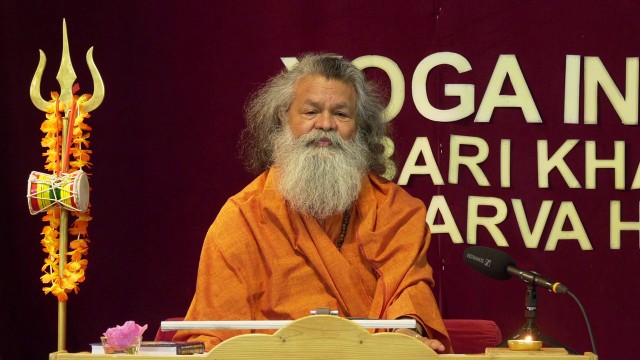
Evening satsang with Vishwaguruji from Strilky Ashram, Czech Republic. When Vishwaguruji in his young age first time arrived in Europe very few people heard about yoga and many people ate meat. At that time Vishwaguruji went back to India. But some Austrian people invite him again to come to Europe. The story of Vishwaguruji's first visit tö Czechoslovakia. Many Czech people are with Vishwaguruji from that time till now. The story of a grandmother in Czechoslovakia who didn't want that her grandchild becomes a vegetarian. Satsang bhajans and prayer were also very new for people at that time. We have to take care of our family. At that time people prayed before eating but now they do not.
You are like bees
13:10 - 13:52 (42 min)
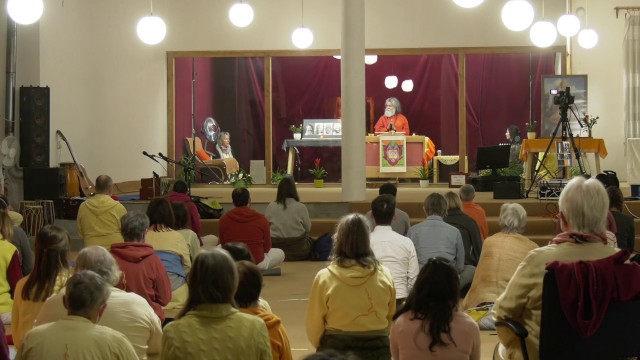
Evening satsang with Vishwaguruji from Strilky, Czech Republic. There are many Gurus and many more disciples in the world. We are not our body, we are Atma. Never be negative with anyone. Bhajan is like honey coming from our throat. I bless you and work for you. The corona will pass away sooner or later. We are all like bees. Singing Bhajans.
Yoga in Daily Life - excercise program
14:00 - 15:32 (92 min)
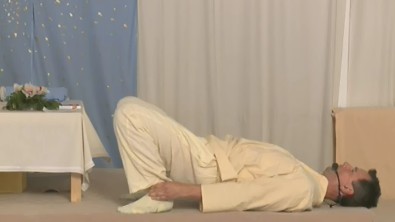
Morning Yoga excercise according to system Yoga in Daily Life from Mahaprabhudeep Ashram, Strilky, Czech Republic.
Full moon Satsang with Vishwaguruji
15:40 - 16:07 (27 min)
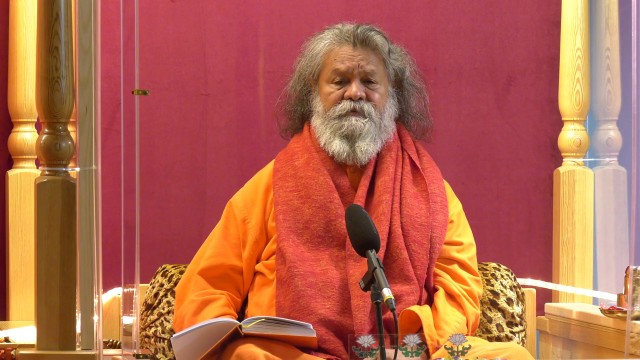
from Guruji Ashram, Vienna, Austria
Death is a transition
16:15 - 17:16 (61 min)
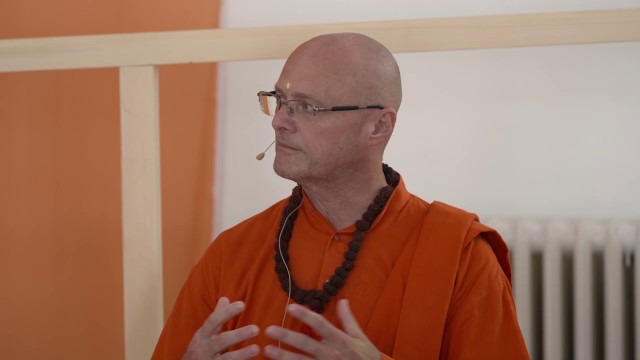
Morning satsang with Vishwaguruji from Strilky Ashram, Czech Republic. Lecture by Swami Avatarpuriji. Once we realize that death is basically a transition from this body to a higher place it is not scary. Who comes will go, that the universal law. A story about king Vidhur, who had a fear about what will happen when he dies. Learnig and translating mantras, a prayer to Lord Vishnu. Salutations to the infinite one, who has thousands forms... Lecture by Swami Vivekpuriji. What is a Guru, how we are feeling about the Guru?
Proper exercise is important to us
17:20 - 17:52 (32 min)
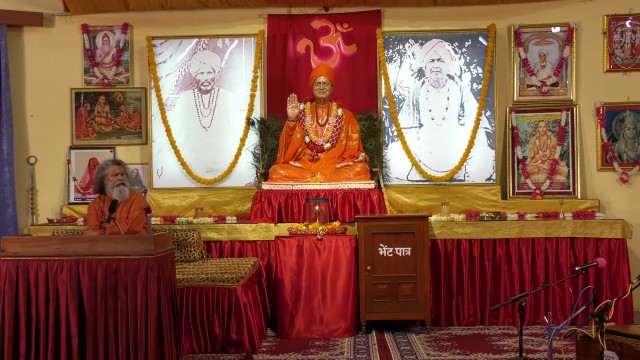
Evening satsang from Jadan Ashram, Rajsthan, India. Two things are important in our lives. What we eat and what we breathe. Yoga in Daily Life are practiced all over the world. Sarva Hitta asanas are good for everyone. Proper exercise is as important to us as food.
A Warm Welcome and the Three Books
18:00 - 18:08 (8 min)
A welcome address and discourse upon a spiritual teacher's return.
"You only have to look in those three books. Everything is explained there."
"When the Guru's kṛpā is upon you, you have nothing to worry about."
A devotee offers a warm welcome to Swāmījī upon his arrival at the airport after a long journey. The speaker emphasizes that all spiritual guidance is contained within three key books: a yoga book, a chakra book, and the Līlā Amṛt. Following this, another speaker chants a Maṅgalācaraṇ, explains its meaning as a salutation to the guru lineage from Sadāśiva to their current Gurudev, and expresses gratitude for the blessing of being in the Guru's service.
Filming location: Vienna, Austria
Our heart is very great
18:15 - 18:48 (33 min)
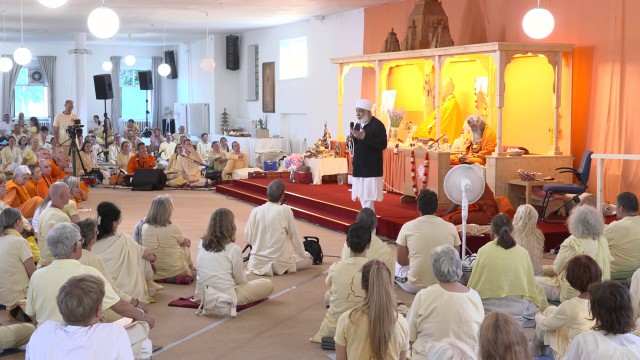
A satsang discourse on the universal sound of Om and the spiritual practice of surrender.
"In India, a name changes with region. In North India, you have Rāma. In Middle India, it becomes Rāma. In South India, it becomes Rāmaṇ."
"The easiest option is to let go, put it down, and allow the mind to become peaceful. The happiest thing is simply to let it be, to release it calmly and let it flow."
A speaker first explains the universality of Om, linking it to the words 'Amen' and 'Amin', and discusses his work promoting Indian traditional sciences in European parliaments. Swami Maheshvaranand then shares a teaching story about a restless monkey to illustrate how surrendering thoughts leads to peace, emphasizing meditation and devotion to the Guru.
Filming location: Strilky, Czech Republic
Be joyful
18:55 - 19:22 (27 min)
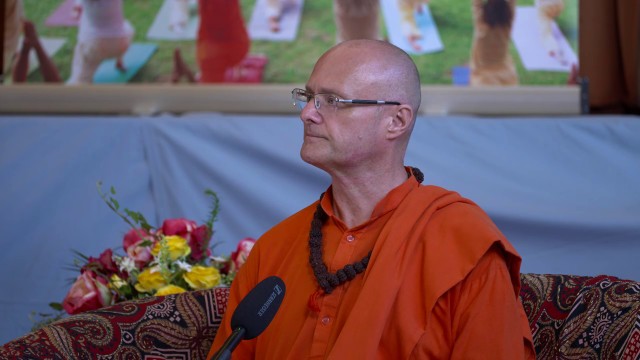
A satsang discourse on the spiritual significance of a guru's birthday, drawing parallels to Christmas.
"I recall Swāmījī saying, 'I was observing one person who was practicing Kriyā under the tree.'"
"For us, the day of incarnation of Mahāprabhujī, the day of incarnation of Swāmījī, Gurujī, is Christmas. But even more than Christmas, because that is our guru."
A spiritual teacher addresses a gathering, explaining why the birthday of a guru is a sacred celebration akin to Christmas. He emphasizes the necessity of a living guru for correct spiritual practice and describes the Guru Tattva (the essence of the guru) as a pure, divine light within a physical form. He explains how devotees can connect to this energy through satsang, devotion, and bhajans, transforming their own energy and creating a joyful spiritual life. The talk includes practical advice on using prayer, song, and positive thinking to change one's internal state and the surrounding atmosphere.
Filming location: Vép, Hungary
Gurudev is always merciful and loving
19:30 - 20:00 (30 min)
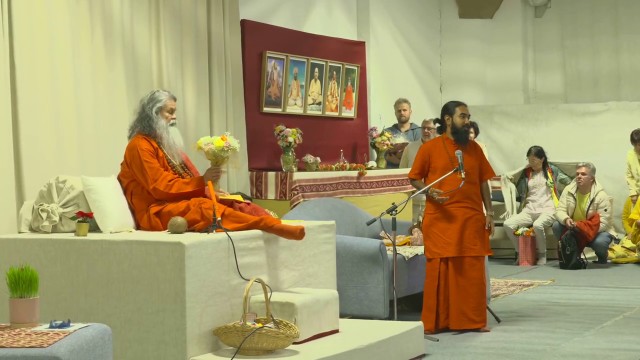
A satsang discourse on the grace and necessity of the guru.
"It does not matter how tired his physical body is or how exhausted he may be. When he is with all of you, with his bhaktas, he always wishes to stay as long as it is possible for him."
"If we want to be freed from this cycle of death and birth, then we need Gurudeva, because he removes this cycle of death and birth from all his bhaktas."
A speaker addresses a gathering in the presence of Gurudeva, expressing gratitude for the guru's loving endurance. He explains the essential role of the Sadguru in spiritual life, using the story of Dhruva's devotion and a parable about two Brahmins discovering that all holy rivers purify themselves at the feet of a true guru. The key theme is that the guru's grace removes all sorrow, purifies sins, and liberates the disciple from the cycle of birth and death.
Filming location: Maha Kumbha Mela, India
The spiritual family
20:05 - 20:56 (51 min)
An opening talk at a spiritual seminar addressing the absence of the guru and the purpose of gathering.
"People are always complaining, 'Oh, Kali Yuga is not good, Kali Yuga is a terrible time.' But if you know how to utilize it, Kali Yuga is also excellent."
"We need to be like a Paramahaṁsa... We should be like that. In this world, we have so many things... we should be like the Haṁsa: take the pearls, take the milk, and leave the water."
A senior disciple addresses the assembled spiritual family at the Vép seminar, acknowledging the physical absence of Viśvagurūjī. He reframes the gathering as a vital opportunity to recharge, strengthen spiritual family bonds, and deepen personal practice. Key themes include extracting the essence from the Kali Yuga, the necessity of a supportive community for sādhanā, and using the seminar for introspection, mauna (silence), and focused practice of āsana and prāṇāyāma to calm the mind.
Filming location: Vép, Hungary
The Guru can change our destiny
21:00 - 21:22 (22 min)
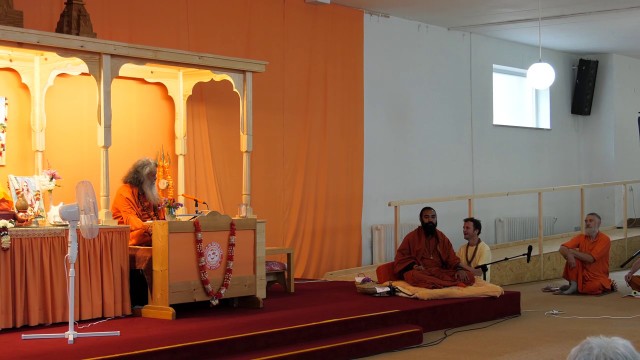
A spiritual discourse on the guru's power to transform destiny.
"Everything depends on our karmas... What is written for you, what is written in your destiny, that is what is going to happen."
"Guru Kṛpāhi Kevalam... So this is Guru Kṛpā. The guru is the one who can actually change your destiny if he wants."
The lecturer narrates a traditional story from Holī Gurujī about a king's guru and the Vedāntā, the deity who writes destiny. The tale illustrates how a guru's compassion and clever guidance can alter the seemingly fixed fate of two princes, demonstrating the supreme grace of the guru. The discourse emphasizes the guru's equal love for all, regardless of status.
Filming location: Strilky, Czech Republic
You and me are one
21:30 - 22:09 (39 min)
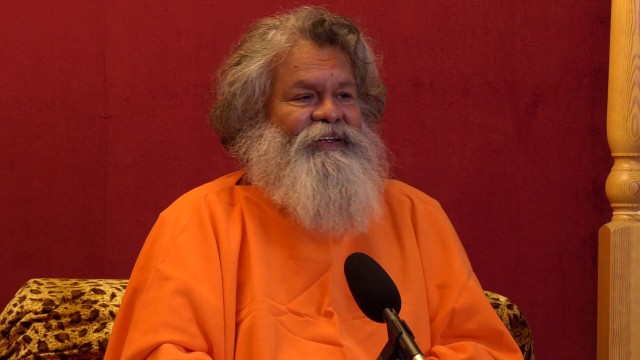
A spiritual discourse on the nature of life, death, and authentic practice.
"Life is everywhere. Then there are the flying creatures... They are happy, or they think, 'We are all right, we are good.'"
"It is said that if they burn the body completely, everything that is there, then they are going far... all is going, life."
The speaker shares a series of contemplations and personal anecdotes, including a story about a mother figure (Mātājī) in Vienna and a nighttime encounter with a spiritual presence resembling his Guru. He discusses the pervasiveness of life, the process of death and cremation, and uses the metaphor of a drop merging into the ocean to describe spiritual unity. The talk concludes with a critique of modern yoga practices focused on money rather than genuine inner realization.
Filming location: Vienna, Austria
About the thousand names of Vishnu
22:15 - 22:45 (30 min)
Evening satsang with Vishwaguruji from Guruji Ashram, Vienna, Austria.
How do we practice Bhramari?
22:50 - 23:09 (19 min)
A teaching session on breathwork and the Brahmari technique.
"You are very good persons, and you must practice every day." "You should do only three practices: on the chest, on the heart, in the navel, and then Brahmari."
A spiritual teacher instructs a group on daily breathing practices, using the analogy of a varied meal to explain the need for different techniques. He outlines a sequence focusing on the heart and navel, details methods of inhalation and exhalation through the nose and mouth, and gives specific guidance on practicing the Brahmari sound. The talk includes practical warnings about social settings and concludes with an encouragement to practice at home.
Filming location: Vép, Hungary
You are like bees
23:15 - 23:57 (42 min)
Evening satsang with Vishwaguruji from Strilky, Czech Republic. There are many Gurus and many more disciples in the world. We are not our body, we are Atma. Never be negative with anyone. Bhajan is like honey coming from our throat. I bless you and work for you. The corona will pass away sooner or later. We are all like bees. Singing Bhajans.
American
Australian