
European
Wonders of the human being
0:50 - 2:16 (86 min)
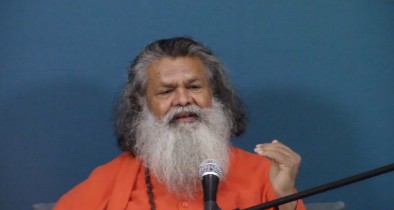
A morning satsang in a Canadian rainforest on the inner body, breath, and spiritual search.
"Where are you searching for me, oh my friend? My heart is in the forest, but I am dwelling in your breath."
"If you really search for me, I will meet you within a second."
Swami Satyanarayana Dasa gives a discourse, using the surrounding forest as a metaphor for the inner landscape of chakras and nadis. He explains the vital importance of breath (prana) and shares stories—including a parable of Ramakrishna and a devotee—to illustrate the intensity of devotion required to know God. The talk covers the five sheaths (Panchakosha), the caution around awakening kundalini, and practical guidance on pranayama and asanas for purifying the physical and energetic bodies.
Filming location: Vancouver, Canada
Marriage has its proper time and order
2:20 - 3:59 (99 min)
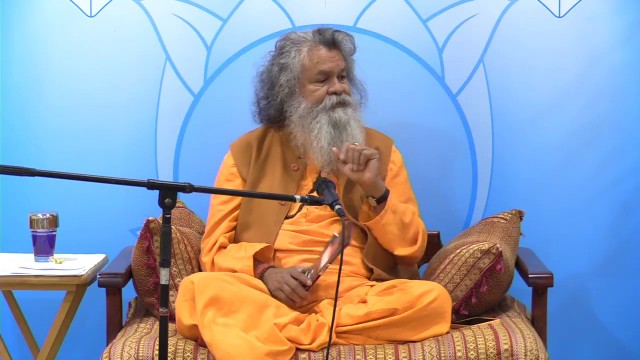
Evening satsang with Vishwaguruji from Sydney Ashram, Australia. Bhajan singing and explanation. Swami Jasraj Puri introduces our Masters and our parampara and their Ashrams and that territory of India. Indian people know many bhajans. There are many languages in India. Everything has its proper time to do. Marriage also has its proper time. In India, a boy and a girl should marry only if the family and a pandit also agreed with that. If you married in a church you should be faithful your whole life to your partner. Nowadays many people leave their partner and it brings many problems for children. The story of a boy and a girl who loved each other but they had a problem with the bread. Practising some simple exercises and bhramari pranayama.
Guruji is Divine Light
4:05 - 4:41 (36 min)
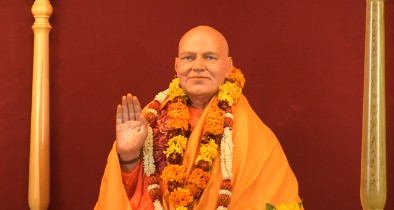
A personal discourse on Guru Bhakti, shared on the incarnation day of the speaker's master.
"The meaning is the same, but the person is the same while the inner being is different. So, it is holy Gurujī's divine incarnation."
"Guru Bhakti is the highest, greatest, divinest, and most successful... All knowledge comes through Guru Kṛpā."
Swami Maheshwarananda (Swamiji) addresses a gathering, reflecting on his first divine encounter with his Guru as a child and the profound training that followed. He describes the transformative power of the Guru's love and protection, illustrating the principles of Guru Bhakti with personal stories, including his Guru's strict discipline, the transfer of spiritual wisdom, and visionary experiences. He concludes with an account of his Guru's passing and the enduring presence of his blessings.
Filming location: Vienna, Austria
Spiritual Way Of Living
4:45 - 5:33 (48 min)
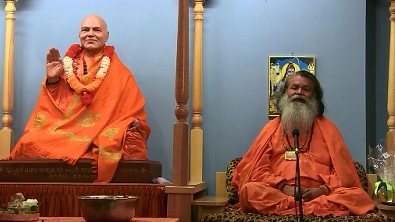
A satsang commemorating the 89th birth anniversary of Satguru Dev Swami Madhavanandaji.
"Everyone has birth, but rare are those who make this birth successful."
"Guru kṛpāhi kevalaṁ kṛpāḥ. On whom the kripa of the Gurudev is there, everyone’s kripa will be there."
A spiritual teacher leads a discourse honoring the birth anniversary of Satguru Dev. He explores the nature of a divine birth, where an immortal soul enters the mortal world as a guide. Key themes include the importance of blessings over curses, the eternal Guru Tattva principle, and the lineage of grace from Alakpuriji through Devpuriji to the present Satguru. The talk emphasizes surrendering negative qualities, following the Guru's word as mantra, and the protective power of faith.
Filming location: Vienna, Austria
Suffering And Sweetness
5:40 - 6:13 (33 min)
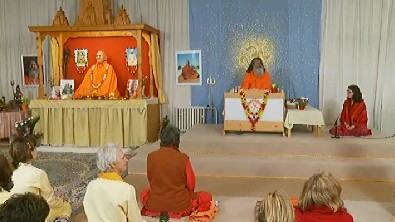
A spiritual discourse on the essence of all teachings, delivered on the occasion of Mahashivaratri.
"All beings desire happiness. So, all entities in this world, including people, have only two wishes: the attainment of happiness and freedom from troubles."
"Sukha and Duhkha are within us. Try to sweep out all the negative vrittis; then you will become free from Duhkha."
A speaker addresses the satsang gathering, exploring the fundamental human pursuit of happiness (Sukha) and freedom from sorrow (Duhkha). He explains that these states originate from within, cultivated by our positive or negative thoughts and actions. The talk weaves together teachings on fear, violence (himsa), non-violence (ahimsa), and the ultimate goal of merging individual consciousness with the divine, using the metaphor of a drop returning to the ocean. He references the wisdom of Satguru Dev and concludes with practical instructions for the upcoming Shivaratri observance.
Filming location: Strilky, Czech Republic
Bhramari helps you sleep well
6:20 - 6:56 (36 min)
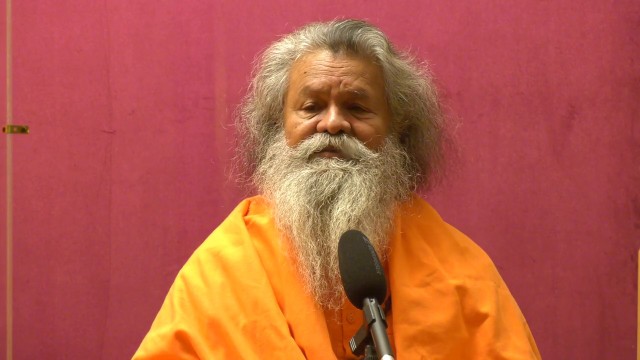
Evening satsang with Vishwaugurji from Guruji Ashram, Vienna, Austria. Practitioners of Yoga in daily life were disciplined and practiced, less affected by the coronavirus. The use of the right herbs and medicines helped them get through the infection. An explanation of the effects of Bhramari pranayama. Very good vibrations occur in both hemispheres of the brain when the teeth are open but the lips are closed. Practicing the correct version of Bhramari five times before falling asleep helps you sleep well.
The way Gurudev is teaching
7:00 - 7:52 (52 min)
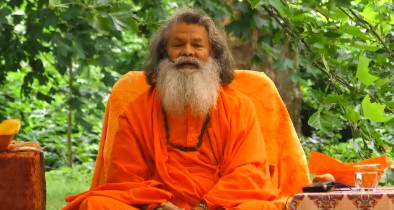
Morning satsang from Summer Retreat in Vep, Hungary. Listening to this lecture by Vishwaguruji we come to know the way a Master helps the Atma of a disciple on their journey towards the Light. Surya Nadi plays an important role in spiritual development.
Around the World - Nadlac
8:00 - 8:08 (8 min)
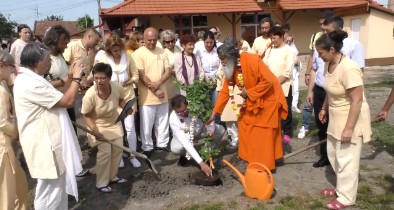
First Vishwagurujis visit to Romania.
Around the world - Opening of new YIDL center in Murska Sobota, Slovenia
8:15 - 8:57 (42 min)
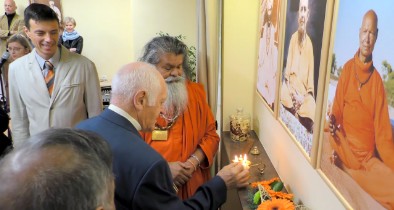
A ceremonial opening for a new yoga ashram in Slovenia, featuring addresses and spiritual teachings.
"Yoga is not specific to one country or one religion; yoga is universal."
"Yoga means balance, harmony, and unity... Yoga is a bright future for mankind, if they will use it."
Local representatives welcome guests and present symbolic gifts of bread, salt, and water. Swami Dayal Puri and the Indian Ambassador to Slovenia give speeches, celebrating the ashram's founding and explaining the ancient, universal science of yoga. The teachings cover yoga's origins in Shiva, its role in modern life for health and inner peace, and the importance of daily practice and willpower. The event concludes with Sanskrit mantras.
Filming locations: Murska Sobota, Prekmurje, Slovenia.
The Living Light of God - Indian Saints
9:05 - 9:32 (27 min)
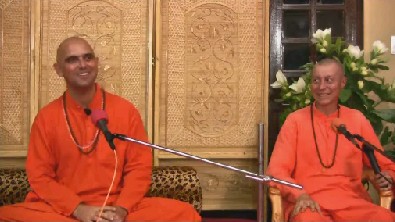
A satsang discourse using a parable to illustrate the guru's role and the disciple's responsibility.
"The saints are there to give us that light, to illuminate our path. The Guru provides the light so we can continue our journey more safely."
"But simultaneously, if we do not apply the brakes of self-discipline and engage in the practices he gives, then that light is of limited use."
The speaker shares a story of a saint offering a light to a speeding motorcyclist who has no brakes, using it as an analogy for spiritual guidance. He explains that the living tradition, or parampara, provides the illuminating light of wisdom through self-realized masters, but disciples must also practice self-discipline. The talk highlights how teachings evolve across generations while preserving their essence, referencing figures like Mahaprabhuji, Guruji, and Swamiji.
Filming location: Jadan, Rajasthan, India
Message of the Deepak
9:40 - 10:10 (30 min)
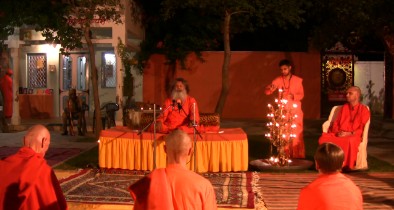
A spiritual discourse on the significance of Diwali (Dīpāvalī).
"This light is the truth, and we light these lights in everyone's heart. If we forget the sins of people, forgive them, and accept them, it means we light the candle again in their heart."
"Therefore, Dīvalī is not only for one day; Dīvalī is every day. When you open your eyes, you get the light, you see the light."
The speaker delivers a satsang on the festival of Diwali, explaining its origin in Lord Rama's return to Ayodhya and its deeper spiritual meaning as the inner light of Brahman. The talk explores the symbolism of the oil lamp—comparing the body to the pot, prana to the oil, the self to the wick, and the flame to the atman—and emphasizes themes of forgiveness, love (prem), non-violence (ahiṃsā), and daily spiritual practice. The discourse includes philosophical reflections, mantra chanting, and a critique of ritual animal sacrifice.
Filming location: Jadan, Rajasthan, India
Evening Satsang with H.H. Vishwaguruji
10:00 - 11:30 (90 min)
In memory of beloved Holy Guruji
In the bliss of bhajans
10:15 - 11:26 (71 min)
Bhajans from different ashrams in India
Practical guide to meditation (11/11)
11:30 - 12:10 (40 min)
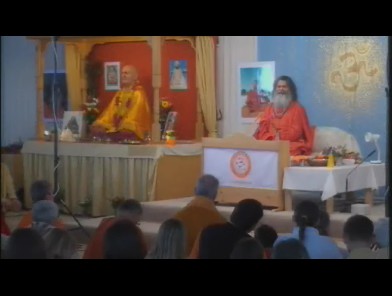
Webcast of morning satsang from Strilky, Czech Republic.
The Guru's name is a priceless diamond
12:30 - 12:46 (16 min)
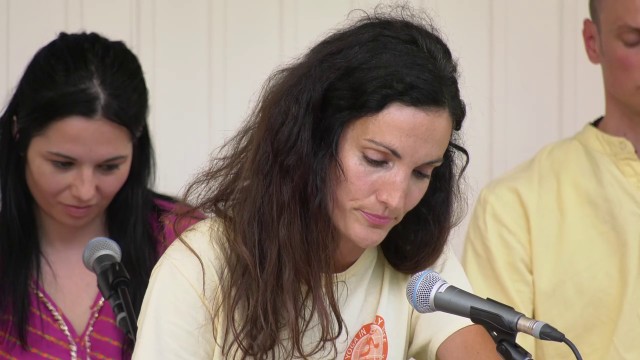
Evening satsang with Vishwaguruji from Strilky Ashram, Czech Republic. Bhajan singing from Strilky. Including bhajan "Ho Guru Sukha Dama Swami"
Tvameva Mata Ca Pita Tvameva
12:50 - 14:06 (76 min)
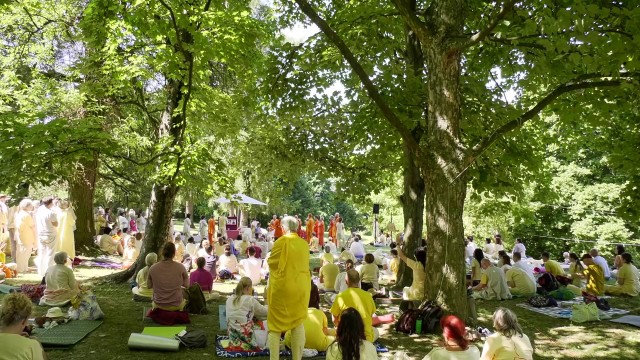
Morning satsang with Viswhaguruji from Strilky Ashram, Czech Republic. Bhajan singing from Strilky. Including He Nata Aba To, Itna to Karana Guruji
Sri Deep Narayan Mahaprahuji
14:10 - 14:17 (7 min)
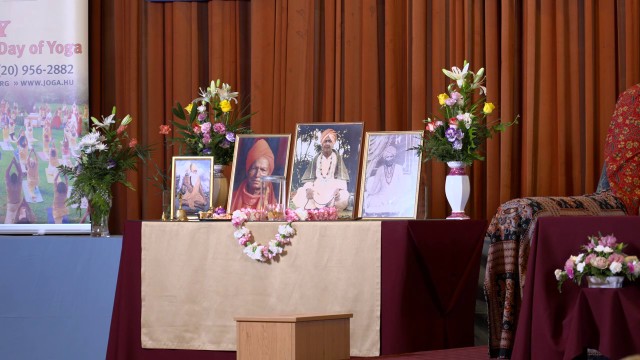
A devotional discourse on the power of the divine name and Guru's grace.
"For the beings of the world—the jīvas and jinn—His name itself is the boat to cross the ocean of existence."
"By always contemplating His name with grace, desire, anger, and greed are cut down."
The speaker offers praise to Śrī Dīp Nārāyaṇa Mahāprabhujī, described as a divine incarnation. The central theme is that constant remembrance and contemplation of this divine name serves as a vehicle for liberation, protecting devotees from worldly afflictions and illusion, and immersing them in divine absorption. The Guru's grace is presented as the essential means for this crossing.
Filming location: Vép, Hungary
Dhyan Karo
14:25 - 14:37 (12 min)
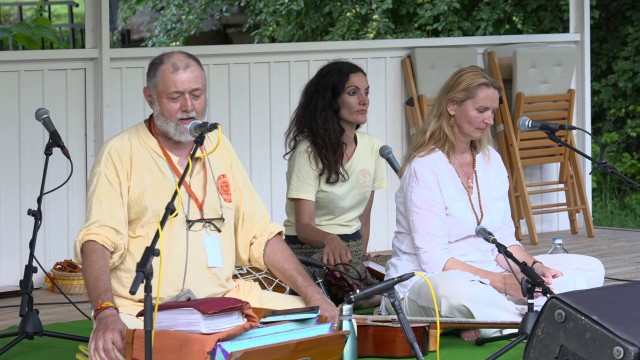
Evening satsang with Vishwaguruji from Strilky Ashram, Czech Republic. Bhajan singing from Strilky, including Dhyan Karo and Kyu Rakhte Ho Parada Ham Se
Singing bhajans by Swami Gajanandji
14:45 - 15:22 (37 min)
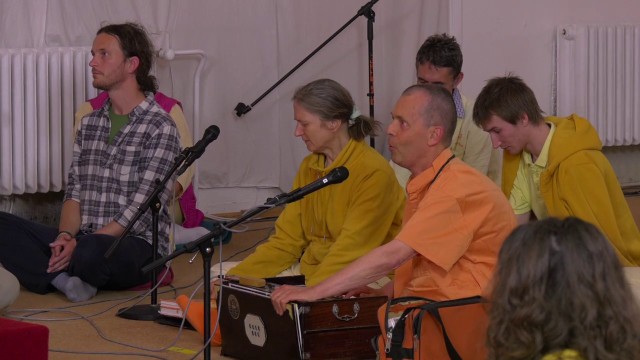
Evening satsang with Vishwaguruji from Strilky Ashram, Czech Republic. Singing bhajans by Swami Gajanandji.
Satsang from Vienna
15:30 - 16:31 (61 min)
Satsang with H.H. Vishwaguruji Maheshwarananda from Guruji Ashram, Vienna, Austria
The spiritual family
16:35 - 17:26 (51 min)
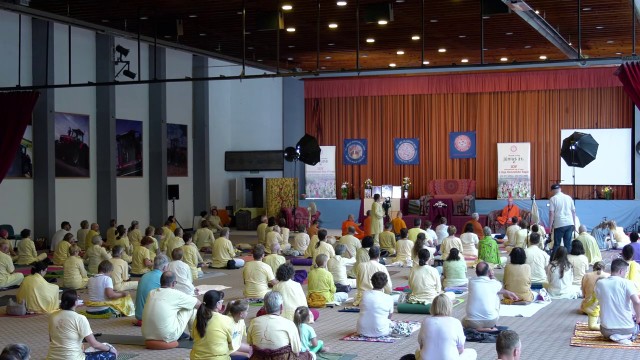
An opening talk at a spiritual seminar addressing the absence of the guru and the purpose of gathering.
"People are always complaining, 'Oh, Kali Yuga is not good, Kali Yuga is a terrible time.' But if you know how to utilize it, Kali Yuga is also excellent."
"We need to be like a Paramahaṁsa... We should be like that. In this world, we have so many things... we should be like the Haṁsa: take the pearls, take the milk, and leave the water."
A senior disciple addresses the assembled spiritual family at the Vép seminar, acknowledging the physical absence of Viśvagurūjī. He reframes the gathering as a vital opportunity to recharge, strengthen spiritual family bonds, and deepen personal practice. Key themes include extracting the essence from the Kali Yuga, the necessity of a supportive community for sādhanā, and using the seminar for introspection, mauna (silence), and focused practice of āsana and prāṇāyāma to calm the mind.
Filming location: Vép, Hungary
Atma is king of the body
17:30 - 18:35 (65 min)
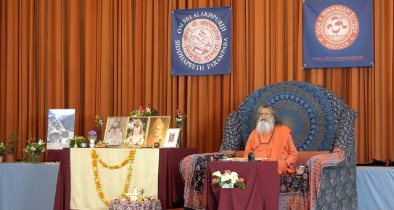
A spiritual discourse on perseverance, self-knowledge, and the inner faculties.
"It is not easy for anyone to remain steadfast on one path. This is true for everybody; it doesn't matter who you are. But when one has a single target, one can achieve it."
"He learned a lesson: if the ant cannot give up, why should I give up my sādhanā? I am sure one day I will achieve my goal. I may fall down many times, but I will get up again."
The speaker shares a parable about an ant persevering to carry a grain of rice, using it to illustrate the necessity of steadfastness on the spiritual path. He expands into an extended metaphor of the body as a coach, with the ten indriyas (faculties) as horses and the Ātmā as the king within. He emphasizes the crucial role of Viveka (discriminative intellect) as the king's advisor to guard against inner thieves like lust, anger, and greed, concluding that the Guru's word is the weapon that dispels them.
Filming location: Vép, Hungary
The Pranas in practice
18:40 - 19:44 (64 min)
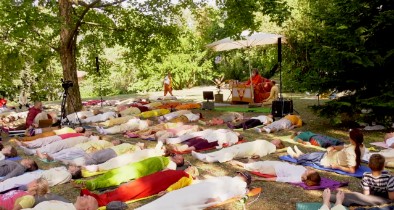
A guided yoga session focusing on Ānandāsana and the importance of Vajranāḍī for vitality.
"There is no existing Śavāsana. Śavāsana is a dead body’s posture, and you are living; you are not dead. Therefore, it is called Ānandāsana."
"Vajrāsana is one of the most powerful postures. It is strengthening first our Vajranāḍī, and Vajranāḍī is like the trunk of this body."
A yoga teacher instructs a large group through a series of postures and exercises, beginning with Ānandāsana and including twists and swings. He explains the physiological and energetic benefits, particularly for digestion and the apāna śakti, and details the role of the Vajranāḍī channel. The session incorporates chanting, demonstrations by students, and concludes with a collective prayer.
Filming location: Strilky, Czech Republic
Nadis and pranayama
19:50 - 20:54 (64 min)
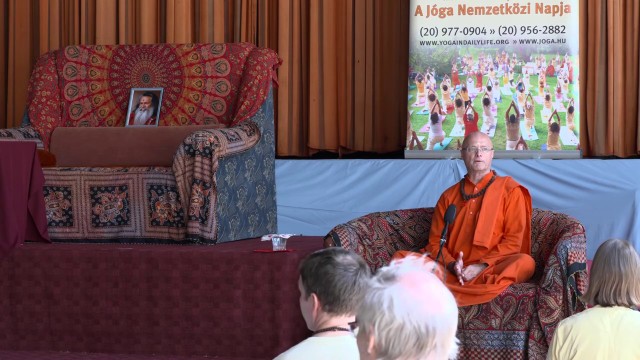
Morning satsang from Summer Yoga Retreat in Vep, Hungary. Lecture by M. M. Swami Vivekpuriji. If you are in good atmosphere you bring good atmosphere everywhere you come. Why we are starting pranayama with the right nostril? Try to inhale the divine, cosmic energy and trough positive thouhts and feelings exhale. Meditative bamboo flute music by Swami Madhuram.
Practice from Wellington with MM Vivekpuri
21:00 - 21:59 (59 min)

Wellington, New Zealand
A good education is important
22:05 - 23:05 (60 min)
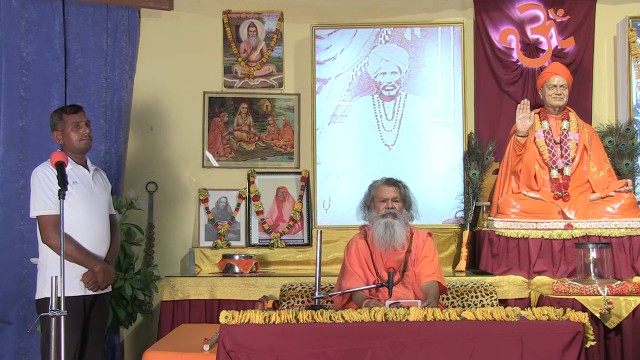
A satsang addressing community discipline, the importance of Hindi, and educational updates.
"If any bus is destroyed, the teachers have to pay the money... The trust means we are trusting you to keep our things okay."
"The Hindi language is the heart of Hindustan. And this Hindi language was born from Sanskrit."
The lecturer speaks to the ashram community, expressing concern over the careless treatment of property like school buses and furniture, instituting a system of financial responsibility. He then introduces the school principal, who delivers a discourse on the origins and significance of the Hindi language, tracing it from Sanskrit and explaining the etymology of the word 'Hindu'. The session includes translations, a financial appeal for the school, and concludes with a devotional song about the value of education.
Filming location: Jadan, Rajasthan, India
Good and bad destiny and karma
23:10 - 23:56 (46 min)
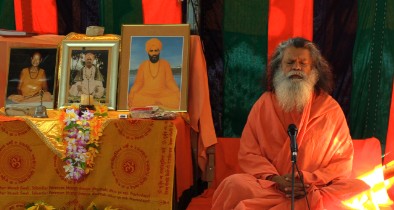
A spiritual discourse on destiny, karma, and religious tradition, incorporating stories and teachings.
"Someone has such a, what we call, good luck, so it comes in your hands... but what you have in yourself, no one can take away. They cannot take your destiny."
"Sanātana Dharma is declared as a living religion, and other religions are dead religions. I would not say death, but finished."
The lecturer leads an evening satsang, exploring the concept of destiny through the lens of karma and consciousness. He narrates a lengthy, illustrative story about the poet Kalidasa, from shepherd to prince to scholar, to demonstrate destiny's unpredictable nature. The talk expands into a comparative discussion of world religions, asserting the perpetual living tradition of Sanātana Dharma in contrast to others he describes as concluded.
Filming location: Australia
American
Australian