
European
Narada cursed Vishnu
0:15 - 0:58 (43 min)
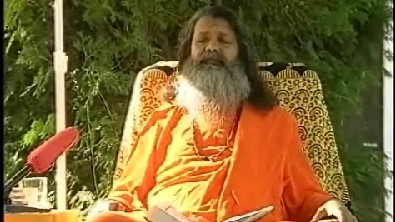
A narration of the mythological story of Nārada's curse upon Lord Viṣṇu, followed by a discourse on its spiritual meaning.
"You made me a monkey, and I tell you, when you will be in great trouble, only the monkey will help you, nobody else."
"The merciful Lord said, 'Nārada, that was all My icchā. It was My will.'"
The speaker recounts how the sage Nārada, enraged after being tricked by Viṣṇu's illusion (māyā), confronts the Lord to curse Him. In his anger, Nārada pronounces a curse that Viṣṇu will incarnate as Rāma, suffer separation from His wife, and be aided by monkeys. Viṣṇu accepts the curse, explaining it was His own divine will, and later dissolves the illusion. A remorseful Nārada seeks forgiveness, and Viṣṇu promises to give him a liberating Kriyā. The talk includes a tangential account of the churning of the ocean (Samudra Manthan) to illustrate Nārada's accusations.
Filming location: Vép, Hungary
Feel the confidence and God will help
1:05 - 1:51 (46 min)
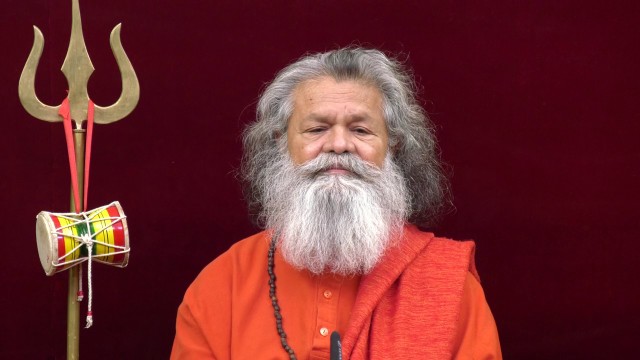
An evening satsang on cultivating spiritual confidence and divine connection.
"Anyone can take from my hands, but not from my jīvā, my ātmā."
"Eko brahma dvitīya nāsti: one Brahman, there is no second. All is one, and when there is duality, there is fighting."
Swami Umāpurījī addresses a global audience, teaching that confidence stems from surrendering daily life and sleep to God. Using metaphors of marriage, a mala's thread, and rain merging into the ocean, he explains that true oneness—beyond emotional attachment—prevents fear and suffering. He shares a story of disciples fighting over a guru's legs to illustrate non-duality, and concludes with a guided Brahmārī Prāṇāyāma technique.
Filming location: Strilky, Czech Republic
The Divine Lineage of Alakpurījī: Saints, Siddhas, and the Eternal Guru
1:55 - 2:25 (30 min)
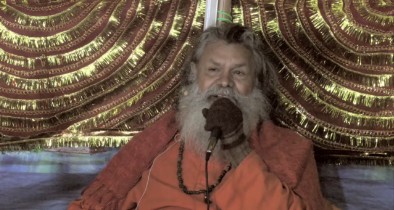
A discourse on the divine lineage of the Alakpurījī Siddha tradition.
"From time to time I incarnate in every yuga to protect the dharma, to liberate all the pure souls, and again to remove or destroy the āsurī śaktis."
"Guru Brahma, Guru Viṣṇu, Guru Devo Maheśvara, Guru Sākṣāt Para Brahma, Tasmai Śrī Guruve Namaha—the Guru Tattva, Śiva Tattva, Viṣṇu Tattva, and Brahma Tattva."
A spiritual teacher narrates from a high Himalayan valley, explaining the eternal Guru principle and the Nityāvatāra of great saints. He recounts the lineage from the ancient Alakpurījī to Devapurījī, then to Bhagavān Śrī Dīp Nārāyaṇa Mahāprabhujī, and finally to their Satguru, Swāmī Madhavānandapurījī, whose birth anniversary is being celebrated. The talk includes a parable about missing divine blessings and emphasizes surrender and patience on the spiritual path.
Filming location: India
The 2nd Sri Swami Maheshwarananda Festival (2/5)
2:30 - 3:38 (68 min)
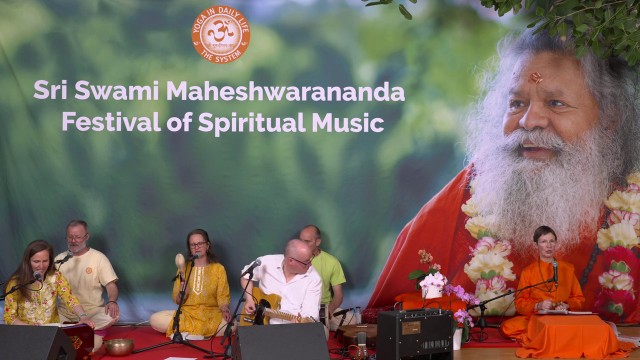
The 2nd Sri Swami Maheshwarananda Festival from Villach, Austria.
The 2nd Sri Swami Maheshwarananda Festival(5/5)
3:45 - 4:21 (36 min)
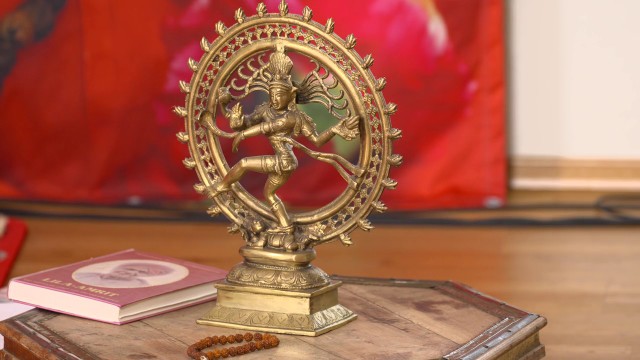
Welcome to the 2nd Sri Swami Maheshwarananda Festival of Spiritual Music from YIDL Ashram in Villach, Austria.
The 2nd Sri Swami Maheshwarananda Festival (3/5)
4:25 - 6:13 (108 min)
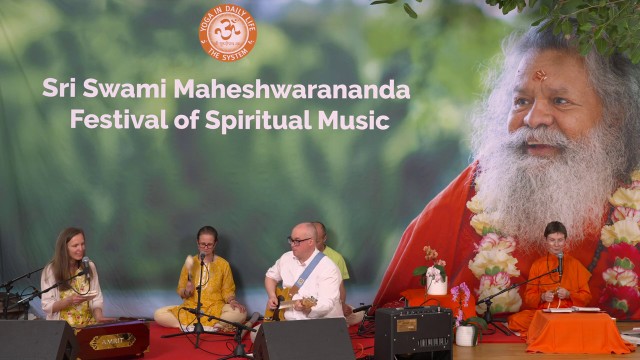
The 2nd Sri Swami Maheshwarananda Festival from Villach, Austria.
Prayer will reach our chakras
6:20 - 7:06 (46 min)
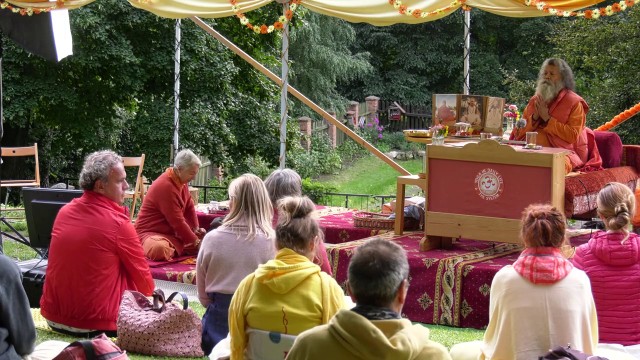
A spiritual discourse on the human body as an instrument, chakras, and daily practice.
"Our instruments in our body, and the instruments we use all day long, then we go to sleep. That is where we are going; we go to sleep."
"First, I am human. When we think really, really, then the whole day we will not do anything wrong to other humans."
Swami Ji addresses the morning gathering, using the fragility of translation equipment and a personal childhood story about a horse to illustrate the need for careful handling of all 'instruments'—including the human body. He outlines an ideal morning routine of gratitude, starting with recognizing one's humanity and honoring parents and the Earth. The talk introduces a long-term study of chakras and kuṇḍalinī, while cautioning against fear and emphasizing that everyone is already divine and should proceed naturally under a true guru's guidance.
Filming location: Strilky, Czech Republic
Sources of happiness
7:10 - 8:32 (82 min)
A satsang on the foundations of health and happiness through Yoga and Āyurveda.
"Health is not everything, but everything is nothing without health."
"Yoga and Āyurveda are like the two wings of a bird to fly."
Swami Maheshvarananda leads an evening talk, presenting health as the primary wealth and outlining Āyurvedic principles for a harmonious life. He shares a parable about a king and a beggar with a bottomless pot to illustrate the insatiability of human desire. The session includes practical demonstrations of energy-awareness and touch techniques for self-healing, and concludes with a critique of modern diet and lifestyle.
Filming location: New Zealand
Two kinds of power
8:40 - 9:46 (66 min)
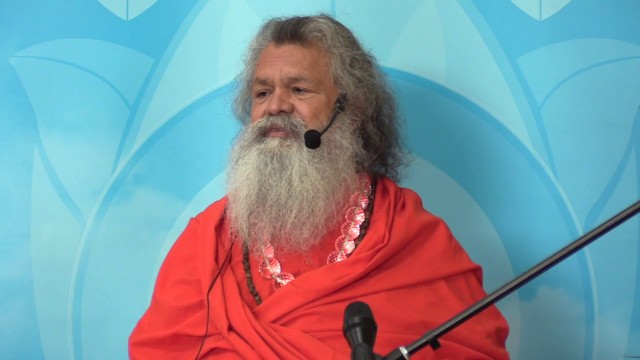
Morning satsang with Vishwaguruji from Brisbane, Australia. We need power for everything. Incarnations have a weapon and also a blessing in their hands. Both Siva and Shakti is power. Now in the Kali-yuga devils are awakened. Siva is the God of the devas and devils also. The negative and positive sides also are within us. A story about a tongue and a tooth. Pranayam always must begin in the left nostril. The ocean is the power of the Earth. All five elements have their power. We need power positive but hard. During meditation, we should see our inner world. Practice and heory are completely different. When we chant OM our tongue should be relaxed.
Discover peace and happiness within you
9:50 - 10:54 (64 min)
Vishwaguru Maheshwarananda Public Lecture, Kosice, Slovak Republic. Vishwaguruji reveals the secrets of our birth. We come from the beautiful Universe with peace and happiness within. This kind of realization is awakened by practicing meditation.
Practice from Wellington with MM Vivekpuri
11:00 - 11:59 (59 min)

Wellington, New Zealand
Meditation can help us
12:05 - 13:30 (85 min)
Public lecture with Vishwaguruji from Poprad, Slovakia. Why don’t we have time? Why are we suffering from stress? And even more if we have more money? If we would practice yoga three hours a day we would have happy life. Meditation can help us. Vishwaguruji gives a short and practical insight into the system of Yoga in Daily Life.
Why we do Anusthan
13:35 - 14:35 (60 min)
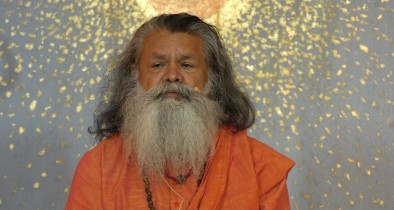
A discourse on the purpose and practice of Anuṣṭhāna, a spiritual observance.
"Anuṣṭhāna is when you make a saṅkalpa. Saṅkalpa means you promise yourself to undertake a practice for a certain purpose: for spiritual development, for good health, for success."
"We pray that all creatures should live in peace, harmony, and health. God protect all. This is our Anuṣṭhāna for this year."
A spiritual teacher explains the traditional practice of Anuṣṭhāna, a vowed observance for specific purposes like family harmony, health, or agricultural success. He contrasts its ideal use for unity and blessings with modern distortions, like praying for divorce. The talk expands to advocate for Anuṣṭhāna as a prayer for universal well-being, encompassing family, community, nature, and all living creatures, emphasizing harmony with the natural world and compassion for animals.
Filming location: Strilky, Czech Republic
Feel the confidence and God will help
14:40 - 15:26 (46 min)
An evening satsang on cultivating spiritual confidence and divine connection.
"Anyone can take from my hands, but not from my jīvā, my ātmā."
"Eko brahma dvitīya nāsti: one Brahman, there is no second. All is one, and when there is duality, there is fighting."
Swami Umāpurījī addresses a global audience, teaching that confidence stems from surrendering daily life and sleep to God. Using metaphors of marriage, a mala's thread, and rain merging into the ocean, he explains that true oneness—beyond emotional attachment—prevents fear and suffering. He shares a story of disciples fighting over a guru's legs to illustrate non-duality, and concludes with a guided Brahmārī Prāṇāyāma technique.
Filming location: Strilky, Czech Republic
Past is gone future is not here yet
15:30 - 16:14 (44 min)
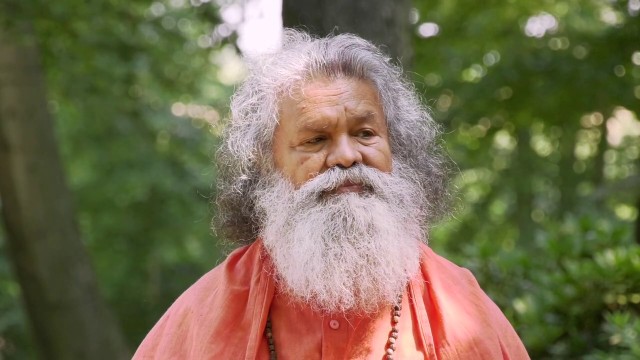
A spiritual discourse on living in the present moment and the nature of past, present, and future.
"Therefore, it is at present. Be in the present."
"So the past is gone. The present is here. But you think, 'In the future, I will also get this.' But you will not get it. That’s it."
An instructor addresses a group, advising them to release attachment to past experiences and future anxieties. He advocates for a simple, relaxed practice, contrasting it with other meditation techniques. Using stories, such as a dog losing its bread by coveting a reflection, he illustrates the futility of dwelling on what is gone or what might be, emphasizing that true practice (Anuṣṭhāna) is about being grounded in the now.
Filming location: Strilky, Czech Republic
Rishis are protecting us
16:20 - 17:15 (55 min)
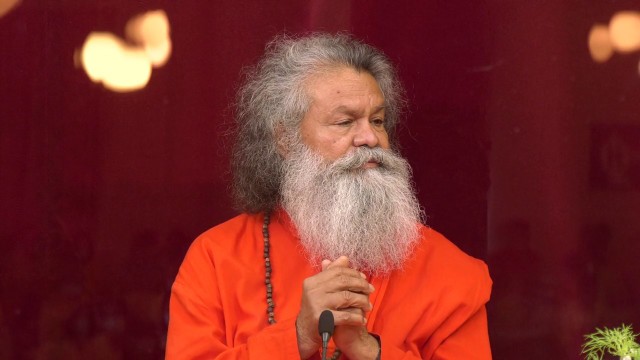
A spiritual discourse on the presence of hidden sages and the nature of true spirituality.
"Often, at the Kumbh Melā, great sādhus speak of certain saints. Perhaps some are there at the Melā, or perhaps they are deep in the great Himalayas. They do not wish to come to us, yet they know everything."
"Holī Gurujī said, 'One in all and all in one.' ... if one from one religion criticizes others, then this is not a true recipient, not a spiritual person."
Swami Ji addresses the assembly, describing the great, invisible ṛṣis (sages) who protect humanity from hidden places like Himalayan glaciers. He emphasizes universal oneness, warning that criticizing others reveals one's own negativity, and shares a parable about a guru repeatedly saving a scorpion to illustrate maintaining one's compassionate nature regardless of others' actions.
Filming location: Strilky, Czech Republic
Stories are within you
17:20 - 18:18 (58 min)
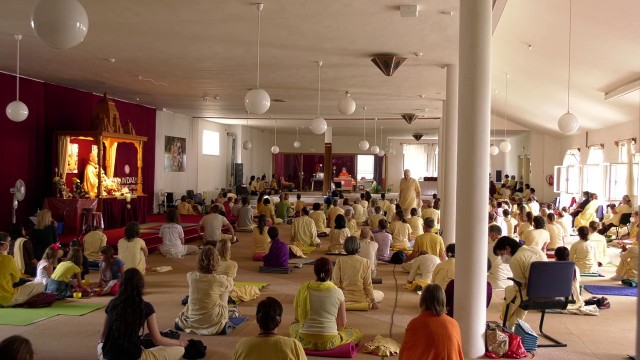
A morning satsang on the guru's grace, devotion, and the power of teaching through stories.
"Na’haṁ kartā means we are not the doer. We cannot do it. If we think we do, it may be confusing. So we give it with both our hands; we surrender it at the holy feet of Mahāprabhujī."
"So, when someone asks you, and you give… The answer first to them. First, give your answers... The answer is yours because you are now a great man."
The speaker, Swami Avatarpuri, opens with the principle of surrender to the guru's grace. He uses analogies, like a sculptor transforming stone into a worshipped deity, to illustrate how devotion elevates the ordinary. He shares a parable about a poor man whose selfless act of seeking answers for others ultimately solves his own plight, emphasizing the power of selfless service and positive speech. The talk concludes with personal anecdotes about the value of stories as a tool for learning and connection.
Filming location: Strilky, Czech Republic
For meditation we need calmness
18:25 - 19:26 (61 min)
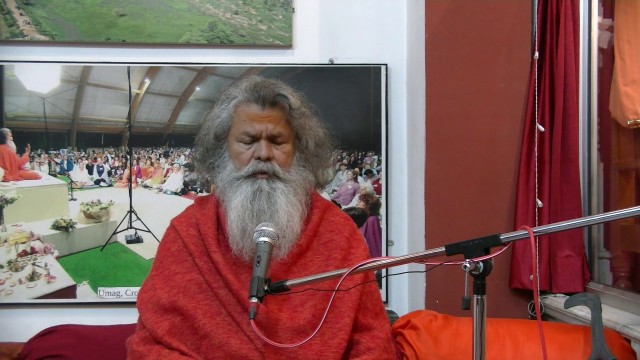
A spiritual discourse on the prerequisites for true meditation and self-realization.
"If you are restless and you meditate, then you become even more restless."
"Mokṣa only can give Gurudev... And that guru is not what we are thinking, could be only in physical form."
A teacher addresses a gathering, explaining that discipline and a pure, guru-focused devotion are essential to overcome restlessness and attain meditation. He uses stories of Ramakrishna, Vivekananda, and a parable about a bamboo surrendering to God to illustrate the necessity of grace and surrender. The talk covers the pitfalls of ego, the levels of consciousness, and briefly touches on the yogic science of chakras and sacred sounds.
Filming location: Jaipur, Rajasthan, India
Influence Of The Full Moon
19:30 - 20:27 (57 min)
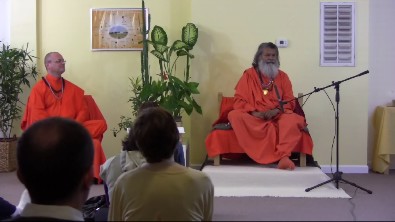
A satsang discourse on the full moon's influence, human consciousness, and spiritual practice.
"In the holy book Bhagavad Gītā, God Kṛṣṇa says, 'Arjuna, I enter into the vegetation as a nectar through the moonlight.'"
"In yoga, we used to say a yoga practitioner and the yogī should be—or every human should be—like a honeybee. It brings nectar even from the poisonous cactus or some plants."
Swami Paramadvaiti leads an evening talk, beginning with the spiritual and ecological significance of the full moon and the honeybee. He expands into a wide-ranging discussion covering the lunar effect on emotions, the importance of fasting, the journey of the soul through the chakras and at death, and the foundational principles of yoga for health and consciousness. He weaves in teachings on managing desires, subconscious impressions from early life, and the ultimate goal of meditation and mantra.
Filming location: New York, USA
The Divine Lineage of Alakpurījī: Saints, Siddhas, and the Eternal Guru
20:35 - 21:05 (30 min)
A discourse on the divine lineage of the Alakpurījī Siddha tradition.
"From time to time I incarnate in every yuga to protect the dharma, to liberate all the pure souls, and again to remove or destroy the āsurī śaktis."
"Guru Brahma, Guru Viṣṇu, Guru Devo Maheśvara, Guru Sākṣāt Para Brahma, Tasmai Śrī Guruve Namaha—the Guru Tattva, Śiva Tattva, Viṣṇu Tattva, and Brahma Tattva."
A spiritual teacher narrates from a high Himalayan valley, explaining the eternal Guru principle and the Nityāvatāra of great saints. He recounts the lineage from the ancient Alakpurījī to Devapurījī, then to Bhagavān Śrī Dīp Nārāyaṇa Mahāprabhujī, and finally to their Satguru, Swāmī Madhavānandapurījī, whose birth anniversary is being celebrated. The talk includes a parable about missing divine blessings and emphasizes surrender and patience on the spiritual path.
Filming location: India
One day we will be together
21:10 - 21:54 (44 min)
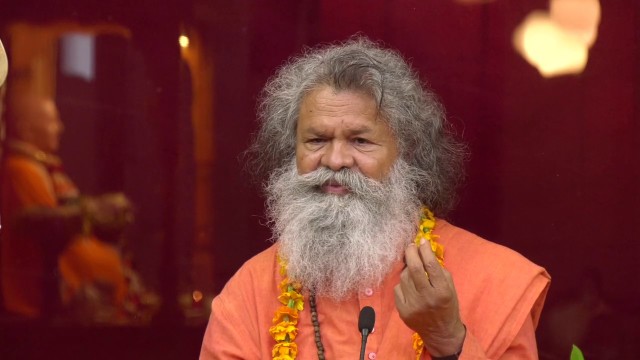
An evening satsang on spiritual unity and the essence of all paths.
"It is very important that everyone has their yoga center's name... but yoga is only one yoga; we simply have different names."
"All children are born into what we call a kindergarten. In the kindergarten, we see all children as very beautiful and very good."
The lecturer addresses the global Yoga in Daily Life community, using analogies of families, children, and the water cycle to illustrate the fundamental oneness underlying all yoga schools, religions, and human beings. He emphasizes respect for all traditions and lineages while cautioning against the discord created by attachment to names and identities. The talk concludes with a prayer for harmony and a reminder to seek inner unity.
Filming location: Strilky, Czech Republic
Opening Address: Yoga for World Peace and Non-Violence
22:00 - 22:07 (7 min)
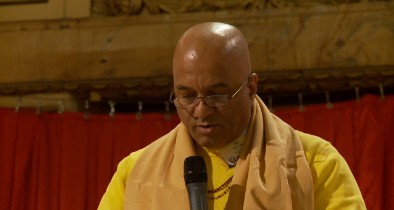
An opening address for the "Yoga for World Peace and Non-Violence" International Conference in Prague.
"Yoga is not a religion. It represents the original balancing principle that promotes nonviolence and peacefulness."
"To achieve peace in the world, we must start by achieving inner peace ourselves."
A representative of the Czech Hindu Religious Society, Vishwaguru Deep Hindu Mandir, welcomes attendees and explains his organization's role in co-organizing the conference. He honors the spiritual lineage of Swami Madhavanandaji and Swami Maheshvaranandaji, detailing global humanitarian projects and drawing a direct connection between yogic principles like non-violence (ahimsa) and the universal pursuit of peace. The speech emphasizes inner peace as the foundation for world peace.
Filming location: Prague, Czech Republic
The Path of Yoga for Universal Peace
22:15 - 22:38 (23 min)
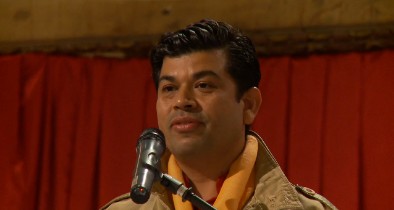
A keynote address advocating for yoga as a universal path to global peace.
"If you want a result in one year, plant crops; in ten years, plant fruit trees; if you want a result forever, practice yoga."
"Yoga is less than 30% physical; it is more than that—it is emotional, mental, and spiritual. For humankind, it is the interconnection from the individual to people, from people to nature, and from nature to the planet."
A speaker from Nepal addresses a World Peace Council conference, framing yoga as a non-religious, practical solution to violence and unrest. He argues for its integration into global education and diplomacy, urging governments to invest in yoga over military spending. The talk blends philosophical teachings from multiple faiths with calls for personal and political action, concluding with a collective peace chant and meditation.
Filming location: Prague, Czech Republic
Heart and intellect
22:45 - 23:24 (39 min)
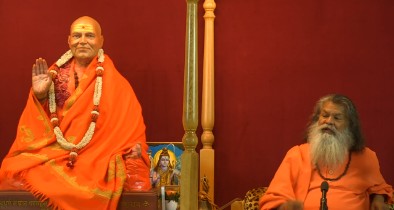
A spiritual discourse on the discipline of mind and the concept of vṛtti (mental fluctuations).
"God has given us a beautiful body and a beautiful inner world, and from that beautiful inner world, more is reflected to the outer world."
"Patañjali said the first word is... discipline. Yoga begins with the discipline."
A teacher explains the nature of vṛtti—the thoughts and attention that stir the consciousness—using examples from Patañjali's Yoga Sūtra and everyday life. He discusses the interplay between the intellect and the heart, the influence of selfishness and desire, and the need for personal discipline (anuśāsanam) to ultimately achieve control of the mind (citta vṛtti nirodhaḥ). The talk references saints like Mīrābāī and includes practical analogies.
Filming location: Vienna, Austria
The center of the Divine Light
23:30 - 0:05 (35 min)
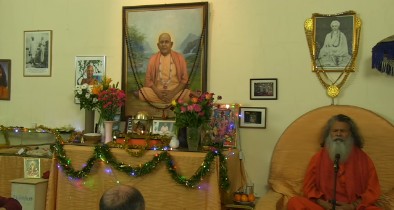
A satsang from the holy seat in Vienna, reflecting on its 40-year spiritual legacy.
"This center is like the sun in the sky, radiating light over the whole globe."
"The task is to first cleanse your heart and cleanse your feelings. Kāma, Krodha, Lobha, Moha, Ahaṁkāra. Give that up."
The lecturer addresses a global audience via webcast from the Vienna ashram. He describes the center's four-decade history as a beacon of yoga and spirituality, blessed by his Guru's presence. He emphasizes that spiritual succession and enlightenment come through dedicated personal practice—sādhanā, mantra, and meditation—rather than mere ritual, urging everyone to perform their inner work diligently.
Filming location: Vienna, Austria
American
Australian