
European
A human should not kill
1:15 - 1:40 (25 min)
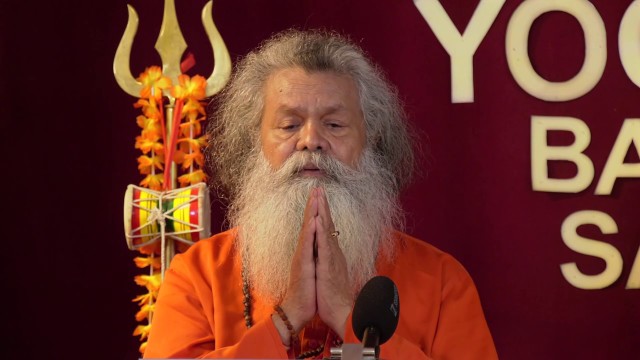
Evening satsang from Strilky Ashram, Czech Republic. Introduction of Mahamandaleshwar Swami Vivekpuriji. Yoga in Daily Life is a system for everyone. Yoga was brought by Bhagwan Shiva for people to reach God. Nowadays many people eat meat and do similar bad things. People should not kill. But you already know and follow this. You should not eat meat. Because of an illness I cannot find the words but I am with you and I am very happy that you are not negative. The bhajans are very important, they tell people what is good and what is not.
I am Thine
1:45 - 2:29 (44 min)
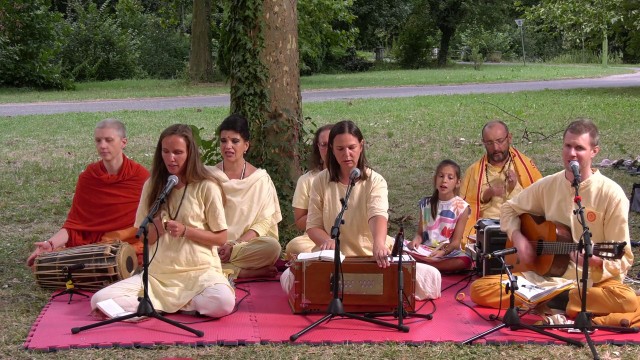
Evening satsang with Vishwaugurji from Vep, Hungary. Singing bhajans Sajjana vali lage sa, Kya tum jano hala hamara. Singing and translation of bhajan Prema ka pyala hari kaba mera bharase. Mahapraphuji say many times, that he will fill the heart of Bhaktas. Singing bhajan Ceta Ceta, ab jiva agyani.
Give up eating meat completely!
2:35 - 4:22 (107 min)
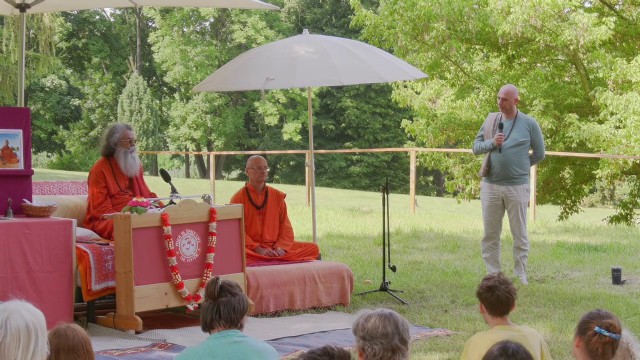
Morning satsang from Strilky Ashram, Czech Republic. Children's presentation to Gurudeva. Niranjanpuri's lecture on Kriya Anustha. If you succeed in calming the mind then you will arrive at a place that will give you joy like nothing before. For this you have to sit properly and concentrate. This can be achieved through practice. Vishwaguruji's lecture on why it is important to avoid eating meat. We eat properly at the seminar, but some people eat meat occasionally in the company of others elsewhere. This is not good, from today onwards give up this behaviour. Personal testimonies on vegetarian eating. Bhajan singing.
A Prayer for the Immortal Soul
4:30 - 5:12 (42 min)
A satsang dedicated to a prayer for the departed.
"Let me sing day and night this name of thine."
"At the end of my life, when I renounce this body, I have only one wish, that you are standing in front of me."
The lecturer leads a prayer satsang in Prague for the late Milena Hypsmanova, recounting her final trip to South Africa. He reflects on the mystery of destiny, time, and mortality, using the story of Oedipus to illustrate how fate unfolds. The discourse explores how spiritual practice and remembrance of God's name prepare the soul for the final transition from life to death.
Filming location: Prague, Czech Republic
The importance of bhajans
5:20 - 6:02 (42 min)
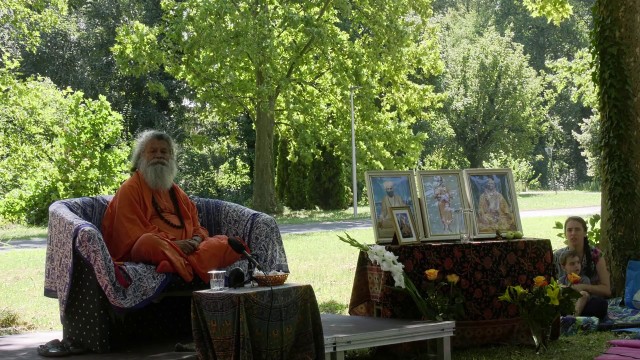
A spiritual discourse and guided practice focusing on devotional music and a breathing technique.
"Bhajan is one of the best in everything... When they sing beautiful bhajans like this, it goes in the whole body."
"So many people are only making bhajans... 'Kṛṣṇa, Kṛṣṇa,' and 'Hare, Hare.' But what is good, very good? But they don't understand."
The speaker leads a session beginning with devotional chanting in English and Hungarian. He discusses the deep, often misunderstood impact of devotional singing (bhajan), using an ambiguous parable about ants and a bee (Brahmari) to illustrate different levels of engagement. He then gives instructions for a breathing practice, likening its gradual mastery to learning to drive or pilot an aircraft.
Filming location: Vép, Hungary
Our cows are like our mother
6:10 - 6:35 (25 min)
A spiritual discourse on Sanātana Dharma, veganism, and compassionate living.
"Otherwise, therefore, my dears, I wish you, of course... Many people will tell me very many things against me, and then okay."
"And then you see, that the one from the, what we call, a little egg. From where is the egg? What is that egg?"
A spiritual teacher delivers a talk, weaving together themes of India's spiritual heritage, the origins of humanity, and the ethics of consumption. He questions the necessity of eating meat and dairy, recounts an anecdote about disciples witnessing a cow's birth leading them to avoid animal products, and discusses the global vegan movement. He cautions against following medical advice to eat eggs, framing non-violence and peace as essential spiritual principles.
Filming location: Jadan, Rajasthan, India
Dharma Is An Universal Principle
6:40 - 7:05 (25 min)
A morning satsang on universal dharma, the nature of spiritual teaching, and self-knowledge.
"To become a teacher of yoga is more time-consuming and difficult than becoming a doctor, because yoga is the science of body, mind, consciousness, and more."
"Dharma rakshita rakshita: 'If you protect dharma, dharma will protect you.'"
The teacher opens the new moon session with blessings, distinguishing between man-made religion and universal sanātana dharma. He explains dharma as the inherent duty and principle governing all existence, emphasizing that true yoga teachers must overcome duality and possess the wisdom of Brahman. The talk includes stories and analogies, concluding with an announcement of a Brahma Vidyā Kriyā practice to check the navel as the center of the universe.
Filming location: Strilky, Czech Republic
We should awake
7:10 - 7:52 (42 min)
A spiritual discourse exploring states of consciousness, reality, and human identity.
"Sleeping is very great. They cannot sleep, not access this bill like that."
"And when we sleep, then there is no light, no thoughts, nothing. That time we became very quick."
A spiritual teacher delivers an extemporaneous talk, weaving together themes of deep sleep, awakening, and the nature of reality. He uses personal anecdotes, analogies of cars and airplanes, and references to lineage gurus like Mahāprabhujī to discuss the journey from individual awareness to a unified state. The talk emphasizes self-reminders like "I am awakened" and "I am human," and concludes by praising the purity of satsang.
Filming location: Brisbane, Australia
Remain pure
8:00 - 9:17 (77 min)
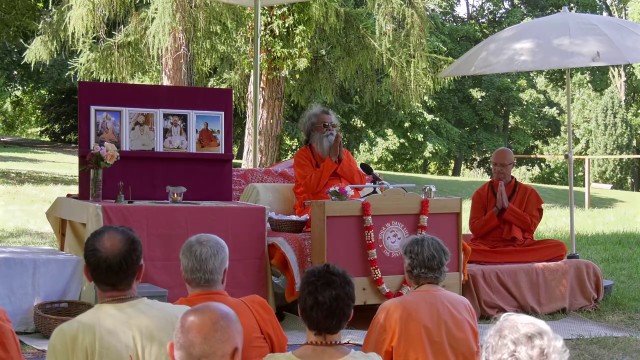
Morning satsang from Strilky Ashram, Czech Republic. The trees of Strilky ashram are so old that we are just children next to them. The story about Bhagwan Shiva. I tell you that you have to be very strong, follow the rules. The problems come from killing and eating animals. They say fights will come, but when they pass we will be very pure and go to God, and the others will fall. Stay pure, as the blue sky is. How should a good family live?
Help every creature
9:25 - 9:50 (25 min)
A spiritual discourse addressing suffering and compassionate action.
"Today, I am giving a message to the whole world. If we can all help someone, it is a great thing."
"This is the heart of the matter: when I see many animals dying and there is no water, I know something good will come again... But we must say we should help. We should help."
The speaker, addressing a global audience, reflects on the severe drought and suffering of animals, questioning divine providence. He shares a teaching story about a mother's ring, which symbolizes the cyclical nature of good and bad times, and references other spiritual narratives involving King Janaka and Ashtavakra. The core message is a call to practical compassion, urging listeners to conserve water and provide for all creatures.
Filming location: Jadan, Rajasthan, India
Practicing of the system 'Yoga in Daily Life', Level 3 - Part 1
10:00 - 11:00 (60 min)
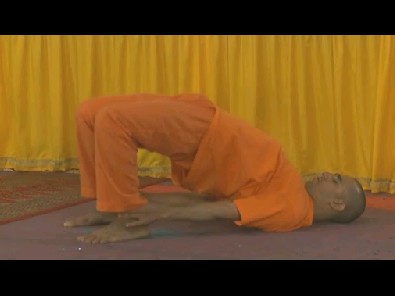
Practicing of the system "Yoga in Daily Life", Level 3 - Part 1, in Om Vishwa Deep Gurukul Swami Maheshwaranand Ashram, Jadan, Rajasthan, India on 27th of October 2009.
When The Light Comes - Darkness Disappears
11:05 - 11:30 (25 min)
A spiritual discourse on the five sheaths (kośas) and the obstacles of attachment.
"In the vijñānamaya kośa, when there is attachment interspersed with 'my' and 'thy,' then this love among brothers or friends changes."
"Cintā (worry) and Tṛṣṇā (longing), both, have occupied this castle of our kośas... they will destroy the whole palace."
Swami Ji explores how subtle attachments within the layers of self, from the physical to the bliss sheath, distort relationships and create suffering. He illustrates this with a parable of two brothers and a mango, showing how unconscious bias fractures unity. The talk emphasizes the need for viveka (discernment) and concludes by advocating for surrender at a spiritual shelter to dissolve worry and desire.
The love between Guru and disciple
11:35 - 11:57 (22 min)
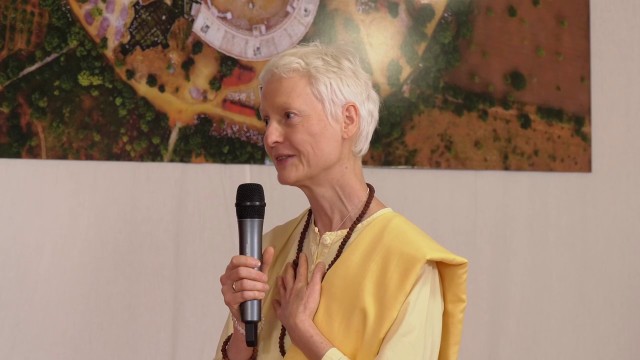
A satsang discourse on spiritual practice and the guru-disciple relationship.
"We are performing this Anuṣṭhāna sādhana, and it is bringing many things to the surface. Many memories are arising from the past, along with many, many situations. And this must happen."
"The Guru also has a human body, like other people... But inside lies the difference: the love that the Guru can give to his disciple—love, love, love. Yes, this cannot be done by anyone else."
A speaker reflects on the inner purification of sādhana, comparing it to cleaning a pond where dirt surfaces to be cleared. They discuss using discernment (viveka) to manage negative qualities and reframe the ego (ahaṃkāra) positively as necessary willpower. The talk then turns to the nature of the Guru's divine love, illustrated with a parable of a priceless diamond inside a common box and the metaphor of a Guru as a self-sacrificing candle. A second speaker shares a personal story of a car accident to illustrate how direct experiences build absolute trust in the Guru's guidance and protection.
Filming location: Strilky, Czech Republic
We are here to learn
12:05 - 12:29 (24 min)
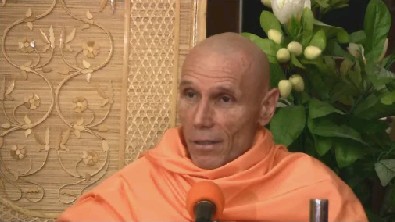
A spiritual discourse on the root of global peace and personal sorrow.
"Since we cannot find the true reason for our misfortunes and dissatisfaction, our ego asserts it is always right."
"The answer for a happy and peaceful world lies only in spirituality, in self-development, in working with oneself, in understanding that we are divine beings originating from the Divine."
Swami Jogeshanand begins with a dedication and explores the theme of peace, connecting personal longing and sorrow to global conflict. He argues that war and extremism stem from humanity's forgotten divine nature and identification with the ego, and calls for religious and political leaders to achieve enlightenment through genuine spiritual practice. He invites listeners to all sincere paths while specifically welcoming them to Yoga in Daily Life centers.
Filming location: Jadan, Rajasthan, India
Our cows are like our mother
12:35 - 13:00 (25 min)
A spiritual discourse on Sanātana Dharma, veganism, and compassionate living.
"Otherwise, therefore, my dears, I wish you, of course... Many people will tell me very many things against me, and then okay."
"And then you see, that the one from the, what we call, a little egg. From where is the egg? What is that egg?"
A spiritual teacher delivers a talk, weaving together themes of India's spiritual heritage, the origins of humanity, and the ethics of consumption. He questions the necessity of eating meat and dairy, recounts an anecdote about disciples witnessing a cow's birth leading them to avoid animal products, and discusses the global vegan movement. He cautions against following medical advice to eat eggs, framing non-violence and peace as essential spiritual principles.
Filming location: Jadan, Rajasthan, India
Help every creature
13:05 - 13:30 (25 min)
A spiritual discourse addressing suffering and compassionate action.
"Today, I am giving a message to the whole world. If we can all help someone, it is a great thing."
"This is the heart of the matter: when I see many animals dying and there is no water, I know something good will come again... But we must say we should help. We should help."
The speaker, addressing a global audience, reflects on the severe drought and suffering of animals, questioning divine providence. He shares a teaching story about a mother's ring, which symbolizes the cyclical nature of good and bad times, and references other spiritual narratives involving King Janaka and Ashtavakra. The core message is a call to practical compassion, urging listeners to conserve water and provide for all creatures.
Filming location: Jadan, Rajasthan, India
A human should not kill
13:35 - 14:00 (25 min)
Evening satsang from Strilky Ashram, Czech Republic. Introduction of Mahamandaleshwar Swami Vivekpuriji. Yoga in Daily Life is a system for everyone. Yoga was brought by Bhagwan Shiva for people to reach God. Nowadays many people eat meat and do similar bad things. People should not kill. But you already know and follow this. You should not eat meat. Because of an illness I cannot find the words but I am with you and I am very happy that you are not negative. The bhajans are very important, they tell people what is good and what is not.
Live pure life and be happy
14:05 - 15:09 (64 min)
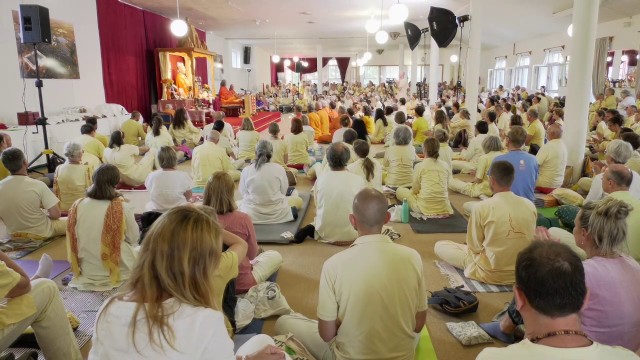
Evening satsang from Strilky Ashram, Czech Republic. Introduction to a very beautiful program with Vishwaguruji and many swamis. Many people came from different places for example Swami Mataji. In India unfortunately, many people begin to eat meat and drink alcohol. Yoga people are very pure in every country. Some people begin to eat meat but it is very bad. Sometimes young couples are not happy with each other. We should decide to marry or not. People in India many people are married according to astrology. To be happy with your partner is also yoga. Bhajan singing. Swani Madhuram speaks about his life in New Zealand and his longing to meet Vishwaguruji.
I am Thine
15:15 - 15:59 (44 min)
Evening satsang with Vishwaugurji from Vep, Hungary. Singing bhajans Sajjana vali lage sa, Kya tum jano hala hamara. Singing and translation of bhajan Prema ka pyala hari kaba mera bharase. Mahapraphuji say many times, that he will fill the heart of Bhaktas. Singing bhajan Ceta Ceta, ab jiva agyani.
We should awake
16:05 - 16:47 (42 min)
A spiritual discourse exploring states of consciousness, reality, and human identity.
"Sleeping is very great. They cannot sleep, not access this bill like that."
"And when we sleep, then there is no light, no thoughts, nothing. That time we became very quick."
A spiritual teacher delivers an extemporaneous talk, weaving together themes of deep sleep, awakening, and the nature of reality. He uses personal anecdotes, analogies of cars and airplanes, and references to lineage gurus like Mahāprabhujī to discuss the journey from individual awareness to a unified state. The talk emphasizes self-reminders like "I am awakened" and "I am human," and concludes by praising the purity of satsang.
Filming location: Brisbane, Australia
Advice for practicing Yoga
16:55 - 17:46 (51 min)
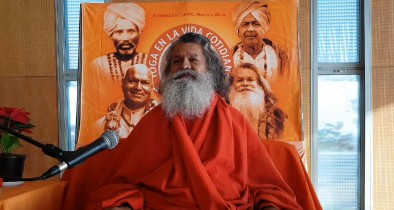
Satsang with Vishwaguruji from Barcelona, Spain. The body consists of five elements. These element are present within us and outside as well. There are different techniques to purify and balance the elements. We should take care of the body while practicing Yoga. Pranayama is also important to practice. It is said that every breath is counted.
The importance of bhajans
17:50 - 18:32 (42 min)
A spiritual discourse and guided practice focusing on devotional music and a breathing technique.
"Bhajan is one of the best in everything... When they sing beautiful bhajans like this, it goes in the whole body."
"So many people are only making bhajans... 'Kṛṣṇa, Kṛṣṇa,' and 'Hare, Hare.' But what is good, very good? But they don't understand."
The speaker leads a session beginning with devotional chanting in English and Hungarian. He discusses the deep, often misunderstood impact of devotional singing (bhajan), using an ambiguous parable about ants and a bee (Brahmari) to illustrate different levels of engagement. He then gives instructions for a breathing practice, likening its gradual mastery to learning to drive or pilot an aircraft.
Filming location: Vép, Hungary
A Prayer for the Immortal Soul
18:40 - 19:22 (42 min)
A satsang dedicated to a prayer for the departed.
"Let me sing day and night this name of thine."
"At the end of my life, when I renounce this body, I have only one wish, that you are standing in front of me."
The lecturer leads a prayer satsang in Prague for the late Milena Hypsmanova, recounting her final trip to South Africa. He reflects on the mystery of destiny, time, and mortality, using the story of Oedipus to illustrate how fate unfolds. The discourse explores how spiritual practice and remembrance of God's name prepare the soul for the final transition from life to death.
Filming location: Prague, Czech Republic
Sound and resonance
19:30 - 20:26 (56 min)
Morning Satsang with Vishwaguruji from Vep, Hungary. Regardless whether you understand bhajans or not, the resonance awakens spirituality in you. The resonance of the songs is reflected in our ten indriyas (organs of perception and action). Swami Sivananda said in his bhajan: those are my friends who understand my words. Shabda means sound, words. In the Gurukul, the warrior students learnt all mantras for archery. By the power of these mantras the arrow goes straight to where the sound of the tiger came from. Vishwaguruji explains the karmic sin of King Dasharatha, father of God Rama.
Let's Try To Save Our Planet
20:30 - 20:56 (26 min)
A report and reflection on the Rio+20 United Nations Conference on Sustainable Development.
"Every paper, newspaper, or magazine you buy makes you part of this forest destruction."
"True high society means simple living and higher thinking."
The speaker, representing an NGO, shares observations from the conference, covering major themes of water scarcity, food security, and the need for ethical education. He criticizes deforestation for paper and calls for a simpler lifestyle, urging the audience to plant trees and reduce consumption. The talk concludes with practical plans for tree-planting initiatives in Slovakia and abroad.
Filming location: Slovakia
Around the world - Opening of new YIDL center in Ptuj, Slovenia
21:00 - 21:38 (38 min)
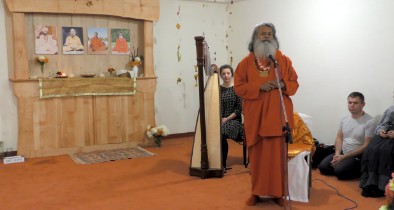
A ceremony marking the 25th anniversary of a yoga center and its inauguration as an ashram in Ptuj.
"Yoga in Daily Life is the authentic school of yoga from India. We, the teachers... carry this out as our mission. We do this voluntarily; we do not make a business of yoga."
"Yoga is the science of body, mind, and soul. Two very important things to know are yoga and Āyurveda."
A representative of the yoga center opens by recounting its 25-year history of community service. Swami Maheshwarananda (Swamiji) then delivers the main address, blessing the new ashram. He speaks on the ancient origins and holistic benefits of yoga and Ayurveda, sharing the story of Hanuman from the Ramayana to illustrate a point. The Indian Ambassador and local officials also offer congratulations. The event includes a mantra chanting and the presentation of a Shiva Lingam to the center.
Filming locations: Ptuj, Slovenia.
When The Light Comes - Darkness Disappears
21:40 - 22:05 (25 min)
A spiritual discourse on the five sheaths (kośas) and the obstacles of attachment.
"In the vijñānamaya kośa, when there is attachment interspersed with 'my' and 'thy,' then this love among brothers or friends changes."
"Cintā (worry) and Tṛṣṇā (longing), both, have occupied this castle of our kośas... they will destroy the whole palace."
Swami Ji explores how subtle attachments within the layers of self, from the physical to the bliss sheath, distort relationships and create suffering. He illustrates this with a parable of two brothers and a mango, showing how unconscious bias fractures unity. The talk emphasizes the need for viveka (discernment) and concludes by advocating for surrender at a spiritual shelter to dissolve worry and desire.
We are here to learn
22:06 - 22:30 (24 min)
A spiritual discourse on the root of global peace and personal sorrow.
"Since we cannot find the true reason for our misfortunes and dissatisfaction, our ego asserts it is always right."
"The answer for a happy and peaceful world lies only in spirituality, in self-development, in working with oneself, in understanding that we are divine beings originating from the Divine."
Swami Jogeshanand begins with a dedication and explores the theme of peace, connecting personal longing and sorrow to global conflict. He argues that war and extremism stem from humanity's forgotten divine nature and identification with the ego, and calls for religious and political leaders to achieve enlightenment through genuine spiritual practice. He invites listeners to all sincere paths while specifically welcoming them to Yoga in Daily Life centers.
Filming location: Jadan, Rajasthan, India
Dharma Is An Universal Principle
22:31 - 22:56 (25 min)
A morning satsang on universal dharma, the nature of spiritual teaching, and self-knowledge.
"To become a teacher of yoga is more time-consuming and difficult than becoming a doctor, because yoga is the science of body, mind, consciousness, and more."
"Dharma rakshita rakshita: 'If you protect dharma, dharma will protect you.'"
The teacher opens the new moon session with blessings, distinguishing between man-made religion and universal sanātana dharma. He explains dharma as the inherent duty and principle governing all existence, emphasizing that true yoga teachers must overcome duality and possess the wisdom of Brahman. The talk includes stories and analogies, concluding with an announcement of a Brahma Vidyā Kriyā practice to check the navel as the center of the universe.
Filming location: Strilky, Czech Republic
Mahaprabhuji is endless joy
22:57 - 23:16 (19 min)
A satsang discourse on the duality of worldly joy and the singular refuge of divine grace.
"The joy of the joyous is very short, but the suffering of the joyous is longer."
"He can give you everything, but he can’t give you what he can give you. We need only confidence, that’s all."
The speaker reflects on the fleeting nature of worldly happiness, which is always paired with hidden sorrow, contrasting it with the endless joy of the divine. He proclaims Mahāprabhujī as the incarnate God and liberator, emphasizing that true peace is found only in unwavering devotion and surrender to this grace, using the metaphor of a seabird that must return to its ship in a vast ocean.
Filming location: Vép, Hungary
Science of chakras
23:17 - 0:33 (76 min)
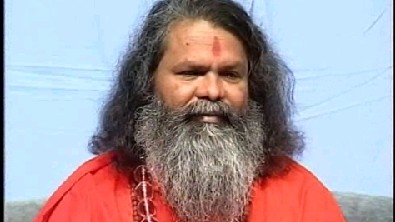
An introductory lecture on yoga philosophy, culminating in a practical demonstration for activating healing energy.
"Yoga means union—the union of the individual consciousness with the cosmic consciousness."
"In every creature, human or animal, where there is life, there is a light of God. That is God, the Creator of all creatures."
Swami Jyotirmayananda opens a discourse on "Kundalini and the Chakras" by defining yoga as a path to cosmic consciousness. He explains the journey of the soul, the yogic anatomy of energy channels (nāḍīs), and the system of chakras. The session includes a guided exercise to awaken the healing energy in one's palms, followed by practical tips for activating the Bindu chakra to improve eyesight and memory.
Filming location: Croatia
American
Australian