
European
Advice for practicing Yoga
0:25 - 1:16 (51 min)
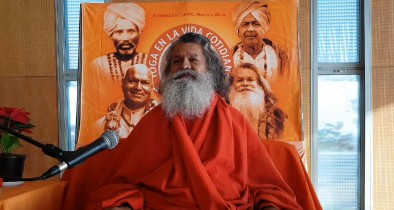
Satsang with Vishwaguruji from Barcelona, Spain. The body consists of five elements. These element are present within us and outside as well. There are different techniques to purify and balance the elements. We should take care of the body while practicing Yoga. Pranayama is also important to practice. It is said that every breath is counted.
The teaching of a Guru is for ever
1:20 - 2:36 (76 min)
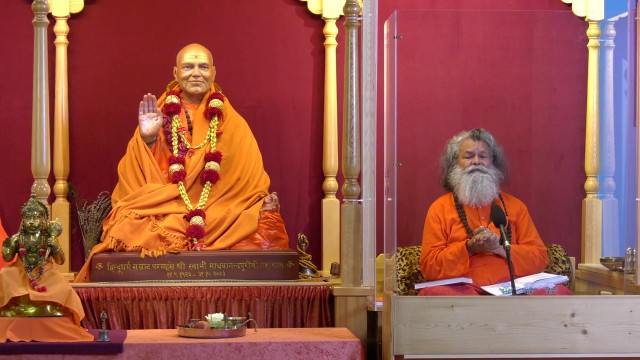
Guru Purnima celebration from Vienna, Austria. Siva was the first living being in the Earth. The story of a photograph what shows a Rishi in the Himalayas. Australian inhabitants are originated from India. British people were very cruel to them. Explanation of bhajan Sataguru Alakapurijji avo. The story of a boy and a girl who married but they had a problem with the hard part of the bread. The story of the river Alakhananda. Practising bhramari and bhujangini pranayama.
The Principles and Power of Sādhanā
2:40 - 3:25 (45 min)
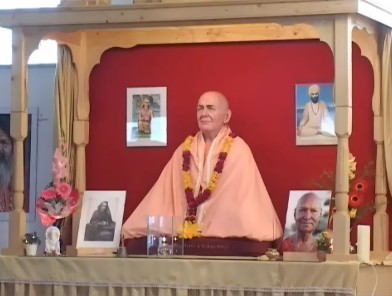
A spiritual discourse on the principles of sādhanā and the significance of the Maṇipūra Chakra.
"Any kind of sādhanā requires perfect technique and discipline. One must follow the principles."
"That energy, which is located in the maṇipūra cakra, is called hara-śakti. That is the life force, the energy that keeps you moving."
A teacher explains the necessity of disciplined practice, using the analogy of fueling a car correctly. He delves into the esoteric importance of the Maṇipūra Chakra as the seat of life force (hara-śakti) and the junction of vital energies, connecting its functions to immunity, sound resonance (nāda), and mythological symbolism involving Vishnu. The talk covers related practices like Śabda Sañjālan and Khaṭupranām, emphasizing that authentic practice requires devotion, a spiritual lineage, and following a master's instructions to awaken inner energy and burn karmic seeds.
Filming location: Strilky, Czech Republic
A Spiritual Journey: Lessons from the Himalayan Lakes and Caves
3:30 - 3:50 (20 min)
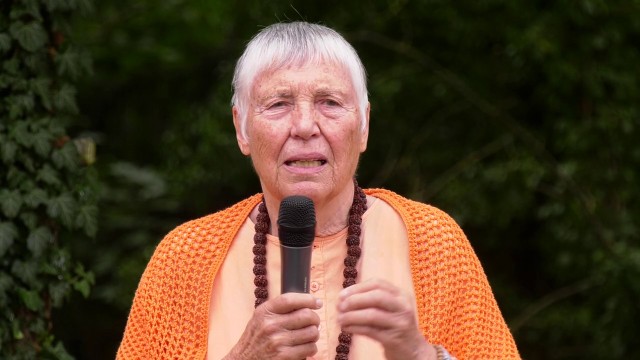
A satsang sharing spiritual lessons from Himalayan pilgrimage.
"I never give up. You also should never give up." "When things should be, they will be. You must agree with this."
Swami Shantipuri addresses the gathering on his Sannyasa birthday, recounting his journey to the Satopant Lake in the Himalayas after his Guruji's Mahasamadhi. He describes a profound meditation experience there, from which he received three core spiritual lessons symbolized by the lake: to accept life's events like the shore accepts waves, to cultivate inner calm by having no expectations, and to give freely from one's inner reservoir of wisdom like a flowing stream.
Filming location: Vép, Hungary
The Miraculous Heart
3:55 - 4:16 (21 min)
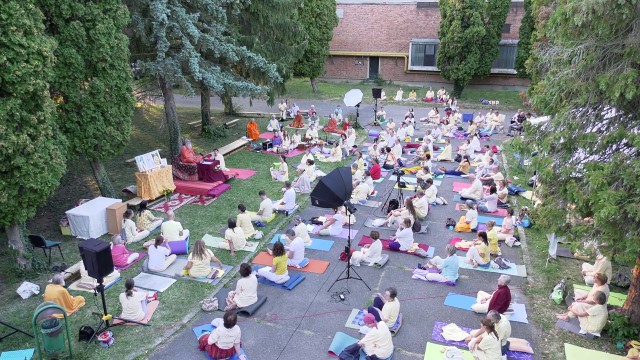
Evening satsang with Vishwaugurji from Vep, Hungary
How the worm becomes Bhramari
4:20 - 5:04 (44 min)
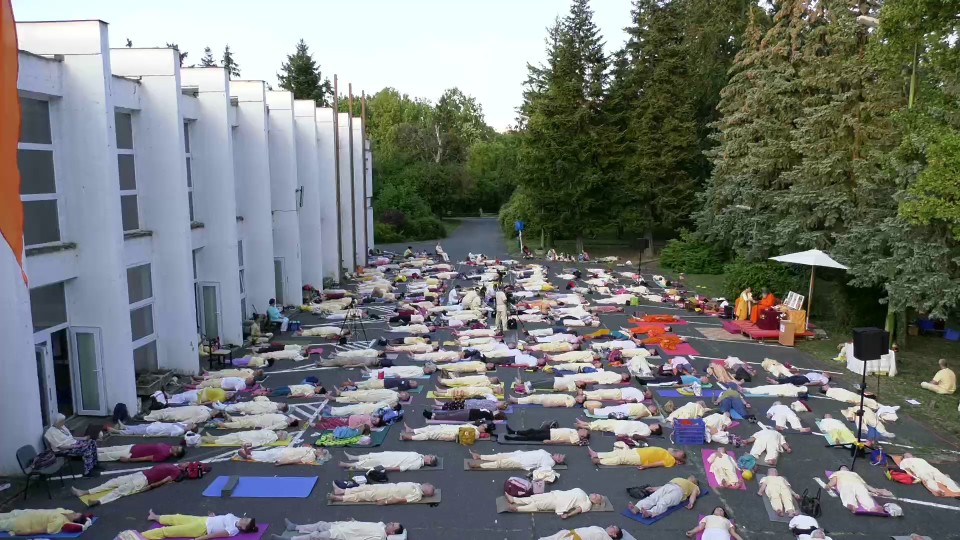
Evening satsang with Vishwaugurji from Vep, Hungary. Relaxation. Concentration on the navel and the heart. There are three different forms of bhramari. They have the same voice. One of them lives on the earth the second builds their nest in our house. They can bite us. The nest of bhramari is very comfortable. they bring worms there. Slowly slowly the worm transforms into a bhramari. We should practise bhramari only for short time.
We should awake
5:10 - 5:52 (42 min)
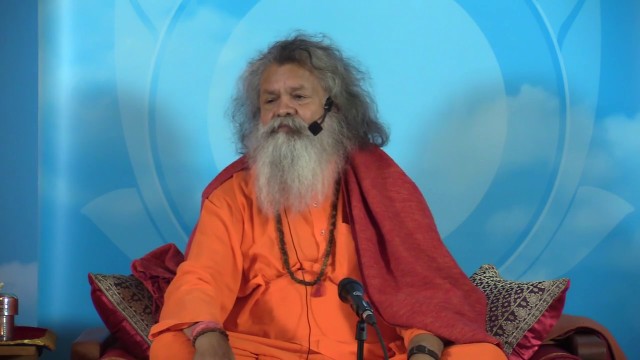
A spiritual discourse exploring states of consciousness, reality, and human identity.
"Sleeping is very great. They cannot sleep, not access this bill like that."
"And when we sleep, then there is no light, no thoughts, nothing. That time we became very quick."
A spiritual teacher delivers an extemporaneous talk, weaving together themes of deep sleep, awakening, and the nature of reality. He uses personal anecdotes, analogies of cars and airplanes, and references to lineage gurus like Mahāprabhujī to discuss the journey from individual awareness to a unified state. The talk emphasizes self-reminders like "I am awakened" and "I am human," and concludes by praising the purity of satsang.
Filming location: Brisbane, Australia
I am Thine
6:00 - 6:44 (44 min)
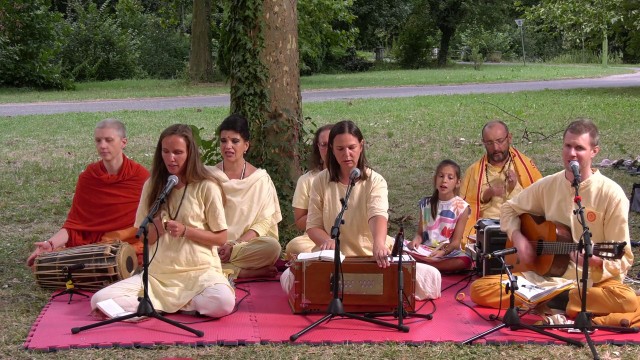
Evening satsang with Vishwaugurji from Vep, Hungary. Singing bhajans Sajjana vali lage sa, Kya tum jano hala hamara. Singing and translation of bhajan Prema ka pyala hari kaba mera bharase. Mahapraphuji say many times, that he will fill the heart of Bhaktas. Singing bhajan Ceta Ceta, ab jiva agyani.
Help every creature
6:50 - 7:15 (25 min)
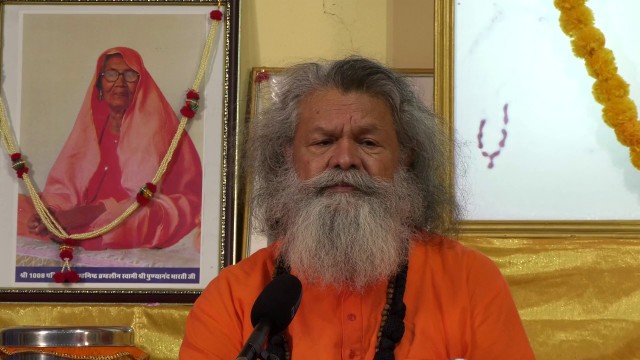
A spiritual discourse addressing suffering and compassionate action.
"Today, I am giving a message to the whole world. If we can all help someone, it is a great thing."
"This is the heart of the matter: when I see many animals dying and there is no water, I know something good will come again... But we must say we should help. We should help."
The speaker, addressing a global audience, reflects on the severe drought and suffering of animals, questioning divine providence. He shares a teaching story about a mother's ring, which symbolizes the cyclical nature of good and bad times, and references other spiritual narratives involving King Janaka and Ashtavakra. The core message is a call to practical compassion, urging listeners to conserve water and provide for all creatures.
Filming location: Jadan, Rajasthan, India
A Prayer for the Immortal Soul
7:20 - 8:02 (42 min)
A satsang dedicated to a prayer for the departed.
"Let me sing day and night this name of thine."
"At the end of my life, when I renounce this body, I have only one wish, that you are standing in front of me."
The lecturer leads a prayer satsang in Prague for the late Milena Hypsmanova, recounting her final trip to South Africa. He reflects on the mystery of destiny, time, and mortality, using the story of Oedipus to illustrate how fate unfolds. The discourse explores how spiritual practice and remembrance of God's name prepare the soul for the final transition from life to death.
Filming location: Prague, Czech Republic
Our cows are like our mother
8:10 - 8:35 (25 min)
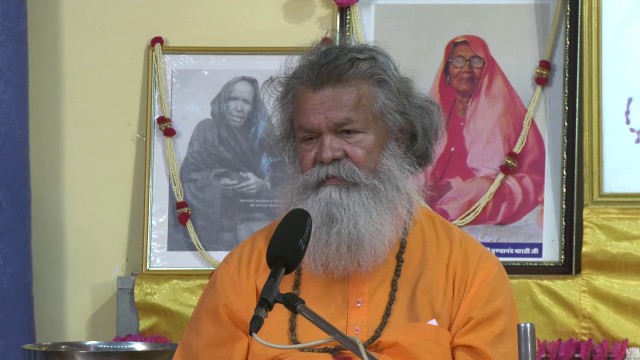
A spiritual discourse on Sanātana Dharma, veganism, and compassionate living.
"Otherwise, therefore, my dears, I wish you, of course... Many people will tell me very many things against me, and then okay."
"And then you see, that the one from the, what we call, a little egg. From where is the egg? What is that egg?"
A spiritual teacher delivers a talk, weaving together themes of India's spiritual heritage, the origins of humanity, and the ethics of consumption. He questions the necessity of eating meat and dairy, recounts an anecdote about disciples witnessing a cow's birth leading them to avoid animal products, and discusses the global vegan movement. He cautions against following medical advice to eat eggs, framing non-violence and peace as essential spiritual principles.
Filming location: Jadan, Rajasthan, India
The importance of bhajans
8:40 - 9:22 (42 min)
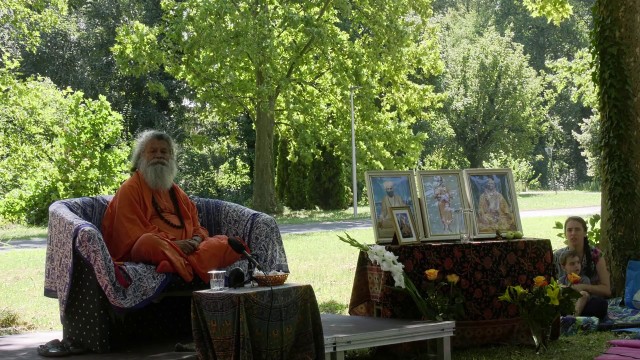
A spiritual discourse and guided practice focusing on devotional music and a breathing technique.
"Bhajan is one of the best in everything... When they sing beautiful bhajans like this, it goes in the whole body."
"So many people are only making bhajans... 'Kṛṣṇa, Kṛṣṇa,' and 'Hare, Hare.' But what is good, very good? But they don't understand."
The speaker leads a session beginning with devotional chanting in English and Hungarian. He discusses the deep, often misunderstood impact of devotional singing (bhajan), using an ambiguous parable about ants and a bee (Brahmari) to illustrate different levels of engagement. He then gives instructions for a breathing practice, likening its gradual mastery to learning to drive or pilot an aircraft.
Filming location: Vép, Hungary
Dharma Is An Universal Principle
9:30 - 9:55 (25 min)
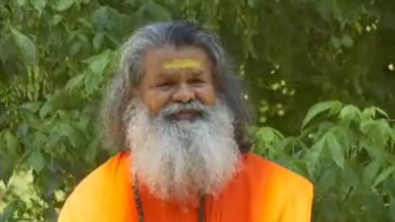
A morning satsang on universal dharma, the nature of spiritual teaching, and self-knowledge.
"To become a teacher of yoga is more time-consuming and difficult than becoming a doctor, because yoga is the science of body, mind, consciousness, and more."
"Dharma rakshita rakshita: 'If you protect dharma, dharma will protect you.'"
The teacher opens the new moon session with blessings, distinguishing between man-made religion and universal sanātana dharma. He explains dharma as the inherent duty and principle governing all existence, emphasizing that true yoga teachers must overcome duality and possess the wisdom of Brahman. The talk includes stories and analogies, concluding with an announcement of a Brahma Vidyā Kriyā practice to check the navel as the center of the universe.
Filming location: Strilky, Czech Republic
Practicing of the system 'Yoga in Daily Life', Level 1 - Part 5
10:00 - 11:06 (66 min)
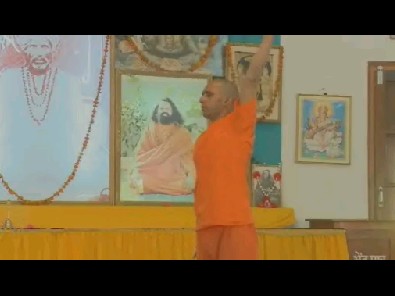
A guided yoga session from the "Yoga in Daily Life" system at a desert retreat.
"This centre is intended to be a yoga retreat and a spiritual centre. Its purpose is to serve humanity, to protect the environment through an ecological way of life, to offer spiritual seekers a path to find the light of spirituality through yoga."
"The book consists of eight levels. All levels include physical exercises, breath exercises, mental exercises, concentration techniques, relaxation and meditation techniques."
An instructor leads a comprehensive practice from Level One, beginning with a welcome to the ashram and its lineage. The session includes Oṁ chanting, deep relaxation (Śavāsana), instruction in the full yoga breath, and a series of āsanas performed lying, sitting, and standing. The practice concludes with Prāṇāyāma (Nāḍī Śodhana) and final Oṁ chanting, aiming to balance the body and mind.
Filming location: Jadan, Rajasthan, India
When The Light Comes - Darkness Disappears
11:10 - 11:35 (25 min)
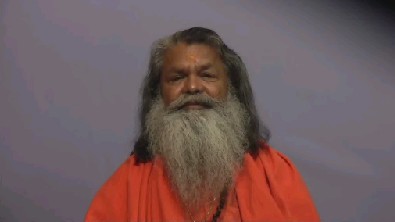
A spiritual discourse on the five sheaths (kośas) and the obstacles of attachment.
"In the vijñānamaya kośa, when there is attachment interspersed with 'my' and 'thy,' then this love among brothers or friends changes."
"Cintā (worry) and Tṛṣṇā (longing), both, have occupied this castle of our kośas... they will destroy the whole palace."
Swami Ji explores how subtle attachments within the layers of self, from the physical to the bliss sheath, distort relationships and create suffering. He illustrates this with a parable of two brothers and a mango, showing how unconscious bias fractures unity. The talk emphasizes the need for viveka (discernment) and concludes by advocating for surrender at a spiritual shelter to dissolve worry and desire.
The teaching of a Guru is for ever
11:40 - 12:56 (76 min)
Guru Purnima celebration from Vienna, Austria. Siva was the first living being in the Earth. The story of a photograph what shows a Rishi in the Himalayas. Australian inhabitants are originated from India. British people were very cruel to them. Explanation of bhajan Sataguru Alakapurijji avo. The story of a boy and a girl who married but they had a problem with the hard part of the bread. The story of the river Alakhananda. Practising bhramari and bhujangini pranayama.
Meditation with Vishwaguruji from "Yoga for Wellness" Conference, India
13:00 - 13:20 (20 min)
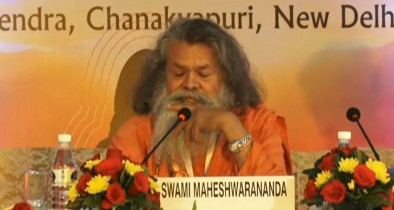
Vishwaguruji leads a Meditation at the International Conference 'Yoga for Wellness' organized by the Ministry of AYUSH, Government of India and held at Pravasi Bariyat Kendra in New Delhi. The inaugural session was attended by the Vice President of India.
Inaugurual session of the conference "Yoga for Wellness"
13:25 - 14:34 (69 min)
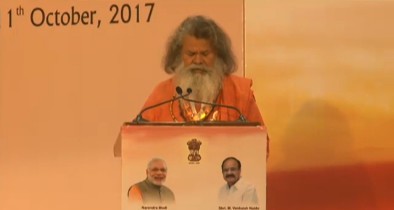
Inaugurual session of the conference on 'Yoga for Wellness' organized by the Ministry of AYUSH, Government of India and held at Pravasi Bariyat Kendra in New Delhi. The inaugural session was attended by the Vice President of India.
Do we reach?
14:40 - 14:58 (18 min)
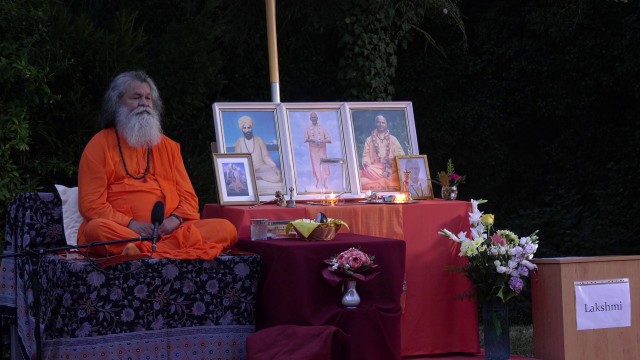
A spiritual discourse reflecting on human progress, simplicity, and the search for fulfillment.
"We were living very well. We were very happy because many people, on the farmer's side, had no telephone."
"Oh human, you will never be complete. You will never say, 'I am okay, finished.'"
The speaker, Swāmījī, recounts observations from life in Vienna, India, and America to contrast past communal simplicity with modern technological complexity. He questions whether material advancement leads to true achievement or contentment, suggesting it is a transient game. The talk concludes with an urging to look inward for lasting peace.
Filming location: Vép, Hungary
Vegetarian cooking lesson 4, Vegetable Soup
15:00 - 15:23 (23 min)

A cooking demonstration for Hungarian lentil soup at a yoga seminar.
"If we want our family to enjoy vegetarian food, we can take care of these small details."
"Even friends who are not vegetarian or not really open to vegetarian food like this soup very much, and in this way, they come to appreciate the vegetarian kitchen."
Agnes Bugán Szabónyi from Vépr, Hungary, guides viewers through preparing a traditional Hungarian lentil soup. She details the ingredients, including lentils, paprika, and fresh vegetables, and explains the steps from soaking the lentils to sautéing spices and simmering the soup. She emphasizes the dish's appeal to non-vegetarians and shares tips for family-friendly preparation, concluding with well-wishes for a successful vegetarian lifestyle.
Filming location: Vép, Hungary
Why are we making war?
15:30 - 16:53 (83 min)
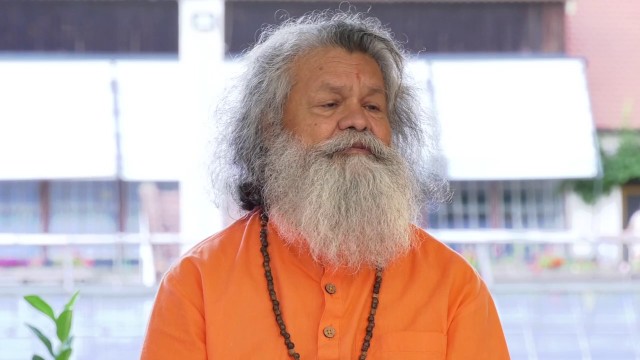
Evening satsang with Vishwaguruji from Strilky Ashram, Czech Republic. Why do we come here, sometimes from very far distances? Because we want to become better humans. We shouldn't be fighting wars and killing. This is also the teaching of Jesus. Many people do not understand this and follow their own will. The explanation of the meaning of the traditional welcoming hand gesture when the two palms meet.
The world needs Yoga in Daily Life
17:00 - 18:04 (64 min)
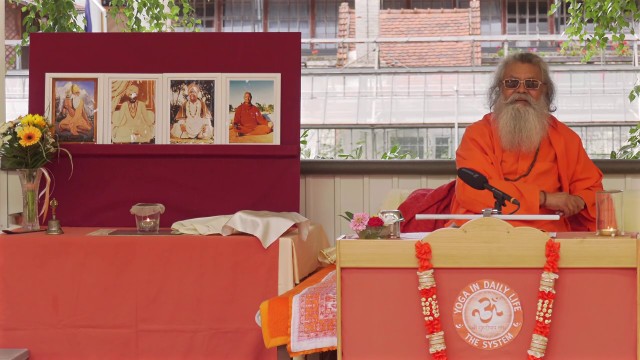
A spiritual gathering at a sacred ashram featuring discourses and personal testimonies.
"You know that you are here from where you were placed. Do you know from how many different places you had to travel?"
"I asked Mahāprabhujī, 'Please, she is this silver girl.' I know that she has some blocks in her face, in her destiny. But I asked Mahāprabhujī, please, just remove it."
A speaker describes the holiness and history of the grove, noting visits from gurus. A disciple then shares his spiritual journey to Swāmījī, recounting miraculous events like the stopping of rain. Another disciple, Joseph, testifies to the healing power of prāṇāyāma after a brain cyst and details his work using yogic techniques to help athletes, including an Olympic swimmer, achieve gold medals. The themes are the necessity of a living guru, the power of blessing, and applying yoga in daily life.
Filming location: Strilky, Czech Republic
Give up eating meat completely!
18:10 - 19:57 (107 min)
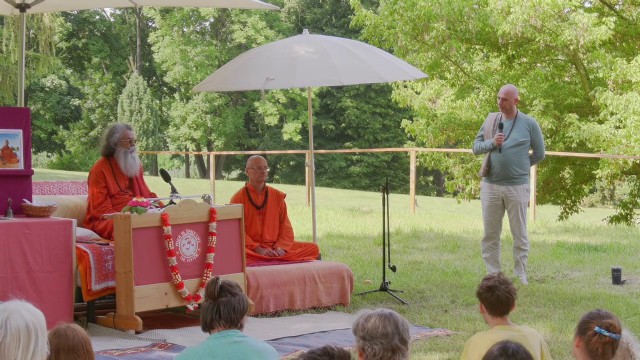
Morning satsang from Strilky Ashram, Czech Republic. Children's presentation to Gurudeva. Niranjanpuri's lecture on Kriya Anustha. If you succeed in calming the mind then you will arrive at a place that will give you joy like nothing before. For this you have to sit properly and concentrate. This can be achieved through practice. Vishwaguruji's lecture on why it is important to avoid eating meat. We eat properly at the seminar, but some people eat meat occasionally in the company of others elsewhere. This is not good, from today onwards give up this behaviour. Personal testimonies on vegetarian eating. Bhajan singing.
Everything is in our heart
20:00 - 20:13 (13 min)
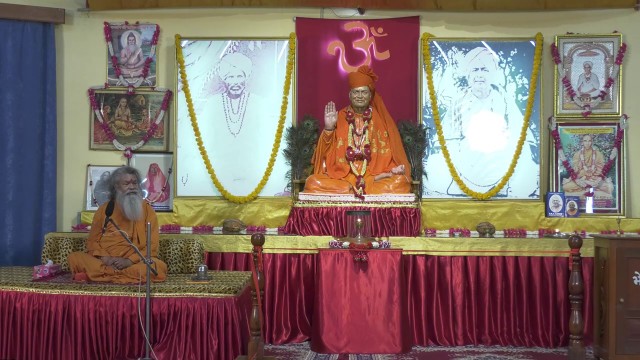
A spiritual discourse reflecting on the grace and presence of the guru through personal anecdotes.
"Please don't, Swāmijī, don't let them take this. Gurujī said, 'Don't worry, let them eat.'"
"What is the guru? What is the sādhu? And what is there, and how it is?"
The lecturer shares a series of recollections and stories involving Mā Prabhujī, Mahāprabhujī, and other spiritual figures, illustrating the mysterious and abundant grace of the guru. He recounts an incident where Gurujī allowed cows to eat from a field, which later resulted in more abundance for the owner. The talk meanders through various memories, highlighting the deep devotion of disciples and the pervasive, guiding presence of the guru in all aspects of life.
Filming location: Jadan, Rajasthan, India
Advice for practicing Yoga
20:05 - 20:56 (51 min)
Satsang with Vishwaguruji from Barcelona, Spain. The body consists of five elements. These element are present within us and outside as well. There are different techniques to purify and balance the elements. We should take care of the body while practicing Yoga. Pranayama is also important to practice. It is said that every breath is counted.
Around the World - Nadlac
21:00 - 21:08 (8 min)
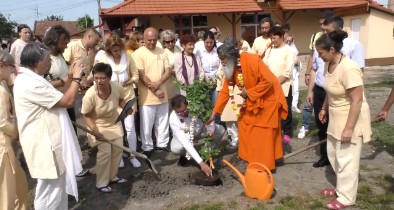
First Vishwagurujis visit to Romania.
Around the world - Opening of new YIDL center in Murska Sobota, Slovenia
21:15 - 21:57 (42 min)
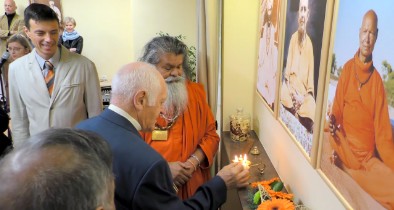
A ceremonial opening for a new yoga ashram in Slovenia, featuring addresses and spiritual teachings.
"Yoga is not specific to one country or one religion; yoga is universal."
"Yoga means balance, harmony, and unity... Yoga is a bright future for mankind, if they will use it."
Local representatives welcome guests and present symbolic gifts of bread, salt, and water. Swami Dayal Puri and the Indian Ambassador to Slovenia give speeches, celebrating the ashram's founding and explaining the ancient, universal science of yoga. The teachings cover yoga's origins in Shiva, its role in modern life for health and inner peace, and the importance of daily practice and willpower. The event concludes with Sanskrit mantras.
Filming locations: Murska Sobota, Prekmurje, Slovenia.
A Spiritual Journey: Lessons from the Himalayan Lakes and Caves
22:05 - 22:25 (20 min)
A satsang sharing spiritual lessons from Himalayan pilgrimage.
"I never give up. You also should never give up." "When things should be, they will be. You must agree with this."
Swami Shantipuri addresses the gathering on his Sannyasa birthday, recounting his journey to the Satopant Lake in the Himalayas after his Guruji's Mahasamadhi. He describes a profound meditation experience there, from which he received three core spiritual lessons symbolized by the lake: to accept life's events like the shore accepts waves, to cultivate inner calm by having no expectations, and to give freely from one's inner reservoir of wisdom like a flowing stream.
Filming location: Vép, Hungary
The Principles and Power of Sādhanā
22:30 - 23:15 (45 min)
A spiritual discourse on the principles of sādhanā and the significance of the Maṇipūra Chakra.
"Any kind of sādhanā requires perfect technique and discipline. One must follow the principles."
"That energy, which is located in the maṇipūra cakra, is called hara-śakti. That is the life force, the energy that keeps you moving."
A teacher explains the necessity of disciplined practice, using the analogy of fueling a car correctly. He delves into the esoteric importance of the Maṇipūra Chakra as the seat of life force (hara-śakti) and the junction of vital energies, connecting its functions to immunity, sound resonance (nāda), and mythological symbolism involving Vishnu. The talk covers related practices like Śabda Sañjālan and Khaṭupranām, emphasizing that authentic practice requires devotion, a spiritual lineage, and following a master's instructions to awaken inner energy and burn karmic seeds.
Filming location: Strilky, Czech Republic
We are here to learn
23:20 - 23:44 (24 min)
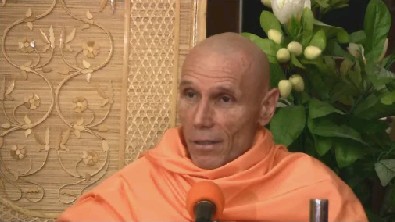
A spiritual discourse on the root of global peace and personal sorrow.
"Since we cannot find the true reason for our misfortunes and dissatisfaction, our ego asserts it is always right."
"The answer for a happy and peaceful world lies only in spirituality, in self-development, in working with oneself, in understanding that we are divine beings originating from the Divine."
Swami Jogeshanand begins with a dedication and explores the theme of peace, connecting personal longing and sorrow to global conflict. He argues that war and extremism stem from humanity's forgotten divine nature and identification with the ego, and calls for religious and political leaders to achieve enlightenment through genuine spiritual practice. He invites listeners to all sincere paths while specifically welcoming them to Yoga in Daily Life centers.
Filming location: Jadan, Rajasthan, India
Give up eating meat completely!
23:50 - 1:37 (107 min)
Morning satsang from Strilky Ashram, Czech Republic. Children's presentation to Gurudeva. Niranjanpuri's lecture on Kriya Anustha. If you succeed in calming the mind then you will arrive at a place that will give you joy like nothing before. For this you have to sit properly and concentrate. This can be achieved through practice. Vishwaguruji's lecture on why it is important to avoid eating meat. We eat properly at the seminar, but some people eat meat occasionally in the company of others elsewhere. This is not good, from today onwards give up this behaviour. Personal testimonies on vegetarian eating. Bhajan singing.
American
Australian