
European
The blessed day of Gurupurnima
0:15 - 0:55 (40 min)
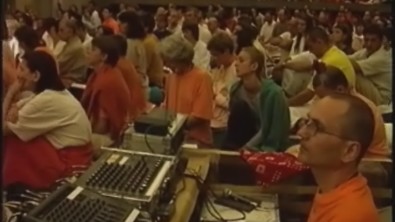
A satsang discourse on the significance of Guru Pūrṇimā.
"Gu means darkness, and ru means light. When the darkness disappears, the light appears."
"Gurudev is the jewel of the Parāś, and the disciple is the iron. When the disciple comes to the Gurudev, he changes from iron into gold."
A speaker explains the cosmic and spiritual importance of Guru Pūrṇimā, describing the Guru as the highest principle and the day as the start of the spiritual year. He discusses the Guru's role in transforming the disciple, shares devotional poetry and bhajans about longing for the master, and uses the analogy of a farmer's harvest to describe how devotees should present their spiritual progress. The talk concludes with blessings for the congregation's spiritual practice.
Filming location: Vép, Hungary
Without work, nothing can happen
1:00 - 1:58 (58 min)
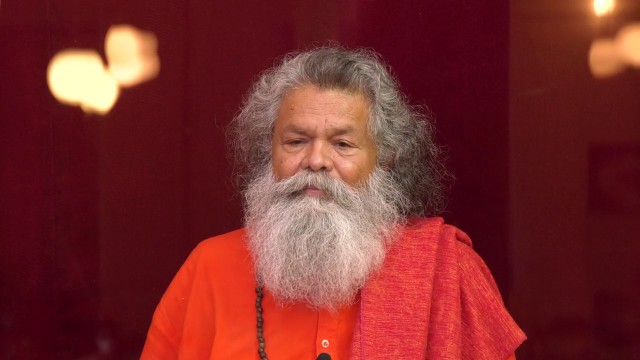
A spiritual discourse weaving ancient creation myths with teachings on dharma and modern life.
"Jīva jīva bhakṣate: all creatures eat other creatures. So that began to move."
"Dharma is spirituality and good, not killing anyone, taking care of everyone. Adharma is the opposite."
A spiritual teacher narrates a syncretic creation story, blending tales of Varāha lifting the earth, Brahmā's emergence from a lotus, and the evolutionary rise of life. He explains the primordial cycle of life consuming life (jīva jīva bhakṣate) and the subsequent establishment of dharma. The discourse shifts to contemporary lessons, advocating for non-violence, mindful consumption, self-reliance, and environmental responsibility, while cautioning against addiction.
Filming location: Strilky, Czech Republic
The Path of the Pilot: Mastering the Inner Aeroplane
2:05 - 2:57 (52 min)
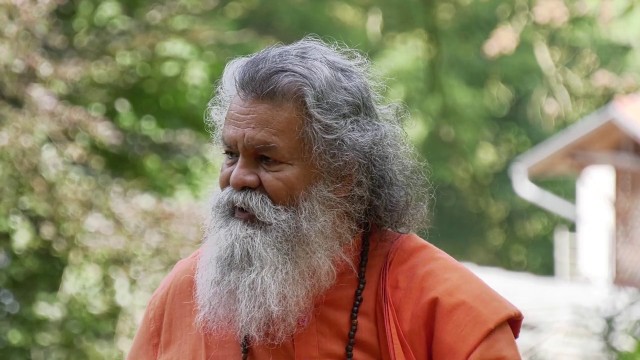
A spiritual discourse using the metaphor of a pilot to discuss self-mastery and inner power.
"The pilot knows what is happening, yet he remains peaceful. When they all land in the same place, they are happy again."
"Therefore, how we are sitting here is not possible; it is not easy. Power, inner power."
The lecturer leads a satsang, explaining that the individual is the pilot of the body's "aeroplane." He discusses the need to control the mind and nervous system (Vajranāḍī), shares stories about disciples undergoing surgery without anesthesia through yogic focus, and describes witnessing fire-walking rituals to illustrate the power of mantra and sādhanā.
Filming location: Strilky, Czech Republic
Outer and inner meditation
3:05 - 3:58 (53 min)
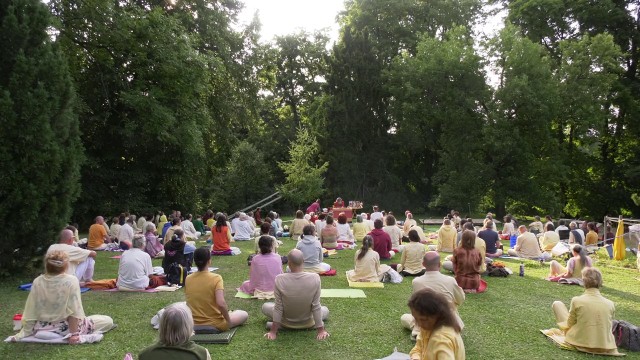
A spiritual discourse on meditation, inner science, and the living tradition of the guru.
"Meditation is within. But how? And who is really the best?"
"Therefore, this science is also very good, and that is also good... So it is better that we should be neutral."
Swami Ji addresses a gathering, contrasting external observation with true inner meditation. He shares a story of an old yogī with a profound indifference to the physical body to illustrate a deeper science. He discusses the upcoming Kriyā Initiation, outlining its prerequisites and daily practice, and expands on the nature of a living spiritual lineage, where every individual is part of a continuous flow of knowledge from generation to generation.
Filming location: Strilky, Czech Republic
The Unselfish Work
4:05 - 4:31 (26 min)
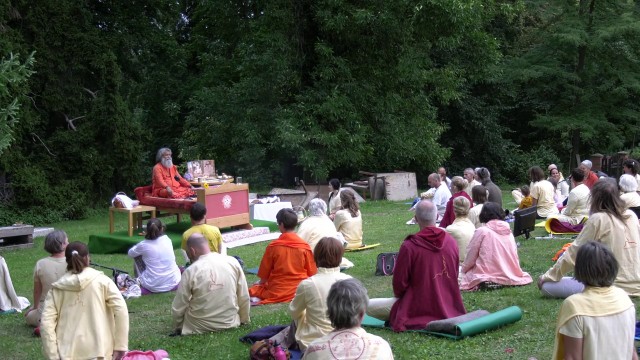
A satsang discourse on karma yoga, selfless service, and the four aims of life.
"Sometimes, when we engage in seva, work, and karma yoga, we think, 'I am doing this. If I were not here, who would do it?'"
"Swāmījī says, 'The greatest sin is to waste time. Use it or lose it.'"
The speaker shares a parable from Swāmījī about a dog who mistakenly believes it is pulling a cart, illustrating the illusion of self-importance in service. The talk emphasizes performing niṣkāma karma (selfless action) as a privilege and explores the four Puruṣārthas (dharma, artha, kāma, mokṣa) as life goals attainable only through dedicated effort and Guru's grace, referencing teachings and bhajans from saints like Ācāla Rāmajī.
Filming location: Strilky, Czech Republic
Our duty to have a devotion
4:35 - 5:51 (76 min)
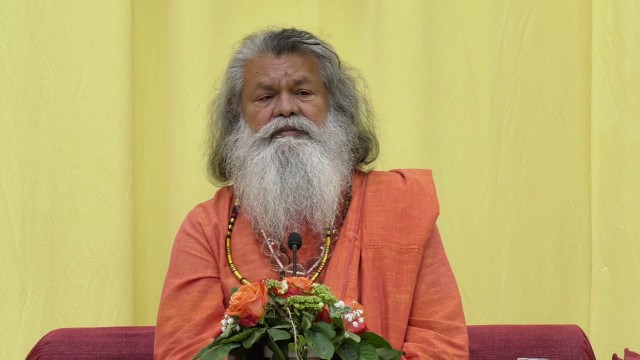
A spiritual discourse on lineage, devotion, and the nature of the soul.
"Our generation to generation to generation is of Alak Purījī. It is a tradition, and the tradition is not merely a tradition; it is, and it has to be, to receive the blessing of adoration."
"The reality is clear: spirituality needs to be in our heart. It does not matter what happens; I will not give up."
Swami Maheshwarananda (Swamiji) addresses a gathering, centering on the rediscovered lineage from Alak Purījī through Devpurījī and Mahāprabhujī to the present. He emphasizes unwavering devotion to the guru, illustrates the master-disciple relationship with anecdotes, and discusses the responsibilities and detachment required of a sannyāsī. The talk expands into teachings on the layers of existence (kośas), karma, and the soul's journey, using everyday metaphors for spiritual concepts.
Filming location: Slovenia
The Thirsty Horse and the Path of Spirituality
5:55 - 6:47 (52 min)
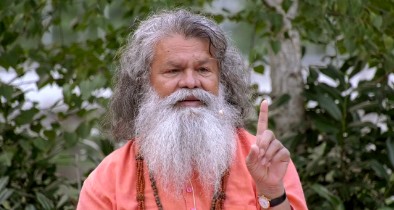
An evening satsang on overcoming worldly stress and pursuing spiritual practice.
"We are thirsty horses in this world, from little children to older people. We are all in this stress."
"If you want to quench your thirst for spirituality, then you should do it... amidst the sound of the generator... amidst this noise of the world."
The lecturer addresses the pervasive stress of modern life, using the parable of a thirsty horse afraid of a water pump to illustrate the need to practice spirituality amidst worldly noise. He discusses the inescapable realities of time and karma, explaining concepts of sin (pāpa) and piety (puṇya) and the impurities of the inner instrument (Antaḥkaraṇa). He narrates the transformative stories of the sage Valmiki, a bandit who became a seer through chanting, and the poet Tulsidas, who was inspired by his wife to turn his love toward God. The talk emphasizes continuing spiritual practice (sādhanā) with humility despite life's obligations.
Filming location: Strilky, Czech Republic
The fire element
6:55 - 7:46 (51 min)
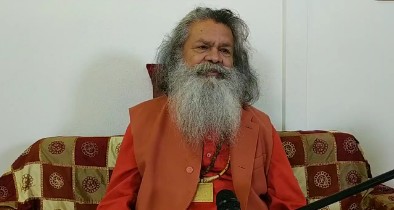
A spiritual discourse on the five elements, focusing on the fire principle and its impact on health and consciousness.
"Fire is very holy. There are different kinds of fire. The first is the light of God, the divine light."
"Without fire, we cannot survive at all. This is the element we have to maintain. Our health depends on this principle, the fire element."
A spiritual teacher explains the dual nature of the fire element, contrasting the divine light of wisdom and peace with the destructive fires of anger, ignorance, and burnout. He connects this principle to mental health, societal behavior, and traditional Vedic ceremonies for homes and life stages. The talk concludes with a Q&A session addressing charity, balancing work and family, and dealing with falsehoods.
Filming location: UK
Perfections
7:50 - 8:48 (58 min)
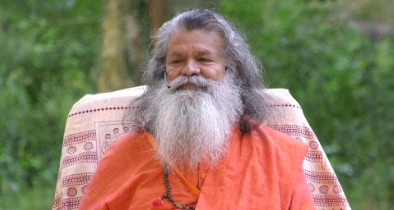
An evening satsang on the gurukul tradition, spiritual abilities, and the importance of live spiritual practice.
"Humans are born as embodiments of God, but God found that he made a mistake. Therefore, he took away or hid within them those miracles, abilities, and knowledge."
"Through that sādhana, the opening of the third eye of Śiva, they could see far distances, hear far distances, and communicate over far distances."
The lecturer addresses attendees at a seminar, framing the gathering as a modern 'gurukul of the heart'. He discusses the guru-disciple relationships of divine figures like Rama and Krishna, laments the loss of ancient spiritual sciences and siddhis (powers) in the modern age, and explains why such abilities are concealed from humanity to prevent misuse. He shares a story of Mahaprabhuji's clairvoyant healing, illustrates the need to purify mental impurities, and emphasizes the irreplaceable value of being physically present in a sanctified environment over watching webcasts. The talk concludes with thanks to volunteers and an invitation to a pilgrimage.
Filming location: Vép, Hungary
The Yogic Science
8:55 - 9:54 (59 min)
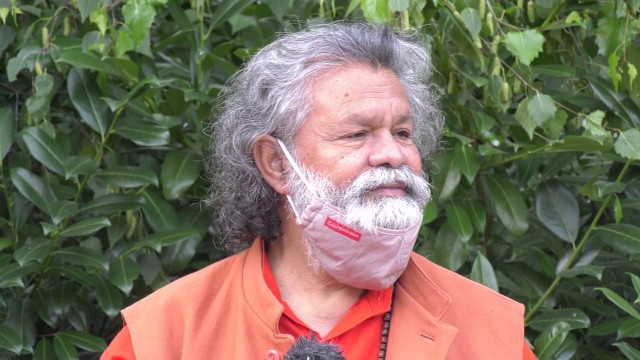
Evening satsang with Vishwaguruji from Strilky Ashram, Czech Republic. We want to become one as a human. Quality is one of the best. A good education gives good quality as a nice statue can be formed from a big rock. Energy and the five elements are connecting to the Yogi. We are entering into the oneness when entering into the practice hall. Atma is the pilot or captain of our airplane. If something is not good we can't fly. We have to be alert, the Sadhana is very important, as Holy Guruji wrote in one bhajan.
Outer and inner meditation
10:00 - 10:53 (53 min)
A spiritual discourse on meditation, inner science, and the living tradition of the guru.
"Meditation is within. But how? And who is really the best?"
"Therefore, this science is also very good, and that is also good... So it is better that we should be neutral."
Swami Ji addresses a gathering, contrasting external observation with true inner meditation. He shares a story of an old yogī with a profound indifference to the physical body to illustrate a deeper science. He discusses the upcoming Kriyā Initiation, outlining its prerequisites and daily practice, and expands on the nature of a living spiritual lineage, where every individual is part of a continuous flow of knowledge from generation to generation.
Filming location: Strilky, Czech Republic
Practicing of the system 'Yoga in Daily Life', Level 1 - Part 2
11:00 - 12:04 (64 min)
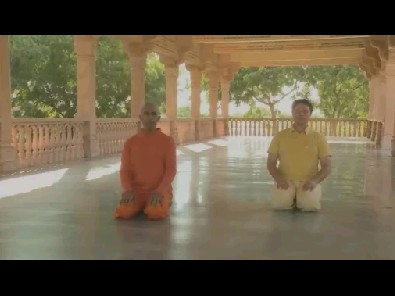
A guided morning yoga class from the Yoga in Daily Life system.
"Relax your whole body from the toes to the top of the head and from the top of the head to the toes."
"Prepare yourself for practicing prāṇāyāma, the breath technique... Breathe twenty times only through your left nostril."
An instructor leads a comprehensive session from the Om Vishwadeep Gurukul ashram. The practice begins with deep relaxation in Ānanda Āsana, followed by a series of gentle stretches, spinal twists, and core exercises like Pavanamuktāsana, all coordinated with conscious breathing. The class transitions to seated postures for spinal extension and flexion, concludes with guided relaxation and a round of Nāḍī Śodhana prāṇāyāma, and ends with a closing mantra.
Filming location: Jadan, Rajasthan, India
Gold and God
12:10 - 12:37 (27 min)
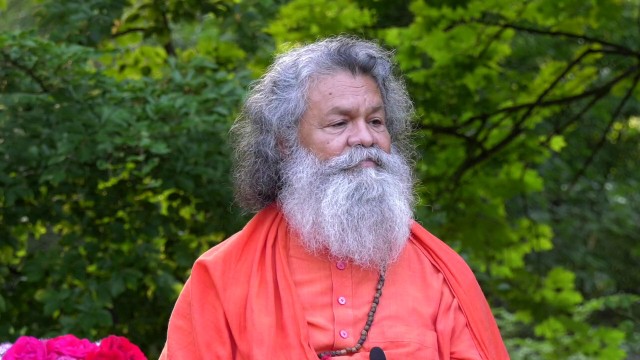
An evening satsang on the universal gift of yoga, transcending divisions of school or religion.
"Yoga is for good health, harmony, understanding, peace, and long life, and to be friends. This is the purpose of yoga."
"It does not matter which religion, which place, anywhere. Only human. If one is human, that is all."
A spiritual teacher addresses a global audience, emphasizing yoga as a divine tool for health, happiness, and harmony meant for all humanity. He recounts a parable about the introduction of gold and money, contrasting a past era of simple, reciprocal giving with modern complexity and attachment. The core message is that yoga, given by God, is a unifying practice beyond any sectarian or material divisions.
Filming location: Strilky, Czech Republic
Chakras in the human being
12:45 - 13:30 (45 min)
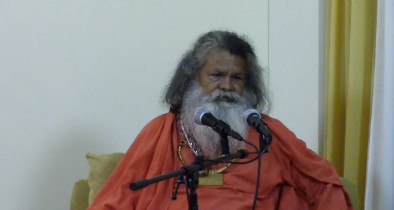
A lecture on the science of yoga, focusing on the kuṇḍalinī, the chakras, and specifically the Viśuddhi cakra.
"The definition of a chakra is a cycle, and chakra means turning."
"Viṣ means poison. Everything negative, unpleasant, and harmful for us is a poison. The opposite is nectar, the good things."
Swami Madhavanandji Bhagavan delivers the fifth lecture in a series on chakras. He explains chakras as fundamental cycles of energy, describes the five layers of the human body (kośas), and details the function of the Viśuddhi (throat) chakra in purifying psychic and emotional poison. He illustrates this with the story of Lord Śiva drinking the ocean's poison and holding it at his throat. The talk concludes with a promise to teach practical purification techniques and an invitation for questions.
Filming location: Vancouver, Canada
Dharma and adharma
13:35 - 14:10 (35 min)
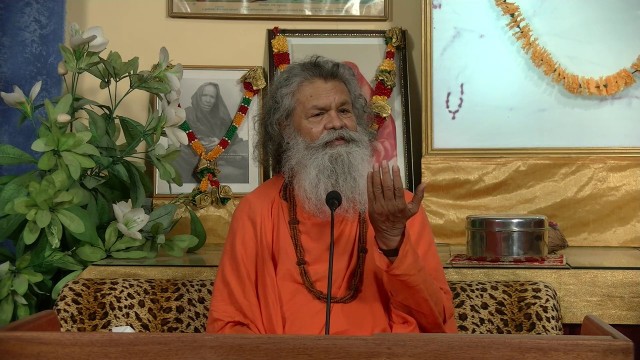
Evening satsang with Viswhaguruji from Jadan Ashram, Rajasthan, India. Our prayers have strength only if we follow ahimsa. Also don't say painful words to anyone. Don't use water unnecessarily because it is our life. Air is also life. Tulsi is not only a saint plant but it is God himself. Don't think negative of others. Bhajan singing.
Great saints are always awakened
14:15 - 15:03 (48 min)
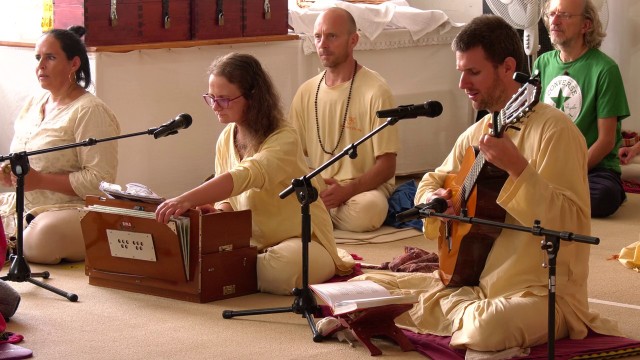
Evening satsang with Vishwaguruji from Strilky Ashram, Czech Republic. We pray to Mahaprabhuji and ask for his blessing. Great saints are for all. Great yogis are always awakened. They practise the yogic way of sleeping that is yoga nidra. Mahaprabhuji sent a message to his disciples in the Yoga nidra bhajan. Jiva is always awakened. we are bounded to the samsara which is senseless. Atma goes to paramatma like a drop to the ocean. We are attached to many things. When we die we should release everything. Only yogis nknow what is the real yoga nidra.
God is the giver
15:10 - 15:48 (38 min)
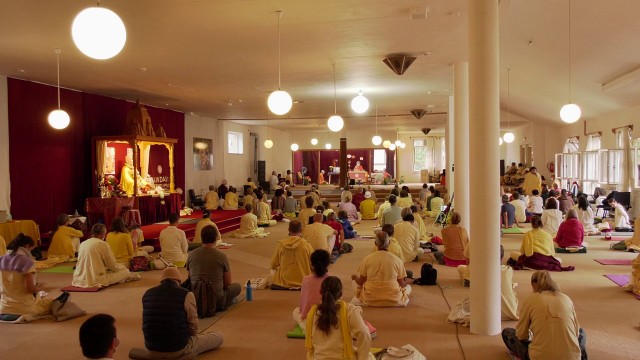
A spiritual discourse following bhajans for Guru Pūrṇimā.
"If you have no time for practicing yoga or anything, then it means you also have no time for eating."
"God knows everything: when, how, and where He is acting. So do not be proud of yourself."
A speaker addresses a gathering, reflecting on the recent bhajans and the attendees' spiritual practice (anuṣṭhāna). The talk emphasizes the necessity of sādhanā, comparing it to the essential need for food, and explores themes of divine grace, humility, and the interconnectedness of all life. Using analogies of rain, a water well, and a caged parrot, the speaker advises constant prayer, mantra repetition, and cultivating goodwill for all creatures to ultimately realize oneness.
Filming location: Strilky, Czech Republic
We are all in one
15:55 - 16:31 (36 min)
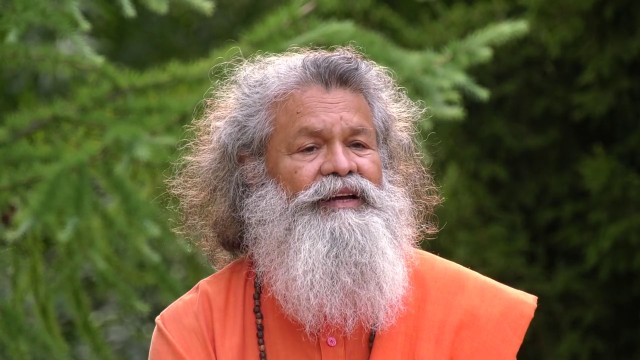
A satsang featuring devotional singing and spiritual discourse.
"Every time you sing this bhajan, remember what it means. All the bhajans we have are from great saints—many, many holy saints."
"You know, my heart is in you, and your heart is in me, if you want. I give it to you. So that is our yoga in daily life: that we are one in all and all in one."
Following a bhajan written by Mahāprabhujī, the speaker reflects on the power of devotional music from various languages and saints. The discourse expands into a contemplation of the body's energy, describing chakras as powerful points in every joint, and emphasizes care for the physical form. Themes of spiritual homecoming, unity, and the interconnectedness of all life are woven together, concluding with an affirmation of oneness.
Filming location: Strilky, Czech Republic
The basic qualities of our chakras
16:00 - 16:32 (32 min)
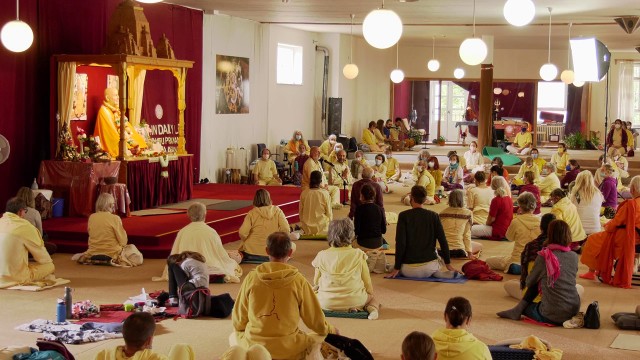
An introductory lecture on the chakras and hidden human powers, based on the book The Hidden Powers in Humans.
"If we touch words like yoga in life, words like sādhanā, our guru, then our life is directed positively."
"Swamījī said that if we are able to manage the Svādhiṣṭhāna Cakra, the power of concentration and the other powers there, we are halfway through on our path."
A speaker guides the satsang, reviewing the foundational powers within the first three chakras. He explains how dormant karmic power and Kuṇḍalinī reside in the Mūlādhāra, and how conscious living through sādhanā in the Svādhiṣṭhāna grants access to vital energies like Prāṇa-śakti. The talk outlines the progressive awakening through the Maṇipūra, Anāhata, and Viśuddhi chakras, emphasizing the guru's essential role in managing this process and illuminating the disciple's path from darkness to light.
Filming location: Strilky, Czech Republic
The beauty of Mahaprabhudeep Ashram
16:35 - 17:05 (30 min)
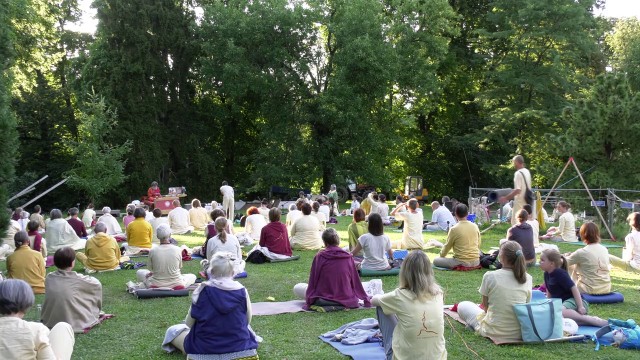
A spiritual discourse and devotional singing from an ashram, praising India's sacred land and the blessings of the Guru.
"Dhanya Dhanya Bhārata Bhūmi, svahitha kari paramasukhāsāgara Prabhu Nelliyaihi Avatāra Anantariṣimuni Yorayogī."
"If one can come here only for one hour or two hours, that is also very much. For one day, two days, three days, four days, day by day, everything comes: the purification, meditation, concentration, peace, harmony, health."
A speaker, likely a swami or devotee, leads a session that begins with Sanskrit chants and hymns glorifying India (Bharat Bhumi) and its divine incarnations. He describes the beautiful, healing atmosphere of the ashram in the forest, emphasizing the benefits of visiting for purification and spiritual practice. He discusses the upcoming Guru Purnima celebration, encourages attendance, and shares insights on karma yoga and the virtues of organic gardening from the ashram's land. The session includes a direct appeal to Indra, the rain god, for clear weather and concludes with devotional singing and the mantra "Śivo'ham."
Filming location: Strilky, Czech Republic
I am not the doer
17:10 - 17:32 (22 min)
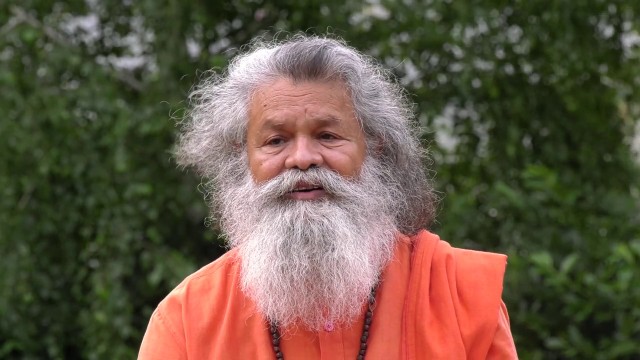
Evening satsang with Vishwaguruji from Strilky Ashram, Czech Republic. Bhajan singing. Chanting mantras. We are not the doer. During all of our life a Supreme leads us and does everything. We are swiming in the ocean of life. Our spiritual life should be happy. The story of a bird on the boat in the ocean.
How to think of black magic
17:40 - 18:27 (47 min)
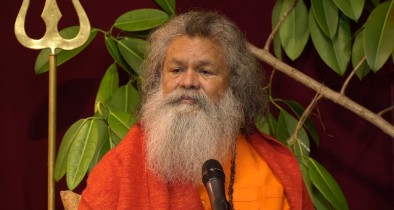
A satsang discourse debunking fear-based beliefs around black magic and ghosts through storytelling.
"People are very much frightened. They speak of ghosts and such things, and many claim they can take away the black magic which is supposedly on you."
"If we believe in God, then believe in God. God will give everything. God will never do anything negative for us."
Swami Ji narrates two cautionary tales to illustrate how fear and superstition are exploited. The first story tells of a village magician who manipulates a grieving widow, and the second describes a 'ghost' that turns out to be a moonlit chimney. He emphasizes that true spiritual practice, such as having a Guru Mantra and faith, offers protection, concluding that it is one's own fear, not external forces, that causes suffering.
Filming location: Strilky, Czech Republic
Outer and inner meditation
18:35 - 19:28 (53 min)
A spiritual discourse on meditation, inner science, and the living tradition of the guru.
"Meditation is within. But how? And who is really the best?"
"Therefore, this science is also very good, and that is also good... So it is better that we should be neutral."
Swami Ji addresses a gathering, contrasting external observation with true inner meditation. He shares a story of an old yogī with a profound indifference to the physical body to illustrate a deeper science. He discusses the upcoming Kriyā Initiation, outlining its prerequisites and daily practice, and expands on the nature of a living spiritual lineage, where every individual is part of a continuous flow of knowledge from generation to generation.
Filming location: Strilky, Czech Republic
Without work, nothing can happen
19:35 - 20:33 (58 min)
A spiritual discourse weaving ancient creation myths with teachings on dharma and modern life.
"Jīva jīva bhakṣate: all creatures eat other creatures. So that began to move."
"Dharma is spirituality and good, not killing anyone, taking care of everyone. Adharma is the opposite."
A spiritual teacher narrates a syncretic creation story, blending tales of Varāha lifting the earth, Brahmā's emergence from a lotus, and the evolutionary rise of life. He explains the primordial cycle of life consuming life (jīva jīva bhakṣate) and the subsequent establishment of dharma. The discourse shifts to contemporary lessons, advocating for non-violence, mindful consumption, self-reliance, and environmental responsibility, while cautioning against addiction.
Filming location: Strilky, Czech Republic
Our duty to have a devotion
20:40 - 21:56 (76 min)
A spiritual discourse on lineage, devotion, and the nature of the soul.
"Our generation to generation to generation is of Alak Purījī. It is a tradition, and the tradition is not merely a tradition; it is, and it has to be, to receive the blessing of adoration."
"The reality is clear: spirituality needs to be in our heart. It does not matter what happens; I will not give up."
Swami Maheshwarananda (Swamiji) addresses a gathering, centering on the rediscovered lineage from Alak Purījī through Devpurījī and Mahāprabhujī to the present. He emphasizes unwavering devotion to the guru, illustrates the master-disciple relationship with anecdotes, and discusses the responsibilities and detachment required of a sannyāsī. The talk expands into teachings on the layers of existence (kośas), karma, and the soul's journey, using everyday metaphors for spiritual concepts.
Filming location: Slovenia
Around the world - Yoga in Slovakia
22:00 - 23:37 (97 min)
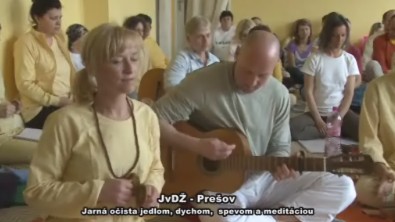
Yoga practice in Slovaka, the city of Presov
Amrit Sagar
23:30 - 0:34 (64 min)
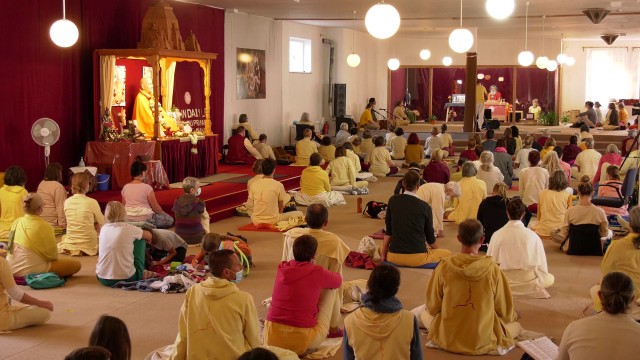
A satsang discourse on the spiritual significance of a devotional bhajan and the nature of divine light.
"All the names I have given to you are beautiful, beautiful names. For example, Amṛt Sāgar."
"This bhajan is not only beautiful, but it is the whole cosmos, everything in one."
Swami Māheśvarānanda leads a gathering, reflecting on a recent trip to Vienna and the previous day's program led by a disciple named Amṛt Sāgar. He explains the profound meaning of her name—"Ocean of Nectar"—and the cosmic significance of a bhajan composed by his guru, Satguru Svāmī Madhavānandjī. He shares stories of his guru's compassion and the journey of the disciple Amṛtsāgar, while elucidating the bhajan's key words: prakāś (light), amṛt (nectar), and sāgar (ocean), describing them as metaphors for the soul, immortality, and divine consciousness that permeates the universe.
Filming location: Strilky, Czech Republic
The Unselfish Work
23:45 - 0:11 (26 min)
A satsang discourse on karma yoga, selfless service, and the four aims of life.
"Sometimes, when we engage in seva, work, and karma yoga, we think, 'I am doing this. If I were not here, who would do it?'"
"Swāmījī says, 'The greatest sin is to waste time. Use it or lose it.'"
The speaker shares a parable from Swāmījī about a dog who mistakenly believes it is pulling a cart, illustrating the illusion of self-importance in service. The talk emphasizes performing niṣkāma karma (selfless action) as a privilege and explores the four Puruṣārthas (dharma, artha, kāma, mokṣa) as life goals attainable only through dedicated effort and Guru's grace, referencing teachings and bhajans from saints like Ācāla Rāmajī.
Filming location: Strilky, Czech Republic
American
Australian