
European
Do good things and be happy
0:25 - 1:11 (46 min)
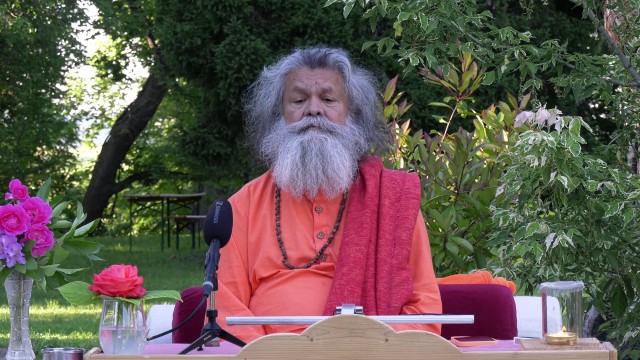
Evening satsang with Vishwaguruji from Strilky Ashram, Czech Republic. Bhajan singing. Bhajans are one of the best things in the world. When we sing good words come from our hearts and make other people happy. Sometimes people are happy also when they do bad things. The story of a sadhu and a tree. We should be peaceful and positive so we can go to God. Om Ashram is for the future generation. Half of iva was a woman and the other half was a man.
The Power of Tapasyā: Pārvatī's Resolve
1:15 - 2:03 (48 min)
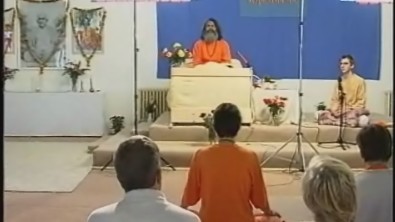
A spiritual discourse narrating the story of Pārvatī's resolve to perform tapasyā (austerity) and explaining its power.
"Tapasya is the giver of happiness and the remover of all troubles."
"Through the power of tapasyā, Brahmā is able to create this world. Through the power of that tapasyā... Viṣṇu is able to protect the world. And through that power of tapasyā, Śiva, is able to destroy all the negative powers."
The speaker recounts how Pārvatī, consoling her mother Mēnā, describes a dream in which a Brāhmaṇa instructs her to undertake severe spiritual austerity, affirming the truth of sage Nārada's words. The narrative details the immense power of tapasyā, using the examples of the Hindu trinity and Śeṣanāga, and describes Pārvatī's subsequent journey into the forest for a prolonged, extreme penance to attain Lord Śiva. The discourse frequently shifts to address a modern audience directly, exhorting them to cultivate similar willpower in their own sādhanā (practice) to overcome mental obstacles and attachments.
Filming location: Strilky, Czech Republic
The materialized OM
2:05 - 2:27 (22 min)
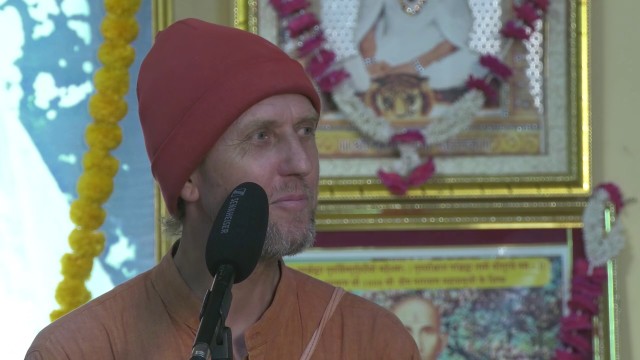
An address to the ashram community about the final push to complete the Omāśram temple.
"Four months will pass like the blinking of an eye."
"It is a part of our work to make it happen that this crown will now be presented to Swāmījī."
A speaker addresses the gathered residents and volunteers, emphasizing the imminent opening ceremony of the home temple. He describes the transformative energy brought by Gurudev's presence and the accelerated pace of work, urging everyone to participate and to invite skilled helpers from abroad. The talk reflects on the ashram's profound growth over decades and frames the project as a divine vision materializing for the benefit of future generations.
Filming location: Jadan, Rajasthan, India
Meditation for every creatures
2:30 - 3:33 (63 min)
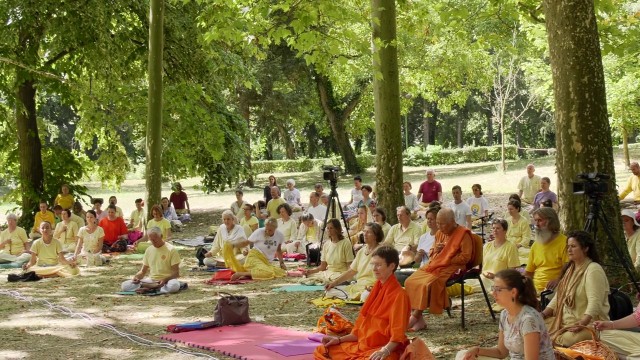
Morning satsang with Vishwaguruji from Vep, Hungary. We can't do too much for innocent creatures but we can give blessing from our heart for them in meditation. It is for every living beings. Silent meditation and relaxation.
Feel the divine sounds of bhajans in your heart
3:40 - 4:42 (62 min)
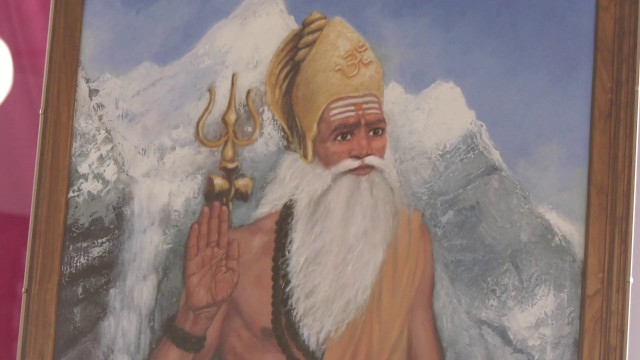
Morning Satsang with Vishwaguruji from Strilky, Czech Republic. Sat means truth and sang means together. Our inner self and our outer self are together. We should respect our mother earth. In our dreams, we can go easily everywhere. the story of a wife and a husband who was a singer and wanted to eat ice cream. The story of a great yogi bhajan singer in India who is blind and Swami Gajanand in Kumbha Mela. Bhajan singers can sing the way that they feel and radiate the whole energy and vibration of the bhajans through their voice and their playing on the instrument.
We should develop positive qualities
4:50 - 5:54 (64 min)
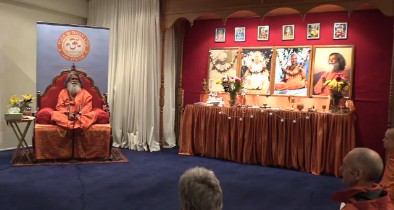
A spiritual discourse on the necessity of practice, overcoming obstacles, and living one's dharma.
"Tons of theory is nothing compared with a grain of practice. Abhyāsa, abhyāsa kaunte, abhyāsa."
"Dharmo rakṣita rakṣitaha. If you protect the dharma, the dharma will protect you."
Swami Ji addresses a gathering, emphasizing that true mastery in spirituality, like in archery or music, comes only from dedicated practice (abhyāsa) and love for the discipline. He explains that the real test of one's principles (dharma), patience (dhīraja), and relationships comes during times of adversity. The talk weaves through themes of faithfulness, the distractions of the mind (vikāras), and the importance of protecting one's spiritual and moral commitments in all aspects of life.
Filming location: Wellington, New Zealand
Release your bad qualities
6:00 - 6:52 (52 min)
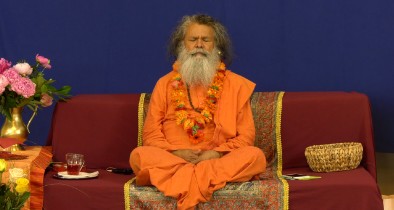
Morning satsang with Vishwaguruji from weekend Yoga seminar in Salzburg, Austria. Traditions are important and more or less similar in the whole world. The Austrian culture is very rich and beautiful. Many books of ancient Indian culture was destroyed by Moguls. We can digest everything except the truth. Tell honestly yourself your negative qualities. Remain natural as it is. Culture and education we should get from our parents. Short meditation how to turn negative to positive.
Feel the divine sounds of bhajans in your heart
7:00 - 8:02 (62 min)
Morning Satsang with Vishwaguruji from Strilky, Czech Republic. Sat means truth and sang means together. Our inner self and our outer self are together. We should respect our mother earth. In our dreams, we can go easily everywhere. the story of a wife and a husband who was a singer and wanted to eat ice cream. The story of a great yogi bhajan singer in India who is blind and Swami Gajanand in Kumbha Mela. Bhajan singers can sing the way that they feel and radiate the whole energy and vibration of the bhajans through their voice and their playing on the instrument.
Meditation
8:10 - 9:05 (55 min)
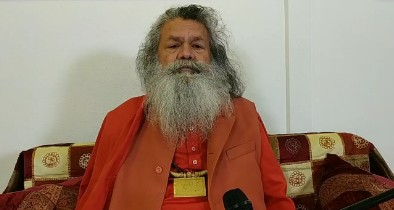
Evening satsang with Vishwaguruji from Cherkasy, Ukraine. Every human has an individual choice. We have to come to our destination on our own. The Soul is searching for the destination. Meditation comes from itself. When you meditate, you are one with yourself. The dream is your reality, to know the moment of falling asleep is the first step in meditation. Practicing meditation with Vishwaguruji.
The Sun Shines in the Kingdom of God: On Habit, Mind, and the Kośas
9:10 - 10:01 (51 min)
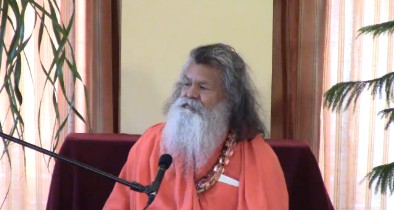
A spiritual discourse on the five sheaths (kośas), habit, and the nature of the mind.
"Whatever kind of habit you have, after a while, that will become your nature."
"The mind is the reflection. Or in the pond, in the water pond, very nice, clean, and very still water. You look, and your face is inside. But it's only a reflection."
The lecturer leads a morning satsang, exploring how habits become second nature, using a parable of a man and a bear to illustrate addiction. He explains the five kośas, focusing on the elusive manomaya kośa (mind sheath), describing it as a reflective layer governing the senses and storing impressions. The talk covers purification through prāṇāyāma, the trap of attachment (mamatā), and the importance of selfless giving.
Filming location: Alexandria, USA
The master and his disciple are one
10:05 - 10:56 (51 min)
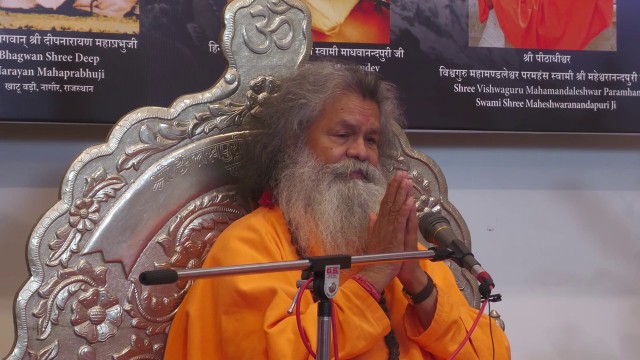
Evening satsang from Jaipur Ashram, Rajasthan, India. Alakhpuriji is the light of Siva. Mahaprabhuji is the light of the sun. The story how Vishwaguruji became sanyas and how he began his sanyas lefe with Guruji. Vishwaguruji tells some of his visions of Mahaprabhuji in Viena. He tells Holiguruji's vision of Sri Devpuriji in India. Guru and disciple should become one. Mother and father and their child are also one. The story of how a bhramari makes the worm to bhramari too. Practising bhramari pranayama with different positions of the hands. Concentration on the effects of bhramari pranayama.
Yoga Sadhana
11:00 - 11:53 (53 min)
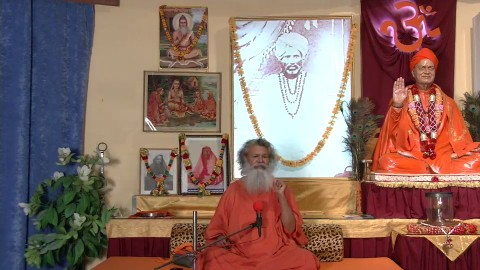
Evening satsang with Vishwaguruji from Jadan Ashram, Rajasthan, India. Shiva is a yogi. The Soul experiences different lives on this Earth. Where is life, there is God. Sadhana means that we have to go to the highest, to God. Mahaprabhuji gave hard training to Holy Guruji. A real disciple understood what means Guru and follows happily even if it seems strick. The holy place and shelter are near the foot of Gurudev.
Practising third level of Yoga in Daily Life System
12:00 - 13:38 (98 min)
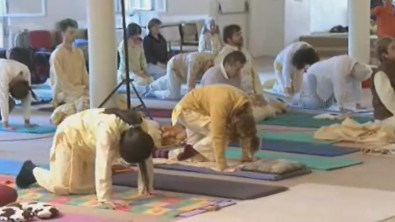
Morning practising. Third part of the System" Yoga in Daily Life" from Mahaprabhudeep Ashram, Strilky, Czech Republic
Pure nourishment
13:45 - 14:34 (49 min)
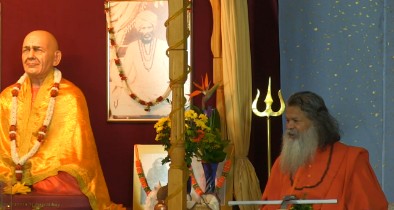
Evening satsang with Vishwaguruji from Strilky Ashram, Czech Republic. We should not destroy the whole plant in order to eat it and should support sattva guna - the quality of harmony and balance. The joy of life is to awaken the knowledge of what it means to be a human. Vishwaguruji explains that Yoga Nidra should be practiced as a meditation: travelling in our inner space.
We are going for oneness
14:40 - 15:28 (48 min)
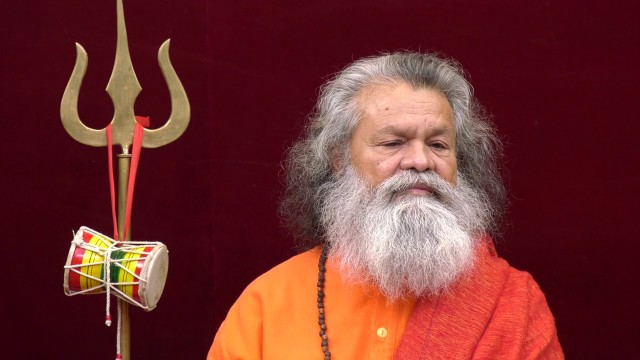
An evening satsang on spiritual oneness and the guru's role.
"The destination is one in all, as our Holy Gurujī said: one in all and all in one."
"Gurudev is one, but many times you see that with Śiva and the Jyotirliṅga."
A spiritual teacher addresses a global Yoga in Daily Life audience, exploring the non-dual path to merging with the divine. He emphasizes that the individual soul (jīvātmā) is always with God, critiques the illusion of separateness, and stresses constant remembrance of the guru as the essential practice to transcend duality and worldly troubles. The talk includes Sanskrit prayers and a mantra explanation.
Filming location: Maha Kumbha Mela, India
Let this life be the last one
15:35 - 16:00 (25 min)
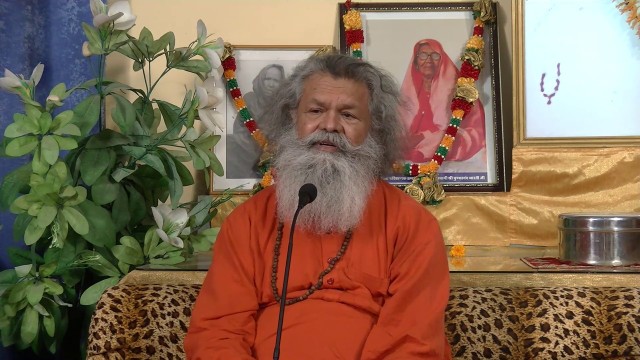
Evening satsang with Vishwaguruji from Jadan Ashram , Rajastham, India. We have no right to print and multiply Alakhpuriji's photo. It is saved by copyright. Yoga asanas are originated from the nature given by Siva. There are many other asanas which are originated from the movements of the rishis. We should come out from the cycles of birth and death. Practising asanas means respecting nature. Satsang bhajans and good words are our spiritual nourishing.
In the service of Life
16:05 - 16:49 (44 min)
India, Summer 2005. Report about the Swamijis activities.
The Paths and Practices of Haṭha Yoga
16:55 - 17:25 (30 min)
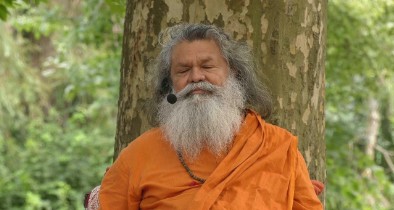
An introductory lecture on the philosophy and practices of Haṭha Yoga.
"According to Patañjali's teaching... the yogas are Karma Yoga, Bhakti Yoga, Jñāna Yoga, and Rāja Yoga."
"Haṭha Yoga pertains to the nervous system, specifically the three primary nāḍīs: Iḍā, Piṅgalā, and Suṣumṇā."
A spiritual teacher begins a weekend workshop by defining Haṭha Yoga's place among yoga's many paths. He explains multiple interpretations, including its definition as the union of the "Ha" (Iḍā) and "Tha" (Suṣumṇā) energies, and outlines its classical six cleansing techniques (Ṣaṭkarma). The talk provides practical guidance on practices like Netī and the foundational principle of beginning all practices on the left side to balance the lunar channel and calm the mind.
Filming location: Vép, Hungary
Atma and the Soul
17:30 - 18:11 (41 min)
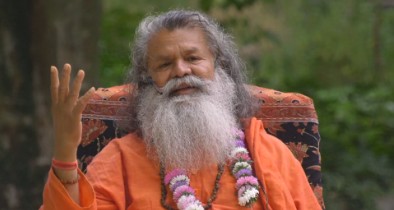
An introductory talk for a yoga retreat focused on self-realization.
"Anuṣṭhāna means we have a saṅkalpa, a resolve, and we practice according to that saṅkalpa to achieve certain aims: for health, for family harmony, for spiritual development, and for what we call Ātmā Jñāna—Ātmā Anubhūti."
"Śaṅkarācārya said there is duality in matter, but unity is in oneness in Ātmā. In diversity, there is unity."
A teacher opens a summer retreat, framing the "Yoga in Daily Life" program as a path to experiencing the Self (Ātmā Anubhūti). He explains non-dual philosophy using Śaṅkarācārya's analogies of water in different cups and the moon reflected in many vessels to illustrate the one Ātmā within all. He warns against procrastination in spiritual practice, sharing a parable about a greedy man delaying a purchase, and emphasizes the need for consistent practice (abhyāsa) to dispel the ignorance that creates suffering.
Filming location: Vép, Hungary
Morning lecture from Strilky seminar
18:15 - 18:57 (42 min)
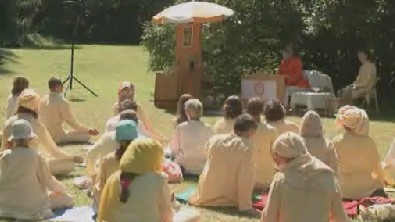
Morning lecture from Mahabrabhudeep Ashram, Strilky, Czech Republic
Do good things and be happy
19:05 - 19:51 (46 min)
Evening satsang with Vishwaguruji from Strilky Ashram, Czech Republic. Bhajan singing. Bhajans are one of the best things in the world. When we sing good words come from our hearts and make other people happy. Sometimes people are happy also when they do bad things. The story of a sadhu and a tree. We should be peaceful and positive so we can go to God. Om Ashram is for the future generation. Half of iva was a woman and the other half was a man.
Raising the Kalash
19:55 - 20:38 (43 min)
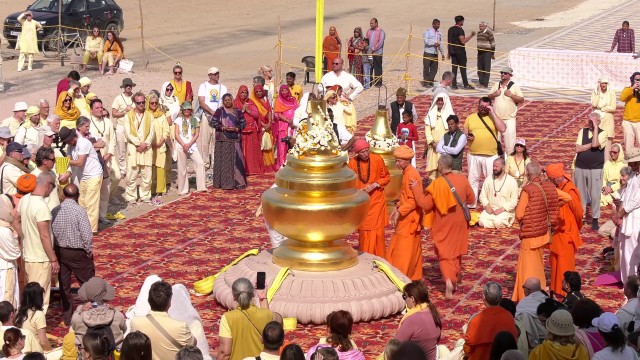
Satsang from Om Ashram, Rajasthan, India. Raising the Kalash on the Shiva Temple.
Preparing the Kalash
20:45 - 21:27 (42 min)
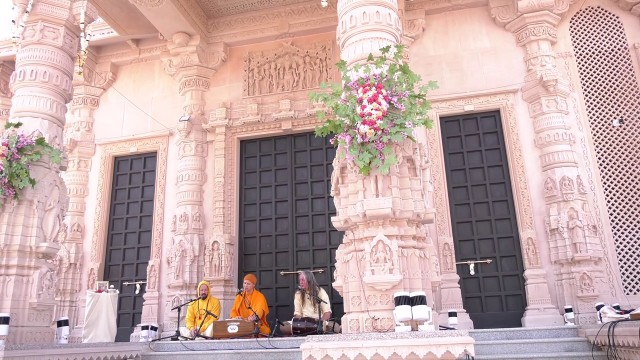
Morning program from Om Ashram, Rajasthan, India. Swami Madhuram Puri singing bhajans (Prakash Punja ...), and preparing the Kalash.
We suffer because we left Nature
21:35 - 22:25 (50 min)
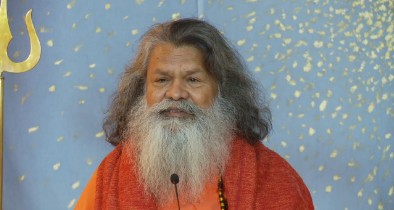
A satsang discourse on spiritual home, practice, and natural living.
"Only through the knowledge of yoga—and I emphasize, not from books but from a self-realized master—are we able to understand the messages hidden within religion."
"We just need to try to be that wooden spoon, to be in satsaṅg, to be in the honey. Slowly, we will gain that sweetness."
The speaker addresses the community, contrasting the challenges of biological family with the spiritual home found in sangha. Using metaphors like the wooden spoon and the ant seeking sugar, he emphasizes humility, opening the heart, and consistent practice. He discusses the role of a Satguru as the path, the importance of teaching knowledge forward, and the need to return to a natural way of living to end suffering.
Filming location: Strilky, Czech Republic
Let this life be the last one
22:30 - 22:55 (25 min)
Evening satsang with Vishwaguruji from Jadan Ashram , Rajastham, India. We have no right to print and multiply Alakhpuriji's photo. It is saved by copyright. Yoga asanas are originated from the nature given by Siva. There are many other asanas which are originated from the movements of the rishis. We should come out from the cycles of birth and death. Practising asanas means respecting nature. Satsang bhajans and good words are our spiritual nourishing.
Around the world - Inauguration Nandeshwar
23:00 - 23:05 (5 min)
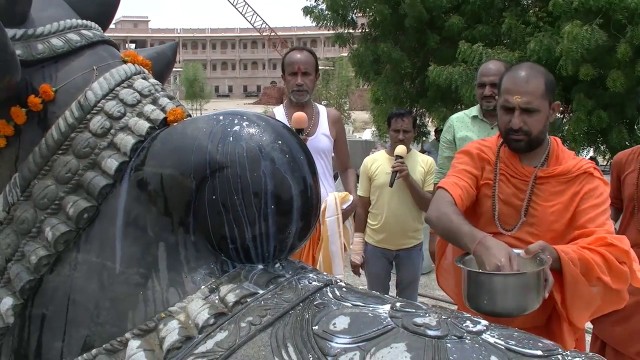
Arrival of Nandeshwar to Om Ashram. Jadan, Rajasthan, India.
The Essence of Yoga in Daily Life
23:10 - 23:45 (35 min)
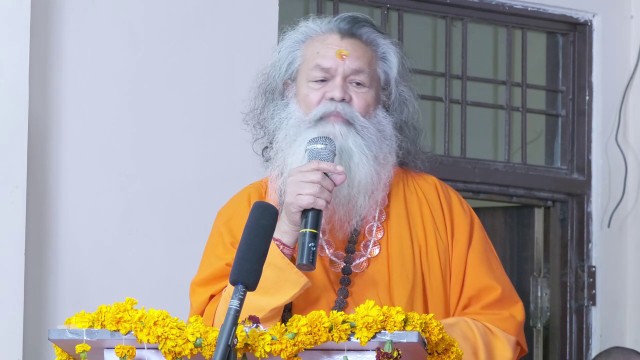
A spiritual discourse and award ceremony on integrating yoga and Sanātana Dharma into daily life.
"You should know why you have come to this world." "Yoga in daily life means in the whole world, in the whole world."
A speaker, referencing Gurudev and Swami Madhavanand, delivers a wide-ranging talk emphasizing the purpose of human life, the principles of yoga, and the protection of animals and Indian culture. He shares anecdotes about teaching yoga abroad, insists on vegetarianism for practitioners, and discusses the global spread of both meat-eating and veganism. The event includes the presentation of awards for promoting Indian culture and peace, with thanks given to organizing institutions like Apex University and the Yoga in Daily Life Foundation.
Filming location: Jaipur, Rajasthan, India
The Paths and Practices of Haṭha Yoga
23:50 - 0:20 (30 min)
An introductory lecture on the philosophy and practices of Haṭha Yoga.
"According to Patañjali's teaching... the yogas are Karma Yoga, Bhakti Yoga, Jñāna Yoga, and Rāja Yoga."
"Haṭha Yoga pertains to the nervous system, specifically the three primary nāḍīs: Iḍā, Piṅgalā, and Suṣumṇā."
A spiritual teacher begins a weekend workshop by defining Haṭha Yoga's place among yoga's many paths. He explains multiple interpretations, including its definition as the union of the "Ha" (Iḍā) and "Tha" (Suṣumṇā) energies, and outlines its classical six cleansing techniques (Ṣaṭkarma). The talk provides practical guidance on practices like Netī and the foundational principle of beginning all practices on the left side to balance the lunar channel and calm the mind.
Filming location: Vép, Hungary
American
Australian