
European
We should not have duality
0:00 - 0:11 (11 min)
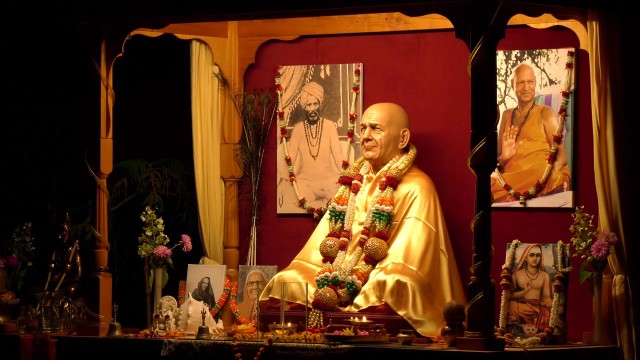
A satsang discourse on the eternal guru lineage and the nature of divinity.
"Other religions are also very good, but they have no God. Not living God."
"So there is one coming once, and there is another one which is forever coming."
The lecturer addresses devotees, reflecting on recent travel and attendance. He explains the concept of a living God through the eternal spiritual lineage (paramparā), contrasting it with his view of other faiths. Using the analogy of universal parents and unique biological mothers, he describes the relationship between the singular divine and the plurality of saints and gurus who manifest it continuously.
Filming location: Strilky, Czech Republic
In the home of the soul
0:15 - 1:18 (63 min)
Summer 2003. in India with presentation of Yoga In Daily Life projects and Swamijis lecture
The Pearl of Everlasting Bliss
1:25 - 1:46 (21 min)
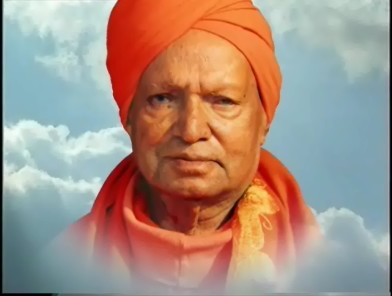
A biographical tribute to the life and legacy of Hindu saint Paramahaṁsa Śrī Svāmī Madhavānandajī.
"My eyes filled with tears, and I fell to my knees. I knew I had found the everlasting light of my life. I was home at last."
"All humans belong to one religion, and that is humanity... ahiṃsā paramo dharma: non-violence is the highest religion."
The narrative chronicles the spiritual journey of Swami Madhavānandaji, from his childhood in Rajasthan and transformative meeting with his guru, Bhagavān Śrīdīp Nārāyaṇa Mahāprabhujī, to his life of devotion, teaching, and global service. It details his initiation, his work establishing ashrams, and his teachings on non-dualism and universal love, culminating in his Mahāsamādhi in 2003 and the continuation of his lineage through his disciple, Swami Māheśvarānandajī.
Filming location: Rajasthan, India; Kathu Ashram, India; Bola Guda Ashram, India; Nepal
God takes care of everything
1:50 - 2:26 (36 min)
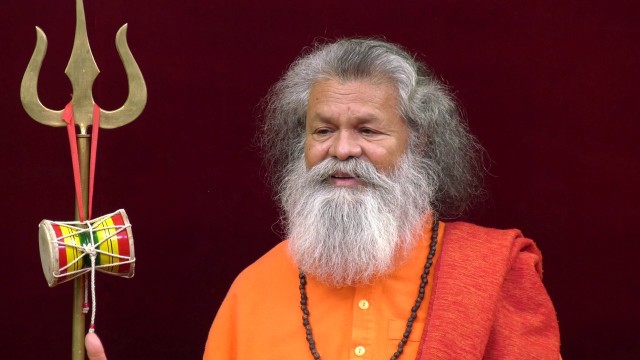
A global satsang and lecture on faith, divine grace, and the role of the guru.
"Many people send messages asking, 'Swāmījī... would you like to give us some more advanced techniques?'"
"God said, 'When it is comfortable, I am just walking with you. But when there is trouble, then you are on the palm of My hand.'"
Swami Maheśvarānandajī addresses practitioners worldwide, reflecting on the global reach of his teachings during the pandemic. He responds to requests for advanced practices by emphasizing foundational faith, using the examples of the ant and elephant to illustrate divine provision. He discusses the nature of God and gurus, advises against ego, and concludes with a parable about God's presence during hardship.
Filming location: Strilky, Czech Republic
Bhajan evening in Jadan Ashram
2:30 - 3:12 (42 min)
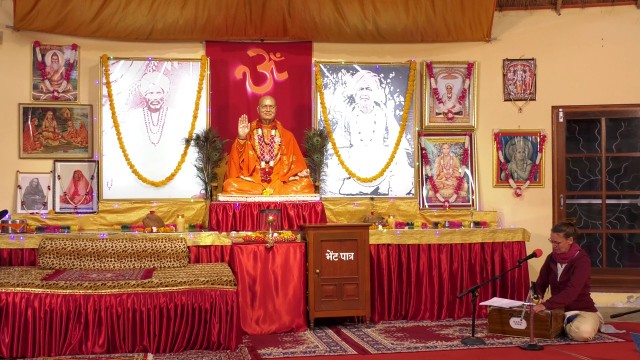
Evening satsang from Jadan Ashram, Rajasthan, India. Bhajan singing
Bhajan singing from Jadan Ashram
3:20 - 4:06 (46 min)
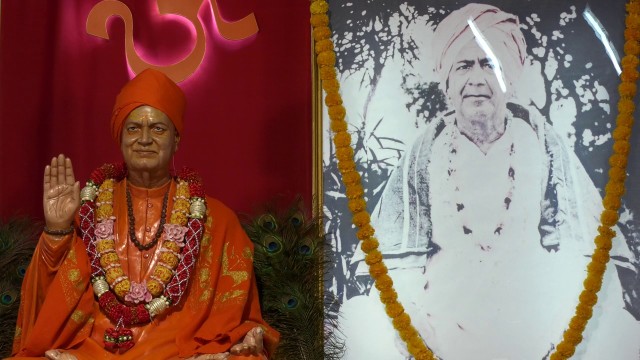
Evening satsang with Vishwaguruji from Jadan Ashram, Rajasthan, India.
Bhajan evening in Strilky Ashram
4:10 - 4:56 (46 min)
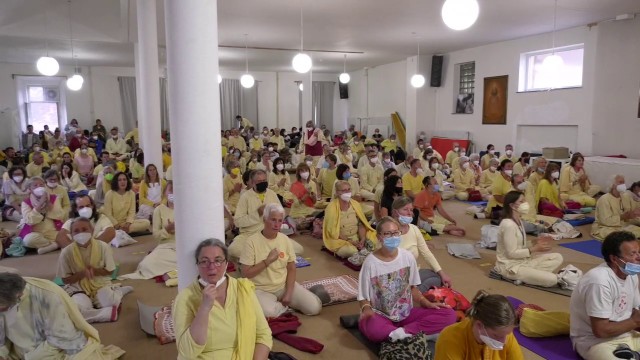
Evening satsang with Vishwaguruji from Strilky Ashram, Czech Republic. Bhajan singing.
Bhajans from Slovenska Vas
5:00 - 5:44 (44 min)
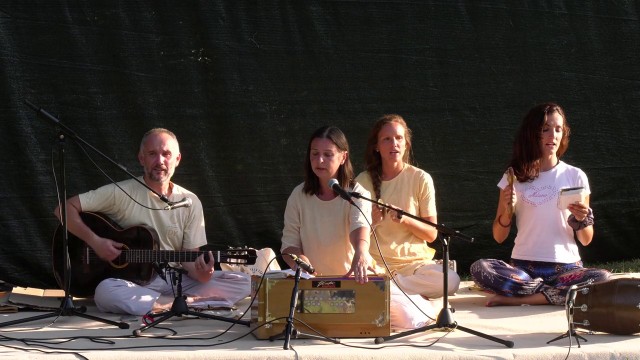
Evening satsang from Slovenska Vas, Slovenia.
How did creation begin?
5:50 - 6:36 (46 min)
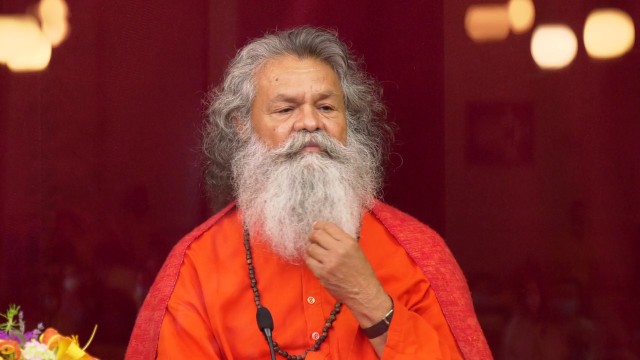
A spiritual discourse on the purpose of pilgrimage and the nature of yoga.
"You have come from a long distance, but you are not tired. Why are you not tired? Because you were coming here to Mahāprabhujī's ashram."
"Holy Gurujī said, 'One in all and all in one.' This means we came from different ways... but we have all come here and become one now."
A speaker welcomes visitors to the ashram, emphasizing the spiritual energy of the place and the unity of the gathering. The discourse then expands into a wide-ranging exploration of yoga, defining it not merely as physical practice but as the fundamental unity underlying all existence, from the cosmic emergence of Śiva from Parabrahma Paramātmā to the ethical principle of non-violence (ahiṃsā) exemplified by the Buddha. Stories of the Buddha and a devoted princess named Sundarī are shared to illustrate the path of purification and knowledge.
Filming location: Strilky, Czech Republic
The Universal Principles of a Happy Life
6:40 - 7:34 (54 min)
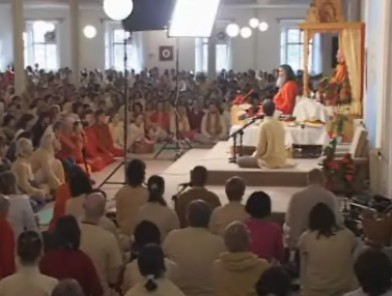
A Sunday satsang on universal spiritual principles and practical yoga.
"Yoga in daily life means to lead life 24 hours according to positive principles."
"One word which is universal: happiness. Can you share happiness? Find the way."
Swami Maheshwarananda delivers a morning talk, weaving together themes of happiness, love, and karma. He emphasizes sharing happiness through selfless action, illustrates principles with a story of kindness, and distinguishes between temporary and everlasting love. The session concludes with teachings on breath and a guided Aum chant.
Filming location: Strilky, Czech Republic
Protect Nature and be truthful
7:40 - 8:35 (55 min)
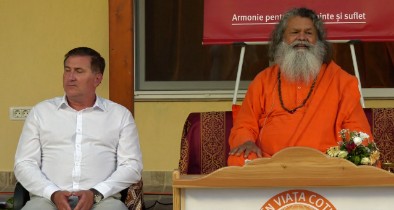
Evening satsang with Vishwaguruji from weekend Yoga Seminar in Nadlac, Romania. Slovak folk dance before Vishvaguruji's talk. Nadlac Town Mayor says some welcoming words to Vishwaguruji for his first visit to Romania. All creatures are connected to one God. If you don't believe that you are lost. All creatures feel the same feelings as humans. Don't be the cause of pain to any creature. Animals can make mistakes but we are human. The first god is the mother. Where there is water, there is God. Respect the vegetation and the rain. First happiness is good health. Saints are here for the sake of all creatures - but you will liberate yourself.
From darkness to light
8:40 - 9:55 (75 min)
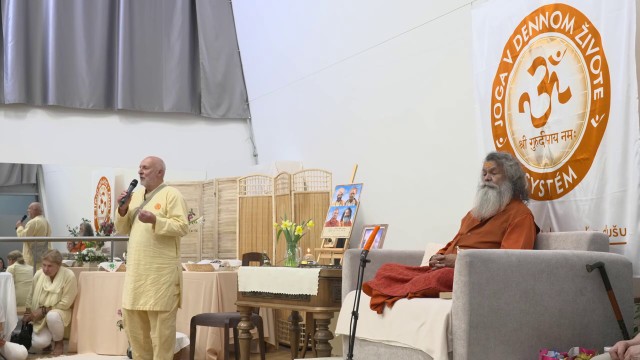
Evening satsang with Viswhaguruji from Presov, Slovak Republic. Bhajan singing. Talk about the meaning of the word Guru.
Evening satsang from Om Ashram (2/2)
10:00 - 10:53 (53 min)

Evening satsang from main tent at Om Ashram, Rajasthan, India. Bhajan singing.
Practice from Wellington with MM Vivekpuri
11:00 - 11:59 (59 min)

Wellington, New Zealand
You are the helper of everyone
12:05 - 12:58 (53 min)
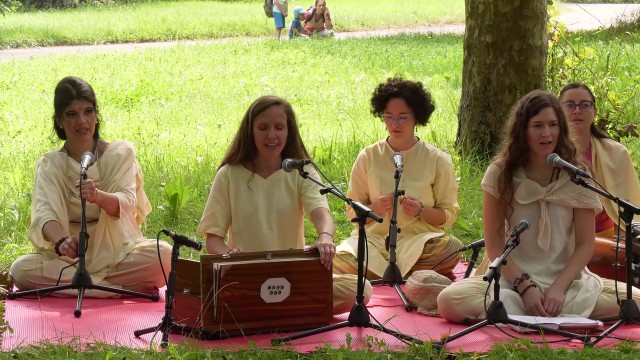
A spiritual discourse on the meaning and practice of a specific mantra.
"Oṃ, the Uncreated Body. It is not referring to the physical body. It is pointing to the body of Consciousness, the body of Awareness, the body of Being."
"When we chant this mantra, we are not invoking something outside of ourselves. We are recognising and affirming our true nature."
A teacher provides a detailed commentary on the mantra "Oṃ Aki Rāchanā Śarīra," explaining its meaning as a pointer to the eternal, unchanging Self or Awareness beyond the physical form. He instructs listeners on how to chant it as a practice of self-recognition and disidentification from the body-mind, describing it as the subjective space of pure knowing.
Filming location: Vép, Hungary
The best ways of learning
13:05 - 13:56 (51 min)
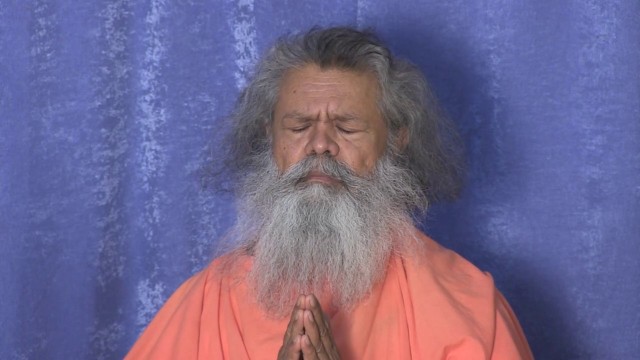
Evening satsang with Vishwaguruji from Jadan Ashram, Rajasthan, India. The word Bhaj means devotion. Doha means two. The first row is asking a question, the second row is answering. This is the best way to learn for the spiritual aspirant. Drama with poems is also good, we will never forget for the whole life. The balance between heart and brain is important. A poor one has good hearth. Gurudev, give me bhakti - that is like a rocket to heaven for the Jiva.
Part 1: Yoga, Faith, and Integration: A Personal Journey and Panel Discussion
14:00 - 15:04 (64 min)
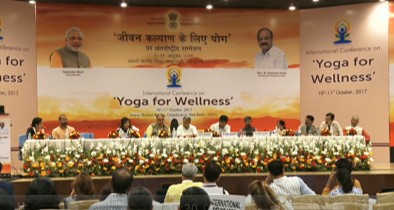
A personal testimony on faith-based yoga healing and a panel discussion on integrating traditional medical systems.
"I refused chemotherapy, radiotherapy, and surgery... I believed those fresh, positive thoughts in my consciousness would bleed down into my nervous system and start to talk to my cells."
"Yoga is not about the āsana. Why not? It is about God. If you allow God's energy to run into your system... God will provide the miracles."
Neil Patel shares his personal journey of using yoga and conscious thought to survive cancer for 18 years after refusing conventional treatment. Following his testimony, a moderated panel featuring practitioners of Homeopathy, Ayurveda, Siddha, and Yoga discusses pathways to integrate these AYUSH systems with modern medicine for holistic wellness. Key themes include treating the whole person, cost-effective care, managing non-communicable diseases, and yoga's role in raising consciousness beyond mere physical health.
Filming location: Delhi, India
Be the tool
15:10 - 15:54 (44 min)
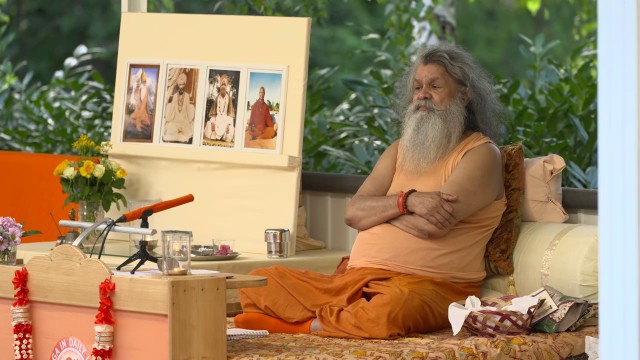
An evening satsang on humility, grace, and being an instrument for divine will.
"Only what is important for us is to understand and to pray to be the tool."
"Always be aware and pray. Please, God, give me opportunity. Give me a chance to be your tool."
Following opening prayers and chants to the guru's sandals, a speaker addresses the gathered and online audience. He shares a parable about a dog who mistakenly believes it is pulling a chariot, and the story of Hanuman receiving a lesson from a sage about the endless cycle of divine service. The core teaching emphasizes surrendering the ego, becoming a selfless instrument for grace, and performing service without seeking recognition, contrasting this with spiritual showmanship.
Filming location: Strilky, Czech Republic
Vegetarian cooking lesson 11, Kadhi soup, Okra and chapatis
16:00 - 16:14 (14 min)

A cooking demonstration on preparing Marwa-style gāṭṭā kadhi, chapati, and regional vegetables.
"When I was thinking about how to explain or show the gāṭṭā... it came to my mind that it is like the attachment of this world. When we touch the besan dough, it sticks very quickly. Then we use the oil of wisdom, which gets rid of the attachment."
"The Marwa kitchen has very, very delicious food—spicy, tasty, healthy, and very natural. The people living there eat only regional food. They know the leaves and fruits growing in their area."
The speaker guides viewers through making kadhi with chickpea flour dumplings (gāṭṭā), using the sticky dough as a metaphor for worldly attachment. The process includes preparing the dough with yogurt and spices, boiling and testing the gāṭṭā, and making chapati. The talk highlights regional Marwa cuisine, mentioning local ingredients like guṇḍā and the health benefits of bitter gourd, which is promised for a future lesson.
Filming location: Vép, Hungary
Make a path through the forest
16:20 - 17:11 (51 min)
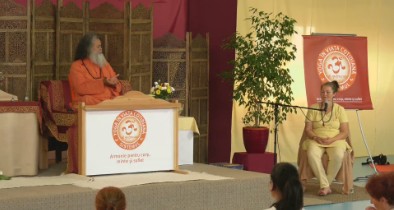
Evening satsang with Vishwaguruji from weekend Yoga Seminar in Nadlac, Romania. Prana is stronger than the physical body. There are always problems in daily life. Partners are together for a period of time then conflicts arise - that is similar to spiritual life. We need a clear path, a sattvic (pure) life, and have to make this path through the forest. Just reading does not help us. We should change ourself inside, otherwise, time is lost. The realisation of Atma Gyana (Self-knowledge) takes more time.
Shiva changed poison into nectar
17:15 - 18:07 (52 min)
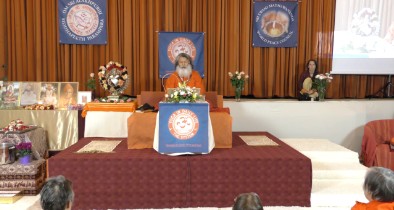
Evening satsang with Vishwaguruji from Vep, Hungary.
In the service of Life
18:15 - 18:59 (44 min)
India, Summer 2005. Report about the Swamijis activities.
The first wealth is health
19:05 - 19:54 (49 min)
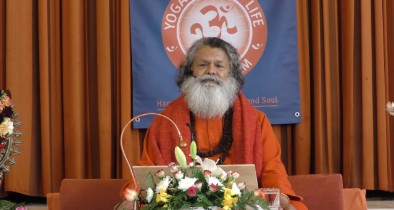
Morning satsang with Vishwaguruji from Vep, Hungary. This lecture explains what is important to our life.The first happiness is a healthy body. Money is also important up to a certain extent, to buy the things that are really needed. Mutual understanding in the household is a great fortune as well.
The Presence of the Guru
20:00 - 20:43 (43 min)
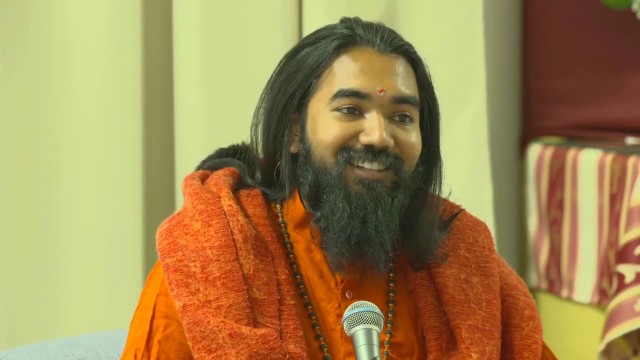
A satsang on devotion, surrender, and relating to the spiritual teacher.
"Gurudev is in the same space, same region, I would say, but we all should know that Gurudev is watching. It doesn’t matter where he is, he is always observing everything."
"If we have that mindset within us, that whatever we are doing, it’s him doing... then nothing is going to stop us in this world."
The lecturer addresses disciples in Slovenia, sharing insights from traveling with Gurudev, Sri Vishwaguru Mahamandaleshwar Paramahamsa Maheshwaranand Puri. He discusses the Guru's omnipresence, the importance of selfless service (seva), and cultivating trust over logic. He advises on etiquette in the Guru's presence, tells a parable about faith, and leads a guided meditation (manasik puja) to feel the Guru's inner presence.
Filming location: Slovenia
Longing for the God
20:50 - 21:39 (49 min)
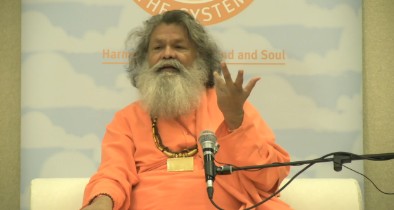
A spiritual discourse on the devotional path of bhakti, centered on the life and poetry of Meera Bai.
"In every temple, there is you; you are sitting, your statue is there... but still I can't see your face."
"O my Bhagavān, O Dātā means giver, I don't ask for anything, only one thing, please give me devotion."
The speaker reflects on the intense devotion of the saint Meera Bai, using her poetry and life story to illustrate the soul's longing for union with the divine. Themes of spiritual love (viraha), the transformative power of selfless service (seva), and the ultimate goal of oneness with Brahman are explored. The talk concludes with a call for universal spiritual education and compassion.
Filming location: London, UK
We should not have duality
21:45 - 21:56 (11 min)
A satsang discourse on the eternal guru lineage and the nature of divinity.
"Other religions are also very good, but they have no God. Not living God."
"So there is one coming once, and there is another one which is forever coming."
The lecturer addresses devotees, reflecting on recent travel and attendance. He explains the concept of a living God through the eternal spiritual lineage (paramparā), contrasting it with his view of other faiths. Using the analogy of universal parents and unique biological mothers, he describes the relationship between the singular divine and the plurality of saints and gurus who manifest it continuously.
Filming location: Strilky, Czech Republic
Yoga in Daily Life: The Fifth Level
22:00 - 22:38 (38 min)
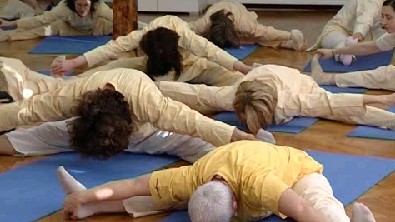
A fifth-level "Yoga in Daily Life" class focused on asana practice and breath awareness.
"Everything we practice in yoga has its purpose, and if we ask ourselves why, we must receive an answer. That is why we say that yoga is the science of the body, mind, spirit, and soul."
"Āsanas do not act only on the body. They are also a correction of our behavior; they act on our consciousness; they affect our entire being."
An instructor guides students through a detailed session, beginning with relaxation in Ānandāsana and emphasizing the purpose behind each alignment detail for reducing stress. The class progresses through a series of asanas including Pavanamuktāsana, Marjari Āsana, Paścimottānāsana, Upaviṣṭha Koṇāsana, Jānu Śīrṣāsana, and Mṛgāsana, with continuous focus on diaphragmatic breathing, mindful movement without strain, and the physical and subtle effects of each posture.
Filming location: Zagreb, Croatia
Evening satsang from Om Ashram (1/2)
22:45 - 23:24 (39 min)
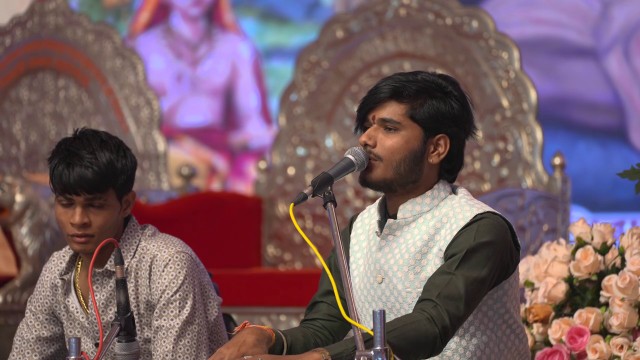
Evening satsang from main tent at Om Ashram, Rajasthan, India. Bhajan singing.
Maya can destroy everything
23:30 - 0:12 (42 min)
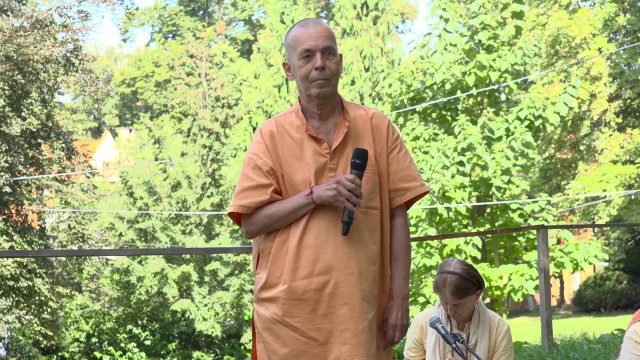
A spiritual discourse warning against greed and emphasizing correct devotional practice.
"Kāma, krodha, mada, lobha, ahaṅkāra. These are all important factors in the downfall of any spiritual seeker."
"For us, our Māyā should be Gurudev. We should run behind him. We should remember Him all the time."
A swami leads a satsang, using parables and a personal anecdote to illustrate the destructive power of greed (lobha). He stresses constant devotion to the Guru over material illusion. The talk concludes with detailed instructions for performing mantra japa correctly, including how to hold a mala and the significance of different rudrākṣa beads, while ultimately pointing to pure devotion as the supreme principle.
Filming location: Strilky, Czech Republic
American
Australian