
European
Going to Brahmaloka
0:50 - 1:49 (59 min)
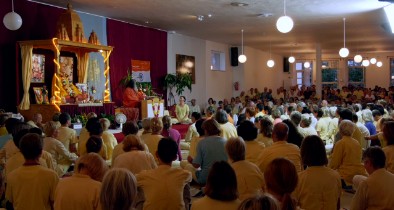
An introductory talk on yoga philosophy and practice at an ashram.
"Even if you are an advanced practitioner, you should do the beginner exercises at least once a week, or you must practice them before performing advanced postures."
"Tons of theory is nothing; a gram of practice."
The lecturer addresses attendees, clarifying misconceptions about terms like Aṣṭāṅga and Haṭha Yoga while emphasizing the foundational importance of basic practices in the "Yoga in Daily Life" system. He discusses the challenges of Vairāgya (detachment) and Jñāna Yoga, using anecdotes and humor to illustrate the gap between theory and practice, and outlines the week's upcoming program of Kriyā Yoga, meditation, and fasting.
Filming location: Strilky, Czech Republic
Om Ashram
1:50 - 1:59 (9 min)
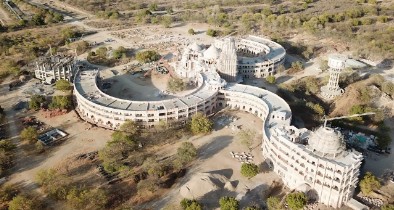
A promotional video about the Omkara Mahavira, a large-scale world peace monument and humanitarian complex under construction in Rajasthan.
"Since 1993, this structure has been under construction for the welfare of humanity, the protection of animals and nature, for teaching yoga, meditation, and philosophy."
"To bring this vision to full fruition, it needs everybody’s contribution. You are not a drop in the ocean. You are the entire ocean in a single drop."
The video details the vision of yogi Paramahamsa Swami Maheshvarananda to build the world's largest Om symbol, which will contain 108 residential compartments. It highlights the existing, operational facets of the site including a free school and college, a hospital, and a large artificial lake for water conservation. The narrative connects this to the global activities of the "Yoga in Daily Life" system, such as tree planting and animal shelters, framing the entire project as a holistic effort for peace, health, and environmental revival. It concludes with a call for donations to complete the monument.
Filming locations: Jhadan, Rajasthan, India.
Around the world -- 2011 Satsang tour of Mahamandaleshwar Swami Jasraj Puri Ji in Hungary
2:00 - 2:07 (7 min)
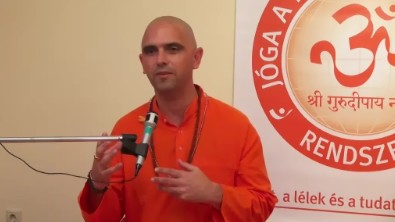
Around the world - 2011 Satsang tour of Mahamandaleshwar Swami Jasraj Puri Ji in Hungary.
Around the world - Bhajans from India
2:15 - 2:31 (16 min)
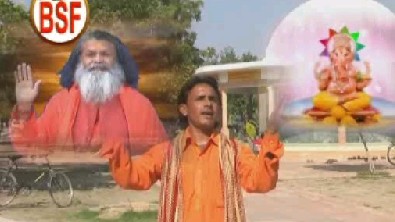
Bhajans and pictures from India
Consciousness and Space
2:35 - 3:07 (32 min)
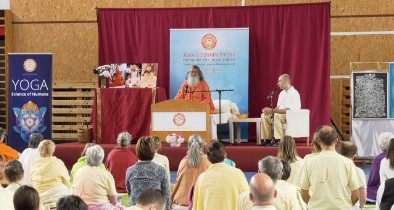
A spiritual discourse on the non-dual nature of consciousness, using the metaphor of water.
"In reality, space does not expand. Because it has no limitation, nothing that can expand and contract. Similarly, that consciousness."
"Eko'ham, dvitīyo nāsti. I am one. Rest is the duality."
The speaker explores the oneness of Ātmā and Paramātmā, arguing that true consciousness and space are limitless and indivisible. Using analogies of a mālā's thread and the water cycle—from ocean to vapor to rain and back—they illustrate how individual souls (jīvā) appear separate but are fundamentally one. The talk references bhajans by Mahāprabhujī's disciples and concludes with reflections on destiny, karma, and the spiritual path of Kriyā.
Filming location: Prague, Czech Republic
Protect Yourself, Keep Discipline
3:15 - 3:51 (36 min)
Morning Satsang with Vishwaguruji from Strilky Ashram, Czech Republic. Try to eat organic food, as far as possible. The main problem in the world is pollution. It is very hard to protect ourselves. Human life is an opportunity, it is not certain that you will get it again.
Vishuddi Chakra and thyroid gland
3:55 - 4:13 (18 min)
A spiritual discourse on the viśuddhi chakra and the symbolism of swallowed poison.
"Wish means poison. Wish means poison."
"Śiva did not swallow it down; he held this poison in his throat here, and he digested it there... Similarly, we say this: in our throat, there is a poison."
The teacher narrates the myth of Śiva drinking the ocean's poison to become Nīlakaṇṭha, using it as a metaphor for the emotional poison swallowed in daily life, such as unexpressed anger or harsh words. This is linked to the viśuddhi (throat) chakra, its purification, and its symbols—the elephant of strength and Brahmā with the Vedas. The talk connects this to broader concepts of the chakra system, kuṇḍalinī, and the necessity of consistent practice over contradictory advice.
Filming location: Vancouver, Canada
The blessed day of Gurupurnima
4:15 - 4:55 (40 min)
A satsang discourse on the significance of Guru Pūrṇimā.
"Gu means darkness, and ru means light. When the darkness disappears, the light appears."
"Gurudev is the jewel of the Parāś, and the disciple is the iron. When the disciple comes to the Gurudev, he changes from iron into gold."
A speaker explains the cosmic and spiritual importance of Guru Pūrṇimā, describing the Guru as the highest principle and the day as the start of the spiritual year. He discusses the Guru's role in transforming the disciple, shares devotional poetry and bhajans about longing for the master, and uses the analogy of a farmer's harvest to describe how devotees should present their spiritual progress. The talk concludes with blessings for the congregation's spiritual practice.
Filming location: Vép, Hungary
Sri Alakhpuriji and the Himalayas
5:00 - 5:28 (28 min)
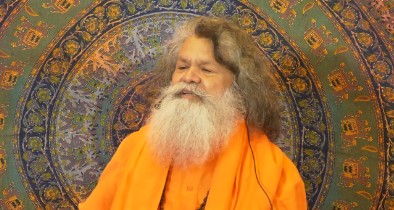
A spiritual discourse on the sacredness of the Earth and the Himalayas.
"Our Earth is a living planet, a Living Earth. If God incarnates, if God comes on this earth, God performs His miraculous things here."
"That place is indescribable... Between these beautiful, mighty mountains is a beautiful valley where Ālakpurījī is always residing."
Swami Maheshvarananda delivers a talk, venerating the Earth as a living, holy creation and detailing the profound spirituality of the Himalayas. He describes the region as the abode of divine incarnations like Śiva and great Siddhas such as Ālakpurījī, sharing anecdotes from pilgrimages and emphasizing the need for inner purity to experience this divine reality. The discourse concludes with a blessing for the journey.
Filming location: Vép, Hungary
Practical guide to meditation (2/11)
5:30 - 6:37 (67 min)
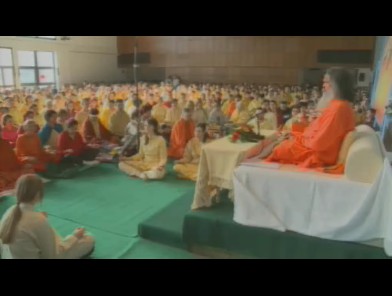
Morning satsang from weekend seminar in Vep, Hungary on 14th of February 2009.
Shiva and the Chakras
6:45 - 8:10 (85 min)
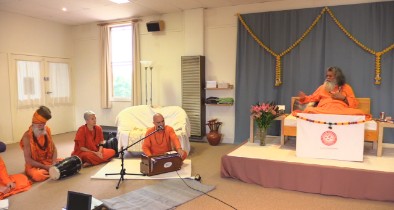
Evening satsang with Vishwaguruji from Melbourne, Australia. One of the best ways to memorize something is to create a little story about it. This is similar with songs. Vishwaguruji explains the meaning of the ancient story about the nectar of immortality rising from the churning of the ocean. The first lower chakras in the feet are the so-called earth chakras; chakras further up in the legs are connected with vegetation; and then continur up to the animal qualities.
The nature of the Guru
8:15 - 8:55 (40 min)
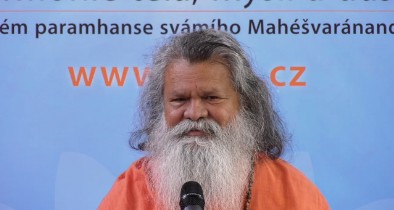
A spiritual discourse on the oneness of the soul and the path to supreme consciousness.
"Our ātmā, your ātmā, every ātmā is one ātmā."
"Step by step, our ātmā, our soul, will merge into the eternal. This is Gurudev's Vākya."
He describes the spiritual journey through the five layers of the body (kośas) toward higher states like Mahātmā and Paramātmā, emphasizing that this one soul exists in every being and element. The talk includes practical advice on meditation (dhun), avoiding negative speech, and humorous observations on language misunderstandings.
Filming location: Prague, Czech Republic
Atma is in every creature
9:00 - 10:02 (62 min)
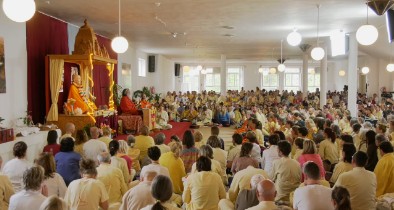
A satsang discourse on spiritual lineage, the nature of the self, and practical wisdom.
"Śrī Guru Ātmā Parāptamā Ho Mātma Puruṣottama, Sakal Jag ke Antaryāmī, Cara Car kī Ātmā Prabhu... in this one line, everything is covered."
"To which doctor will you go? To the doctor in the picture, or to a real, alive doctor?"
Swami Vishwaguruji addresses the gathering, weaving teachings on the essence of the Guru and the universal Ātmā (soul) from the paramparā (lineage) with humorous, practical advice on topics from kingship and knowledge to hair and modern fashion. A disciple then reflects on the profound value of having a living Guru to transmit these teachings.
Filming location: Strilky, Czech Republic
The soul and sound
10:10 - 11:43 (93 min)
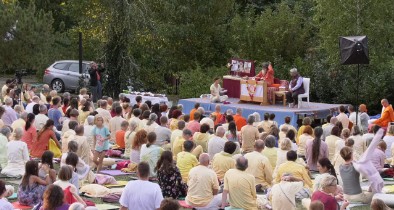
Evening satsang from Strilky Ashram, Czech Republic. Sri Gulabji spoke about the formation of the soul according to the ancient Vedic scriptures. The soul is covered by the five koshas, or bodies. At the beginning of the universe, there was only one matter called Brahma. When Shakti awakened, it created the bindu, with the centre and its surroundings. Communication can take place without sound, for example when the child is in the mother's womb. Vishwaguruji explains how to study and understand the scriptures.
Respect the family traditions
11:50 - 13:24 (94 min)
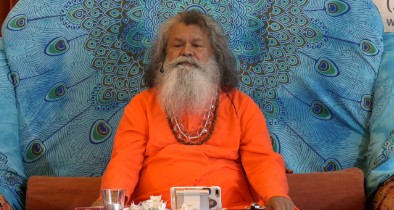
An evening satsang on the oneness of life, contrasting human existence with the natural world.
"Perhaps it is a prayer. They are giving out happiness."
"God gave them some knowledge, just nature, and they are following it."
The speaker observes the innate joy and wisdom in birds and ants, using them to reflect on human discontent and complexity. He explores themes of the singular life force (jīva) within all creatures, the spiritual concepts of ātmā and paramātmā, and the karmic responsibilities within family and marriage. The talk weaves between nature observations, spiritual philosophy, and social commentary, concluding with a bhajan.
Filming location: Vép, Hungary
Shiva and the Chakras
13:30 - 14:55 (85 min)
Evening satsang with Vishwaguruji from Melbourne, Australia. One of the best ways to memorize something is to create a little story about it. This is similar with songs. Vishwaguruji explains the meaning of the ancient story about the nectar of immortality rising from the churning of the ocean. The first lower chakras in the feet are the so-called earth chakras; chakras further up in the legs are connected with vegetation; and then continur up to the animal qualities.
Morning Yoga practice, Umag, Croatia (1/9)
15:00 - 16:37 (97 min)
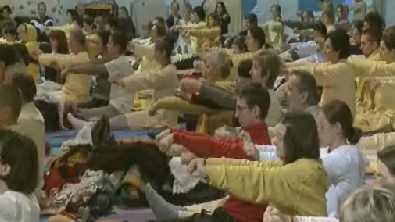
Morning Yoga practice from the international Yoga retreat Umag, Croatia on the 25th of September 2010
Why we do Anusthan
16:45 - 17:45 (60 min)
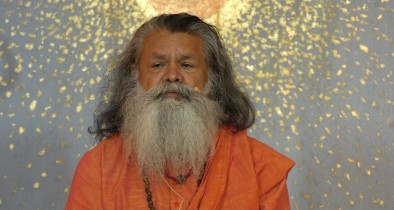
A discourse on the purpose and practice of Anuṣṭhāna, a spiritual observance.
"Anuṣṭhāna is when you make a saṅkalpa. Saṅkalpa means you promise yourself to undertake a practice for a certain purpose: for spiritual development, for good health, for success."
"We pray that all creatures should live in peace, harmony, and health. God protect all. This is our Anuṣṭhāna for this year."
A spiritual teacher explains the traditional practice of Anuṣṭhāna, a vowed observance for specific purposes like family harmony, health, or agricultural success. He contrasts its ideal use for unity and blessings with modern distortions, like praying for divorce. The talk expands to advocate for Anuṣṭhāna as a prayer for universal well-being, encompassing family, community, nature, and all living creatures, emphasizing harmony with the natural world and compassion for animals.
Filming location: Strilky, Czech Republic
The nature of the Guru
17:50 - 18:30 (40 min)
A spiritual discourse on the oneness of the soul and the path to supreme consciousness.
"Our ātmā, your ātmā, every ātmā is one ātmā."
"Step by step, our ātmā, our soul, will merge into the eternal. This is Gurudev's Vākya."
He describes the spiritual journey through the five layers of the body (kośas) toward higher states like Mahātmā and Paramātmā, emphasizing that this one soul exists in every being and element. The talk includes practical advice on meditation (dhun), avoiding negative speech, and humorous observations on language misunderstandings.
Filming location: Prague, Czech Republic
Sound can guide us
18:35 - 19:31 (56 min)
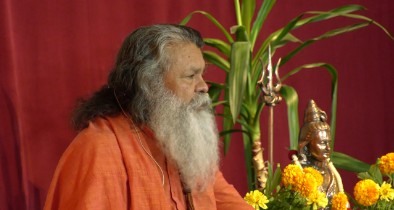
A spiritual discourse on Nāda Yoga, the path of sacred sound, using stories and analogies.
"Who does not understand, then it’s okay—it is some kind of noise. But who can understand? And nāda—only when your heart awakens."
"An instrument is holy. You should very gently, with respect and with love, take care. Any instrument of music is holy, gentle, pure, of quality, and it has sound."
The speaker explains the profound spiritual significance of sound (nāda) and musical resonance (rāga), contrasting it with mere noise. Through humorous anecdotes—like musicians misunderstood by villagers and a farmer terrified by a sitar—he emphasizes that true understanding requires a refined heart and dedicated practice. He discusses the sanctity of instruments, the necessity of daily practice and prayer to Goddess Saraswati, and how the inner sound leads to higher consciousness, connecting these principles to vocal practice and bodily awareness.
Filming location: Strilky, Czech Republic
Glimpse of Kundalini
19:35 - 20:29 (54 min)
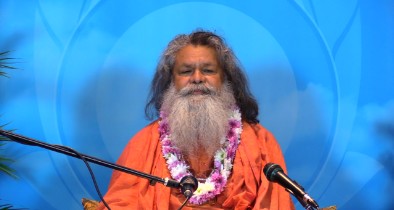
A spiritual discourse on the oneness of the soul and the science of kuṇḍalinī.
"In reality, it is only one soul. This is perhaps the first time you are hearing that every soul is not a different soul."
"Your soul, my soul, my consciousness, your consciousness, this is in the navel. And from here, it goes to the whole body, the whole creation."
The lecturer addresses an audience, explaining the non-dual nature of the soul using analogies like water from a single ocean. He details the human system of five bodies (kośas) and chakras, emphasizing purification through prāṇāyāma and meditation to move from individual consciousness toward cosmic unity. The talk includes practical advice on connecting with the earth and a preview of a video on kuṇḍalinī.
Filming location: Brisbane, Australia
Overview of practicing yoga
20:35 - 21:23 (48 min)
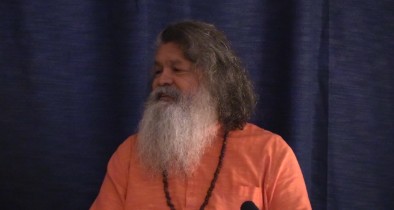
A lecture on the essence and practice of yoga in daily life.
"Yoga in Daily Life has eight steps and is very simple."
"Help is one of the best yogas... your soul, your life, your heart, and your body will bless you."
Swami Maheshwarananda (Swāmījī) delivers a talk on his global "Yoga in Daily Life" system. He clarifies the true meaning of Haṭha Yoga as the six purification techniques (ṣaṭkarma) and outlines the main paths: Karma Yoga (selfless service), Haṭha Yoga, Rāja Yoga, and Jñāna Yoga. He emphasizes daily practice, dedicating time for health and harmony, and explains specific techniques like Netī for sinus health.
Filming location: Auckland, New Zealand
Pranayama and Kundalini
21:30 - 22:42 (72 min)
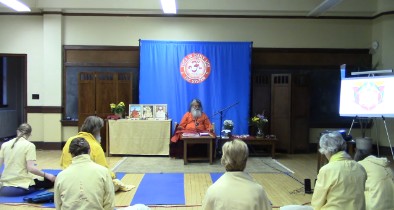
Evenining satsang with Vishwaguruji from Garrison, NY, USA. There are three nadis or nerves that are very important. Different levels of nadi sodhan pranayama should be practiced for about three months after each other. The Soul is in the prison of the elements, closed in the body. After becoming free it follows the destiny.
Science of development into the Supreme
22:50 - 23:46 (56 min)
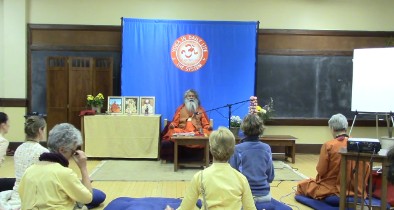
Evenining satsang with Vishwaguruji from Garrison, NY, USA. Firstly, we should understand our whole being. For that we need Masters, practice and realize ourselves: Who am I? The best meditation is to come within thyself. There are five bodies or layers accompanying the Soul. Knowledge has no end.
Going to Brahmaloka
23:50 - 0:49 (59 min)
An introductory talk on yoga philosophy and practice at an ashram.
"Even if you are an advanced practitioner, you should do the beginner exercises at least once a week, or you must practice them before performing advanced postures."
"Tons of theory is nothing; a gram of practice."
The lecturer addresses attendees, clarifying misconceptions about terms like Aṣṭāṅga and Haṭha Yoga while emphasizing the foundational importance of basic practices in the "Yoga in Daily Life" system. He discusses the challenges of Vairāgya (detachment) and Jñāna Yoga, using anecdotes and humor to illustrate the gap between theory and practice, and outlines the week's upcoming program of Kriyā Yoga, meditation, and fasting.
Filming location: Strilky, Czech Republic
American
Australian