
European
Chakras are the source of koshas
0:40 - 1:55 (75 min)
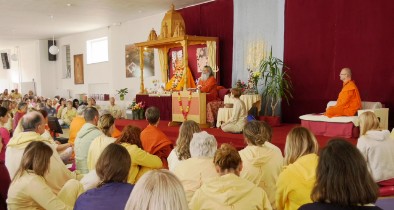
Morning satsang with Vishwaguruji from Strilky Ashram, Czech Republic. God has given us everything to awakening the kundalini. We should maintain these capabilities. Story of a man who made pots by clay. Whatever you do the karma comes back to you good or bad. Story of Gandhi and a child who ate too much sugar. Best samadhi is the fire samadhi. The hair and the nail are in the akasha. Yoga is a human science. Energy is more than the physical body. We need living prana. Prana is life and life is the soul. Do not eat junk food.
Around the world - Shivaratri at Jadan Ashram
2:00 - 2:07 (7 min)
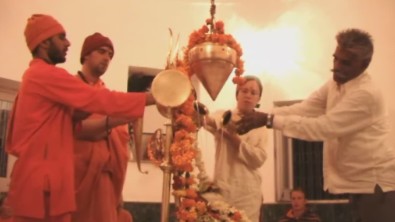
Around The World - Vegetarianism and top sport, Part 3
2:15 - 2:38 (23 min)
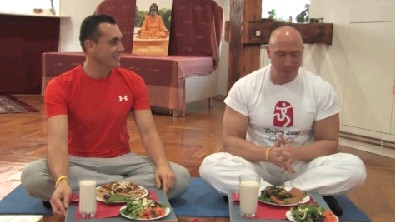
A cooking demonstration on preparing specialized vegetarian meals for athletes.
"Sports food should not be overly spiced or heavily fried, but it should not be tasteless either."
"This preparation, this shake... will be made of almonds, cashews, peanuts, sweetened with raisins, and we will have hazelnuts."
The instructor prepares two distinct meals: a vegetable and fava bean dish for bodybuilders, and a whole wheat pasta sauce for endurance athletes, explaining the rationale behind ingredient choices and cooking techniques for optimal digestion and nutrition. The session includes preparing a protein-rich milkshake sweetened with natural ingredients and concludes with a presentation of the finished plates and thanks to the kitchen team.
Filming location: Zagreb, Croatia
The first wealth is health
2:45 - 3:34 (49 min)
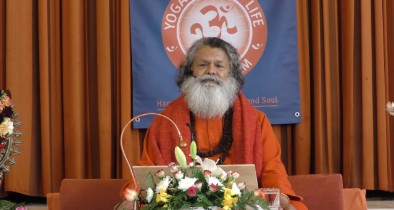
Morning satsang with Vishwaguruji from Vep, Hungary. This lecture explains what is important to our life.The first happiness is a healthy body. Money is also important up to a certain extent, to buy the things that are really needed. Mutual understanding in the household is a great fortune as well.
Relation of the Master and disciple
3:40 - 4:49 (69 min)
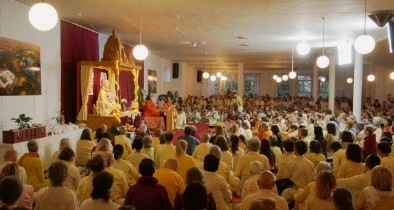
A discourse on the essence of worship and the guru principle.
"Ārādhya means that God or that Master whom we are worshipping."
"Guru Brahma, Guru Viṣṇu, Guru Devo Maheśvara, Guru Sākṣāt Parabrahma, therefore Guru is that Parabrahma."
The lecturer explains the meaning of "Ārādhya" as the personal deity or master one worships, emphasizing the underlying unity of all genuine spiritual paths. He elaborates on the Guru Tattva (guru principle) through the mantra "Guru Brahma, Guru Vishnu, Guru Devo Maheshvara," describing the guru as the source of knowledge (Brahma), protection (Vishnu), and liberation (Shiva). The talk includes parables, such as the story of a monkey destroying a bird's nest out of ego, to illustrate the importance of receiving knowledge with humility and the necessity of a living guru-disciple relationship within a true paramparā (lineage).
Filming location: Strilky, Czech Republic
Soul is One
4:30 - 5:42 (72 min)
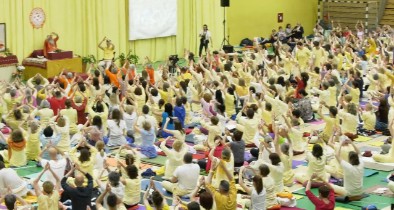
Evening satsang with Vishwaguruji from weekend Yoga Seminar in Novo Mesto, Slovenia. We are all like paras. We can create good qualities in others. When paras touch the iron it becomes gold. Guru is more than paras, Guru can transform the disciple into Guru. If not, either Gurudev is not right, either there is a distance between the Master and disciple. The physical body is called annamaya kosa, while the energy body is called pranamaya kosa. Water is water in each of the forms. Similarly, Soul is one.
Unity
4:55 - 5:41 (46 min)
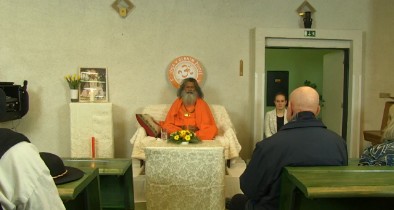
A public lecture on yoga and the purpose of human life.
"Yoga means union, oneness. Where there is duality, there is fighting. Where there is unity, there is peace, harmony, and God-consciousness."
"God gave us happiness for free... So why do we not search within us and become happy? And for that, there is yoga."
His Holiness Vishwaguruji Mahamandaleshwara Swami Maheshvarananda delivers a lecture after an 18-year absence, exploring the goal of human life as union with the formless, omnipresent God. He explains the holistic yoga path—from physical postures and breath control to concentration and the necessity of guided meditation—using parables and emphasizing that happiness and peace are already within. The talk concludes with a blessing for a happy and healthy life.
Filming location: Czech Republic
Release your bad qualities
5:45 - 6:37 (52 min)
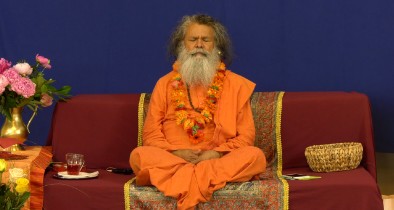
Morning satsang with Vishwaguruji from weekend Yoga seminar in Salzburg, Austria. Traditions are important and more or less similar in the whole world. The Austrian culture is very rich and beautiful. Many books of ancient Indian culture was destroyed by Moguls. We can digest everything except the truth. Tell honestly yourself your negative qualities. Remain natural as it is. Culture and education we should get from our parents. Short meditation how to turn negative to positive.
Peace Tree planting in Villach
6:45 - 7:02 (17 min)
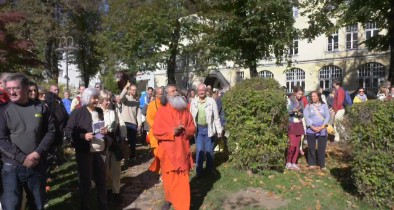
A spiritual ceremony for the planting of a "Peace Tree" in a park.
"You have chosen the tree well. It will be beautiful. It has a long life, right? About 350 years at least."
"This tree is peace. Second is nonviolence. Nonviolence, let's say ahiṁsā, please, nonviolence, and we need that very much."
A spiritual teacher, accompanied by a group, dedicates a newly planted tree as a "Peace Tree." After reading a German peace prayer attached to the tree, the leader chants mantras for peace (Oṁ Śānti) and universal well-being, and explains the tree's symbolism as a steadfast, parental presence representing peace and nonviolence. He blesses the tree, suggesting positive wishes made while circling it may be fulfilled, and declares it a spiritual center or "navel." The event concludes with a group photo and final blessings.
Filming location: Austria
The reflection of the Self
7:10 - 8:22 (72 min)
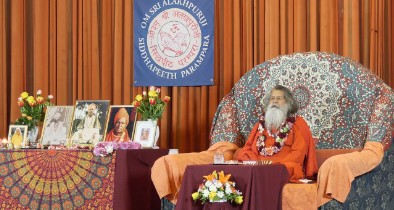
A spiritual discourse on self-realization and daily practice.
"Guru Kripa Hi Kevalam. The matter of knowing the Self can only be with the Guru's grace."
"One in all, and all in one. So I am the ātmā. This is very, very important."
The lecturer leads a satsang, emphasizing the need for personal spiritual effort (sādhanā) and alertness (chetan) to realize the eternal Self (Ātmā) beyond the temporary body and worldly sorrows. He uses analogies like the body as a disposable bag and the importance of mantra repetition, while cautioning against excessive attachment to the material world and the five temporary sheaths (kośas).
Filming location: Vép, Hungary
Purify your body from poison
8:30 - 9:44 (74 min)
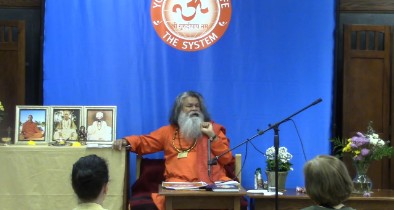
An evening discourse on the Kuṇḍalinī, chakras, and the nature of happiness.
"Happiness is within ourselves. Peace is within ourselves. And unhappiness is from outside."
"It is said that in life, when we walk... beside you is walking your death. You can see it is like the shadow, the shadow of your body."
The speaker explores the sources of happiness and suffering, using the parable of a couple's 50-year misunderstanding over a piece of bread to illustrate how unspoken grievances create internal poison. He connects this to the Viśuddhi (throat) chakra, explaining its role in purification and relating it to the myth of Śiva drinking the ocean's poison. The talk emphasizes communication, forgiveness, and daily practices like prāṇāyāma to cleanse negativity and prevent physical and emotional ailments.
Filming location: Garrison, NY, USA
The Essence of the Vedas and the Generosity of Nature
9:50 - 10:47 (57 min)
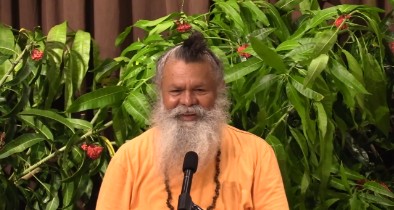
A closing satsang and farewell address at a yoga retreat in Fiji.
"If you give good things, comfort, pleasure, and help in every aspect to every creature... good will come back to you."
"Look at this tree, this coconut, the tiny grass on earth. You do not know the power it holds as an herb."
Swami Avatarpuri (Swāmījī) distills the essence of Vedic philosophy into the principle of karma, using the selfless generosity of nature—a lake (Sarvar), a tree (Tarvar), a saint, and the rain—as a teaching metaphor. He shares a story about a healing herb, advises students to deeply integrate their retreat experiences before teaching others, and leads a final blessing. A student then expresses gratitude on behalf of all attendees, thanking the Swami, the staff, and the Fijian community.
Filming location: Fiji Islands
Chakras and the Kundalini
10:55 - 11:54 (59 min)
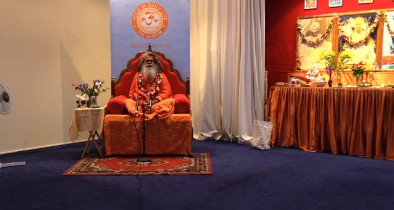
A spiritual discourse on the science of chakras and kuṇḍalinī.
"Yoga is the science of humans. Yoga is the first creation."
"Kuṇḍalinī and cakra science is a great... and we will come tomorrow."
Swami Ji addresses an evening gathering, introducing the profound subjects of chakras and kuṇḍalinī as part of the science of yoga. He explains these concepts through metaphors of resonance, the elements, and the oneness of the soul, while also discussing how emotional and psychological tensions manifest as physical ailments in specific energy centers. The talk promises a detailed exploration over the coming days.
Filming location: Wellington, New Zealand
The fruit of immortality
12:00 - 12:51 (51 min)
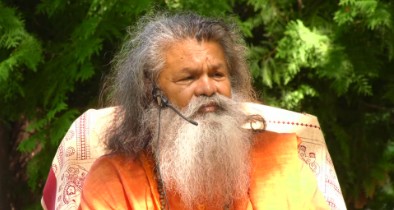
A spiritual discourse on the paradox of vairāgya (dispassion) and renunciation.
"You are the luckiest ones, for you have not yet attained Self-Realization. After Realization, life is completely different."
"Without satsaṅg (holy company), there is no vairāgya. You cannot attain vairāgya without satsaṅg."
Swami Madhavananda (Devpuriji) leads a satsang exploring the difficult nature of true dispassion. He explains that vairāgya is essential for a renunciate but warns it is fragile without the support of spiritual community. Using teachings from Shankaracharya and a detailed parable about a king, a magical fruit, and a chain of betrayals, he illustrates how worldly attachments prevent liberation and how profound disappointment can itself become a catalyst for renunciation. The talk also covers the significance of proper rituals for homes and temples.
Filming location: Vép, Hungary
Turn Kaliyuga into Satyayuga
12:55 - 13:57 (62 min)
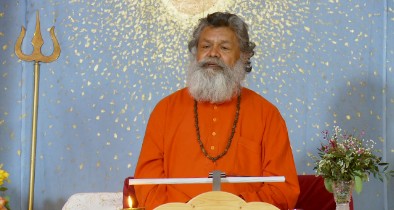
A spiritual discourse on dharma, yoga, and conscious living.
"Life is not a question of what we do, what we have, what we acquire, but a state of completion, a state of contentment."
"The presence of dharma on this earth has brought duality and fighting: anger, hate, jealousy."
The speaker delivers a wide-ranging talk, using parables and teachings to explore the nature of life as a play of duality and the path of dharma. He discusses the obstacles of ego and illusion, the universal principles of yoga for health and harmony, and the urgent need for ethical and spiritual education for children to foster environmental care, family unity, and peace. The talk concludes with an emphasis on yoga as a practical science for a harmonious life.
Bhakti Yoga
14:05 - 14:54 (49 min)
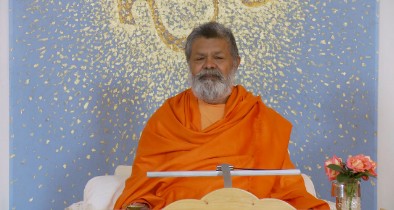
Evening Satsang with Sri Vishwaguru Mahamandaleshwar Paramhans Swami Maheshwarananda from Strilky Ashram, Czech Republic.
Practicing of the system 'Yoga in Daily Life', Level 1 - Part 6
15:00 - 16:05 (65 min)
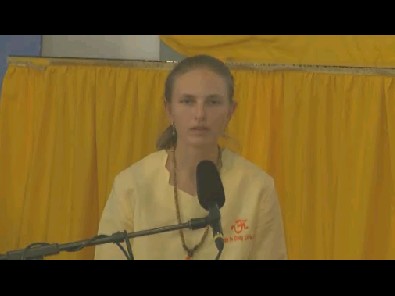
Practicing of the system "Yoga in Daily Life", Level 1 - Part 6, in Om Vishwa Deep Gurukul Swami Maheshwaranand Ashram, Jadan, Rajasthan, India on 24th of October 2009.
Women can bring peace
16:10 - 16:59 (49 min)
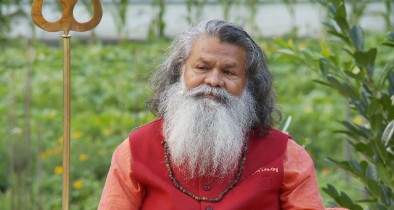
A satsang discourse on Guru Purnima, discussing yoga paths, spiritual discipline, and a teaching parable.
"Karma Yoga needs Bhakti Yoga. Karma Yoga needs Jñāna Yoga. And Karma Yoga also needs Rāja Yoga."
"Guru Vakya is very important. Sometimes you may not immediately realize its goodness, but later you may understand why you should have obeyed."
The lecturer leads the session, connecting the celebrations of Guru Purnima and Raksha Bandhan. He explains the interdependence of the four main yoga paths—Karma, Bhakti, Jñāna, and Rāja—emphasizing that each requires the support of the others through discipline, knowledge, and devotion. He shares a detailed parable about a disciple who ignores his master's instruction, illustrating the critical importance of following Guru Vakya (the master's word) for spiritual protection and progress.
Filming location: Strilky, Czech Republic
Candle meditation - Tratak
17:00 - 17:18 (18 min)
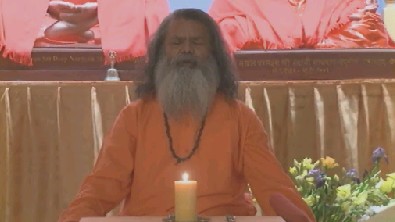
Candle meditation - Tratak. A very effective technique for stress release and improving the eye sight. Specially for the people spending a lot of time in the front of the computer. With explanation and practice. Recorded on 18th May 2010 in Vienna, Austria.
Keep the original message of Yoga
17:25 - 18:53 (88 min)
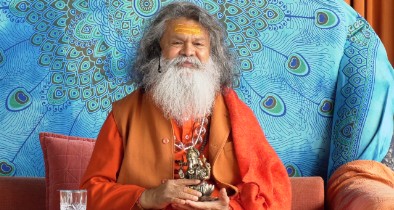
Morning satsang with Vishwaguruji from Vep, Hungary. We worship the Moon, the Sun and all of the creatures. One in All - the Jiva is everywhere. The speech of the Ambassador of India to Hungary Mr. Kumar Tuhin. It is important to keep the original message of the Yoga. It is Sanatana Dharma, India is the cradle of culture. If we are doing only physical asanas we are not going to be successful at all. Sanatana Dharma stands above the duality. Ayurveda and yoga are much elder than five thousand years.
Avoid manipulated products
19:00 - 20:18 (78 min)
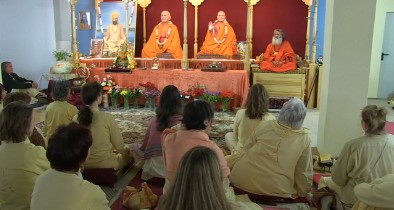
A satsang discourse on the roots of ill health and the supreme value of spiritual community.
"98% of us do not live healthily. So what shall we expect? Our body is suffering. Our mind is suffering."
"Lucky are those who can come to satsaṅg. And unlucky are those who cannot come. Satsaṅg is so pleasant."
The lecturer addresses the gathering, analyzing modern causes of disease from artificial food and polluted water to the manipulation of animals and crops. He stresses the need for disciplined control of the senses, particularly taste. The discourse culminates in a lengthy parable about the ṛṣis Viśvāmitra and Vasiṣṭha, illustrating through a divine test that the blessings of one minute in satsang are more powerful than 62,000 years of solitary tapasyā (austerities).
Filming location: Vienna, Austria
Our duty to have a devotion
19:30 - 20:46 (76 min)
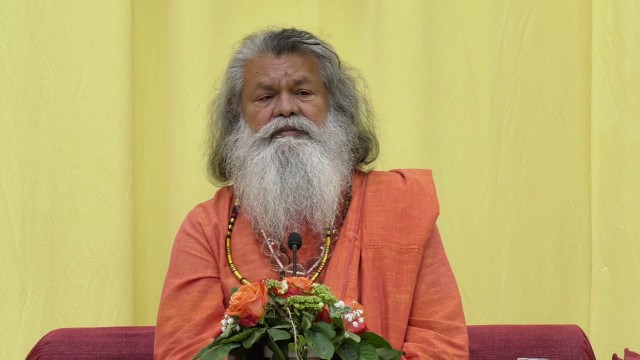
A spiritual discourse on lineage, devotion, and the nature of the soul.
"Our generation to generation to generation is of Alak Purījī. It is a tradition, and the tradition is not merely a tradition; it is, and it has to be, to receive the blessing of adoration."
"The reality is clear: spirituality needs to be in our heart. It does not matter what happens; I will not give up."
Swami Maheshwarananda (Swamiji) addresses a gathering, centering on the rediscovered lineage from Alak Purījī through Devpurījī and Mahāprabhujī to the present. He emphasizes unwavering devotion to the guru, illustrates the master-disciple relationship with anecdotes, and discusses the responsibilities and detachment required of a sannyāsī. The talk expands into teachings on the layers of existence (kośas), karma, and the soul's journey, using everyday metaphors for spiritual concepts.
Filming location: Slovenia
The reflection of the Self
20:25 - 21:37 (72 min)
A spiritual discourse on self-realization and daily practice.
"Guru Kripa Hi Kevalam. The matter of knowing the Self can only be with the Guru's grace."
"One in all, and all in one. So I am the ātmā. This is very, very important."
The lecturer leads a satsang, emphasizing the need for personal spiritual effort (sādhanā) and alertness (chetan) to realize the eternal Self (Ātmā) beyond the temporary body and worldly sorrows. He uses analogies like the body as a disposable bag and the importance of mantra repetition, while cautioning against excessive attachment to the material world and the five temporary sheaths (kośas).
Filming location: Vép, Hungary
Chakras and the Kundalini
21:45 - 22:44 (59 min)
A spiritual discourse on the science of chakras and kuṇḍalinī.
"Yoga is the science of humans. Yoga is the first creation."
"Kuṇḍalinī and cakra science is a great... and we will come tomorrow."
Swami Ji addresses an evening gathering, introducing the profound subjects of chakras and kuṇḍalinī as part of the science of yoga. He explains these concepts through metaphors of resonance, the elements, and the oneness of the soul, while also discussing how emotional and psychological tensions manifest as physical ailments in specific energy centers. The talk promises a detailed exploration over the coming days.
Filming location: Wellington, New Zealand
Turn Kaliyuga into Satyayuga
22:50 - 23:52 (62 min)
A spiritual discourse on dharma, yoga, and conscious living.
"Life is not a question of what we do, what we have, what we acquire, but a state of completion, a state of contentment."
"The presence of dharma on this earth has brought duality and fighting: anger, hate, jealousy."
The speaker delivers a wide-ranging talk, using parables and teachings to explore the nature of life as a play of duality and the path of dharma. He discusses the obstacles of ego and illusion, the universal principles of yoga for health and harmony, and the urgent need for ethical and spiritual education for children to foster environmental care, family unity, and peace. The talk concludes with an emphasis on yoga as a practical science for a harmonious life.
American
Australian