
European
Gurudev sees our past and future
0:00 - 1:16 (76 min)
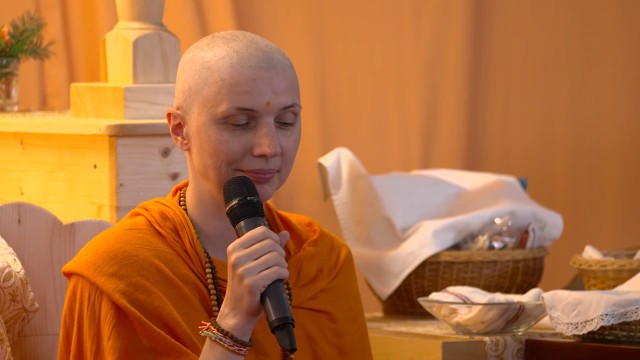
A satsang discourse on the guru's grace, destiny, and the power of surrender.
"Even the guru can change destiny, because there is no higher law than the guru’s law."
"Since the day I told Swāmījī, 'I surrender, do what you want,' I am in peace."
A speaker, likely a senior disciple, addresses the gathering following morning prayers. He discusses the validity of Vedic sciences like astrology (Jyotish) but emphasizes the supreme power of the guru's grace to alter destiny, illustrating this with a traditional parable about a guru changing the fate of two royal children. He shares personal anecdotes of learning to obey the guru's guidance, concluding that true peace comes from complete surrender to the guru's will, allowing him to manage one's life and mitigate karma.
Filming location: Strilky, Czech Republic
Develop your wisdom, do not steal
1:20 - 2:08 (48 min)
A spiritual discourse addressing imitation, authentic wisdom, and the importance of satsaṅg.
"Imitation is stealing. It is not truth, but imitation."
"If the butter has been eaten by all these other writers... they ate only the butter; they did not eat the cow. So, milk the cow."
The lecturer speaks on the prevalence of imitation in the material and spiritual worlds, using examples from currency counterfeiting to plagiarized scriptures. He recounts a parable where a disciple laments that all wisdom has been taken by past saints, and Gurujī's response is to use the intellect (the cow) with devotion to produce fresh wisdom. The talk emphasizes generating original spiritual insight, warns against bad company (ku-saṅga), and concludes with an explanation of a bhajan by Mahāprabhujī about losing one's way by leaving the Guru's shelter.
Filming location: Strilky, Czech Republic
Webcast from Auckland
2:15 - 2:58 (43 min)
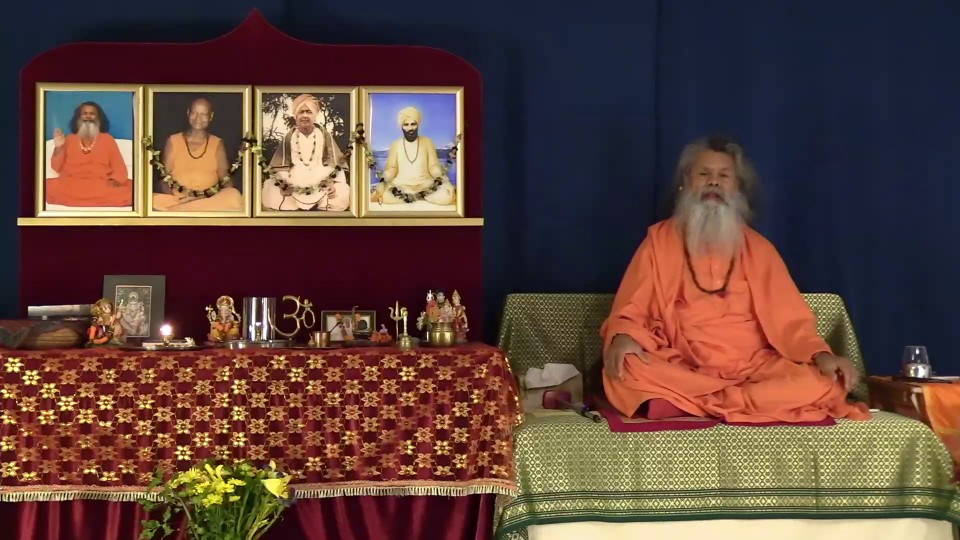
Evening satsang with Vishwaguruji from Auckland, New Zealand.
Mansik Puja, Vienna
3:05 - 3:53 (48 min)
A discourse on the practice and philosophy of Mānasik Pūjā, or mental worship.
"Many people ask questions: how to meditate, what to imagine... So, the best solution is Mānasik Pūjā. When you perform the mental ceremony, you come out of your meditation full of strength, energy, love, and clarity."
"Imagine that you are in the seva of your iṣṭadevatā... For this much time mentally, you are together. You are with it, and then you also get prasāda... This is a beautiful mānasik pūjā."
The lecturer addresses devotees from an ashram in Vienna, explaining the concept and technique of mental worship of one's chosen deity (Iṣṭadevatā). He describes it as a solution to the emptiness that can arise in other forms of meditation, detailing how to mentally perform services like bathing, dressing, and offering food to the divine form. He shares a personal anecdote of his Guruji's disciplined practice and emphasizes that this internal seva cultivates love, dispels negative emotions, and reflects the divine light present in every heart.
Filming location: Vienna, Austria
Around the world -- 2011 Satsang tour of Mahamandaleshwar Swami Jasraj Puri Ji in Hungary
4:00 - 4:07 (7 min)
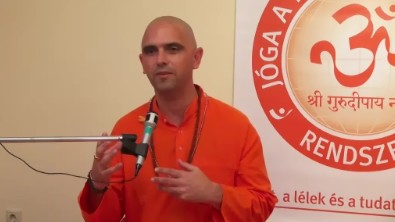
Around the world - 2011 Satsang tour of Mahamandaleshwar Swami Jasraj Puri Ji in Hungary.
Around the world -- Yoga against diabetes from Czech Republic
4:15 - 4:22 (7 min)

An instructional yoga session focused on holistic health and managing modern lifestyle diseases.
"Yoga practices shape our attitude toward health and life. By cultivating physical and mental relaxation, balance, flexibility, and discipline, the practice guides us toward the yogic goals for daily life."
"Teachers... The main emphasis should be on the slowness, calmness, balance, and harmonization the practice brings."
An instructor guides viewers through a practical yoga sequence designed for holistic well-being, emphasizing its role in preventing diseases like diabetes by reducing stress. The narration explains the Yoga in Daily Life system's approach, combining physical postures, breathwork, and meditation to achieve balance on physical, mental, and emotional levels. The session includes specific exercises, like leg lifts and a forearm-supported pose, with cues for proper alignment and mindful observation.
Filming location: Czech Republic
Yoga in Daily Life Workshop in Villach on 13th of June
4:30 - 6:08 (98 min)
A closing discourse on integrating spiritual awareness into daily life, from sleep to nourishment.
"In deep sleep, you know nothing of being a millionaire or a beggar. In deep sleep, you know nothing of whether you are sick or healthy."
"Therefore, before going to sleep, one says to God: 'What I have done all day... I offer all the fruits of my actions. Lord, forgive me if there was anything not good.'"
Swami Avatarpuri concludes a seminar by guiding attendees through a sacred daily rhythm. He explains the unity experienced in deep sleep, followed by prayers upon waking and mindful practices with water, air, and earth. The talk emphasizes gratitude, the divinity in natural elements, and the importance of offering one's actions. He details a spiritual approach to nourishment, advocating for fresh, whole foods and traditional preparation, linking physical health to inner peace and meditation.
Filming location: Austria
In the bliss of bhajans
6:15 - 7:26 (71 min)
Bhajans from different ashrams in India
The essence is always the same
7:30 - 8:08 (38 min)
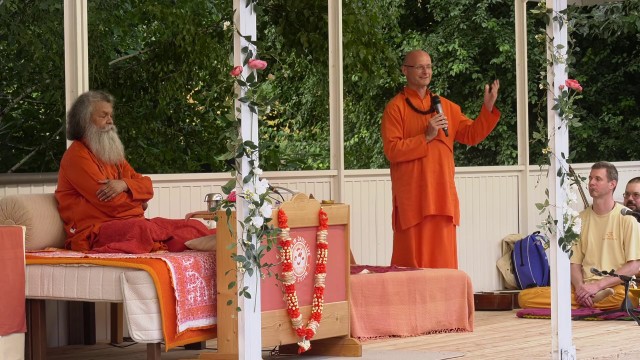
A satsang talk reflecting on spiritual transformation and the grace of the Guru.
"In yoga, it is very important to understand the concepts of Kāla and Deśa. This means that each era has its own appropriate way of behavior, and each place is different."
"What we learn from Viśva Gurujī is not only āsanas... but that we need to be flexible in our hearts and minds."
A speaker addresses the gathering after a Guru Purnima celebration, exploring how the essence of yoga remains constant while adapting across time and place. He shares stories illustrating the Guru's foresight, like predicting currency changes in Croatia, and emphasizes the transformative power of dedicated practice and being physically present in the ashram's energy. The talk uses metaphors like a spoon in honey to describe receptivity to grace and lighthouses for the role of ashrams.
Filming location: Strilky, Czech Republic
Guru's Darshan is the most precious
8:10 - 8:26 (16 min)
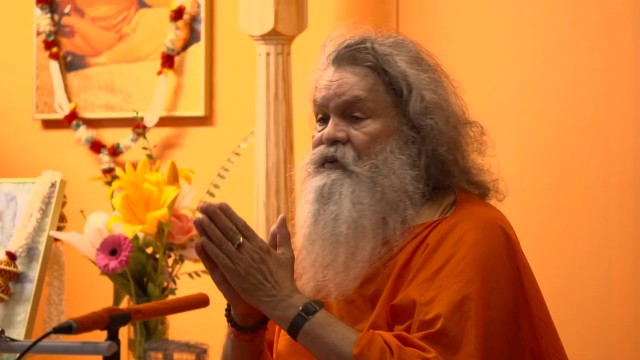
A spiritual discourse sharing a traditional parable about pilgrimage and divine grace.
"All day I am being bathed in by so many thousands and thousands of people. All of their sins come into me... When we come to our guru and we do seva... by the soil which touched his feet—when it touches us, we become pure."
"Gaṅgājī will give you much easier darśan. Whenever you are going on the way, always try to stay only at those houses where the householder has already had Gaṅgā snāna—a bath in the Gaṅgā."
A Swami addresses a satsang, recounting the story of two Brahmins on a pilgrimage to bathe in the Ganga. They follow strict advice on their journey, only to discover the river goddesses themselves—blackened by the sins of devotees—performing seva at a nearby ashram to be purified by their guru's foot-dust. The narrative illustrates that true purification comes from selfless service and guru's grace, not merely ritual.
Filming location: Strilky, Czech Republic
Bhajan singing from Jadan Ashram
8:30 - 9:05 (35 min)
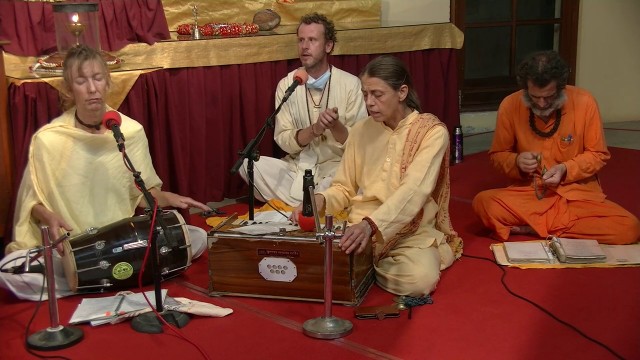
Evening Satsang with Vishwaguruji from Jadan Ashram, Rajasthan, India. Singing bhajans.
Bhajan Singing from Jadan
9:10 - 10:20 (70 min)
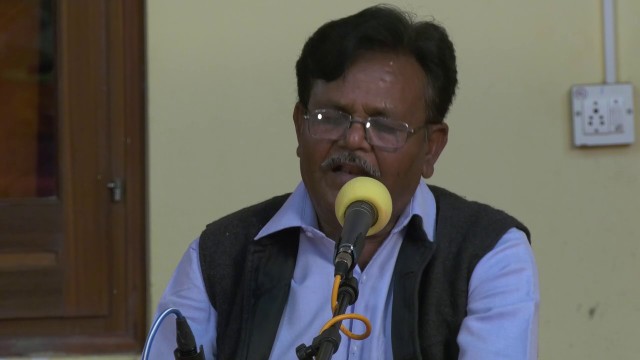
Evening satsang with Vishwaguruji from Jadan Ashram, Rajasthan, India.
Bhajans with Swami Gajanandji
10:25 - 11:04 (39 min)
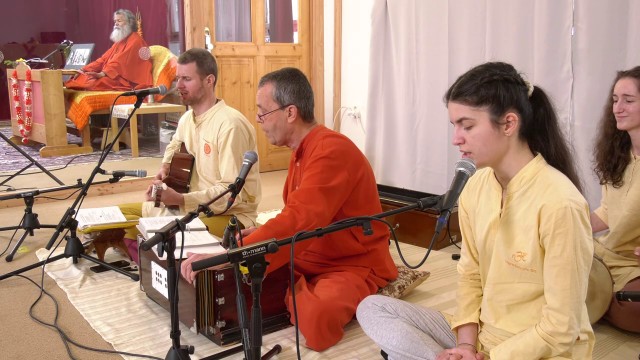
Morning satsang with Vishwaguruji from Strilky Ashram, Czech Republic.
Bhajans from Poprad
11:10 - 11:54 (44 min)
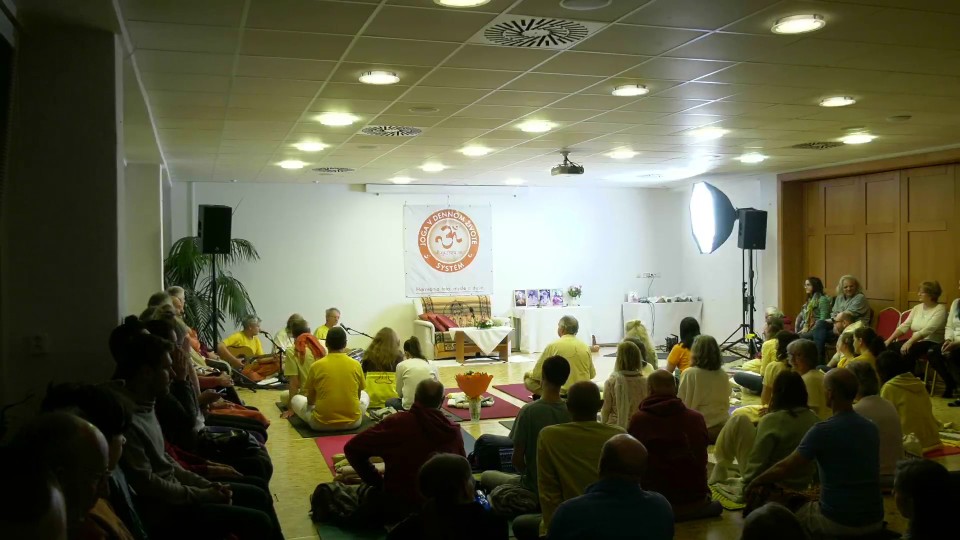
Bhajans from Tatra Hotel, Poprad, Slovakia.
The Nature of the Knower and the Self
12:00 - 12:35 (35 min)
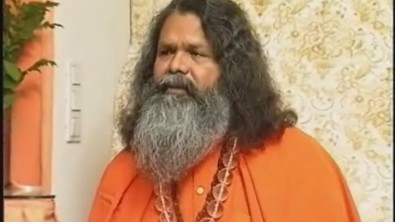
A discourse on Advaita Vedanta and the nature of the Self, based on Śaṅkarācārya's teachings.
"This body is full of vikāra. Some have a cough, some a cold, some have lung problems... But Ātman is not born; there is no change in your Ātman, and it will not die either."
"If you have no form, what can death do to you?... You are Avināśī. So if you are Avināśī, no one can destroy you, no one can take you away; then why are you afraid?"
The speaker expounds on the true nature of the Self (Ātman) as distinct from the body, explaining key Sanskrit terms: Nirvikāra (free from decay/impurity), Nirākāra (formless), Nirmala (pure), and Avināśī (immortal). He emphasizes that identifying with the eternal, formless Self, rather than the impermanent body, is the path to overcoming fear, disease, and sorrow. The talk integrates scriptural commentary, practical advice like breath awareness and Self-inquiry, and concludes with the realization of the Self as all-pervading (Vyāpaka) consciousness.
Filming location: Vienna, Austria
The Forms of the Divine
12:40 - 13:12 (32 min)
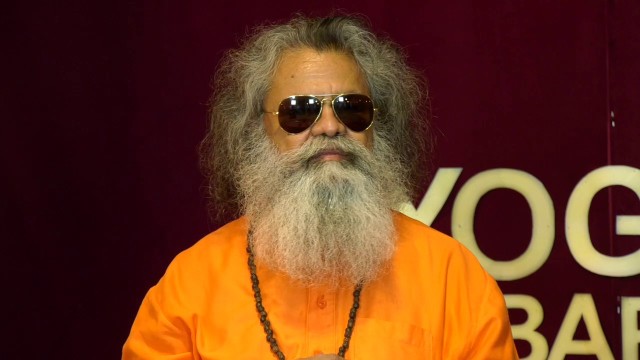
A spiritual discourse on the formless and manifest aspects of the divine.
"One is what we can call God, but we cannot see God; it is only God. That is called Nirākāra. Nirākāra means there is no form or posture."
"The second is Sākār. Sākār means with a form, like a statue or our body, so that we can worship God."
A spiritual teacher delivers a satsang on Guruji's birthday, explaining the concepts of Nirākāra (formless God) and Sākār (God with form). Using examples like Jesus, Krishna, and Buddha, he illustrates how divine incarnations suffer and are often misunderstood. The talk expands to cover creation stories, the cycles of the Yugas, and the importance of righteous living and sādhanā (spiritual practice) in the current Kali Yuga.
Filming location: Strilky, Czech Republic
The One in All and All in One
13:20 - 13:48 (28 min)
A spiritual discourse on universal consciousness, creation, and human purpose.
"Our great master used to say, 'One in all and all in one.'"
"Yoga is not physical postures... Yoga is the balancing principle... Where there is a balance, there is harmony."
The lecturer delivers a talk exploring the origins of the universe, consciousness, and the principle of yoga. He explains the Vedic concept of creation from sound (Aum) and the elemental evolution from space to earth. The discourse covers the oneness of all life, the unique potential of human intellect, and the importance of education in human values, tolerance, and understanding. He concludes by relating the cycle of rebirth to the modern concept of recycling.
Filming location: Brisbane, Australia
Mind and chakras
13:55 - 14:20 (25 min)
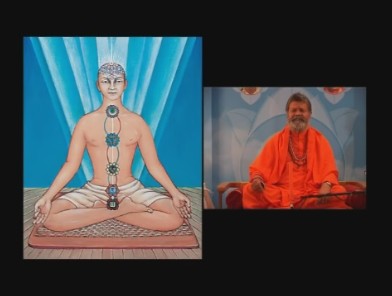
A lecture on the nature of the mind, subconscious impressions, and yogic philosophy.
"Our senses are mostly connected to and work with the consciousness, the awakened state."
"The mind is that principle which functions between the conscious and subconscious, pendling up and down."
The teacher provides a detailed explanation of how sensory impressions become stored desires in the subconscious, using the analogy of an unfulfilled ice cream craving manifesting in a dream. He describes the mind as a pendulum between conscious and subconscious levels, warning against blocking mental energy and instead advocating for directing it through self-discipline. The talk expands into the relationship between emotion, intellect, consciousness, and the nadis (Ida, Pingala, Sushumna), linking psychological concepts to the chakra system and the dormant energy of kundalini.
Filming location: Brisbane, Australia
Mental food
14:25 - 16:23 (118 min)
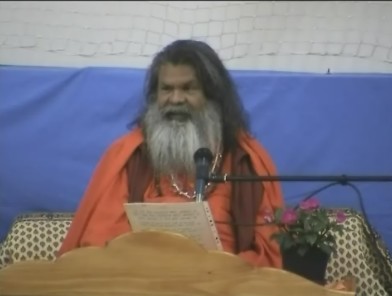
Swamiji in Sliac, April 2007
Mind and chakras
16:30 - 16:55 (25 min)
A lecture on the nature of the mind, subconscious impressions, and yogic philosophy.
"Our senses are mostly connected to and work with the consciousness, the awakened state."
"The mind is that principle which functions between the conscious and subconscious, pendling up and down."
The teacher provides a detailed explanation of how sensory impressions become stored desires in the subconscious, using the analogy of an unfulfilled ice cream craving manifesting in a dream. He describes the mind as a pendulum between conscious and subconscious levels, warning against blocking mental energy and instead advocating for directing it through self-discipline. The talk expands into the relationship between emotion, intellect, consciousness, and the nadis (Ida, Pingala, Sushumna), linking psychological concepts to the chakra system and the dormant energy of kundalini.
Filming location: Brisbane, Australia
Practising asanas from Rijeka
17:00 - 17:41 (41 min)
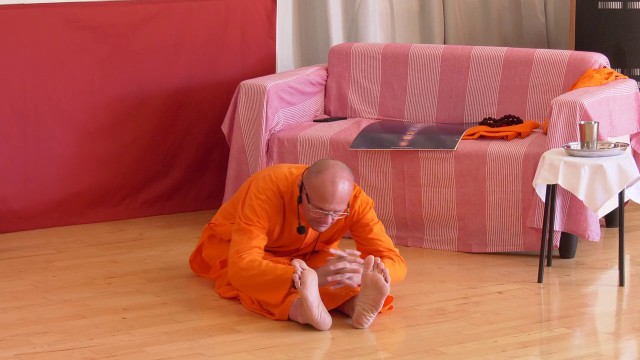
A guided yoga practice focusing on chakra awareness through specific postures and breath.
"Try to understand that the chakra and its location are like a reflection zone... It is the same with some āsanas; they influence and activate a point in our body connected to a cakra."
"If we are concentrated on one point, we will remain without movement. When our mind starts to go here and there, we lose concentration."
An instructor leads a session of āsanas (postures) and mudrās (seals) designed to bring awareness and sensation to the energy centers (chakras) from Mūlādhāra to Sahasrāra. The practice includes Maṇḍūkāsana for the root chakra, rolling movements for Maṇipūra and Viśuddhi, Ākarandanurāsana for Ājñā chakra focus, and Ekapāda Praṇāmāsana for concentration and Anāhata. The teaching connects physical sensation to energetic and mental states, referencing yoga texts and epic stories.
Filming location: Rijeka, Croatia
Mansik Puja, Vienna
17:45 - 18:33 (48 min)
A discourse on the practice and philosophy of Mānasik Pūjā, or mental worship.
"Many people ask questions: how to meditate, what to imagine... So, the best solution is Mānasik Pūjā. When you perform the mental ceremony, you come out of your meditation full of strength, energy, love, and clarity."
"Imagine that you are in the seva of your iṣṭadevatā... For this much time mentally, you are together. You are with it, and then you also get prasāda... This is a beautiful mānasik pūjā."
The lecturer addresses devotees from an ashram in Vienna, explaining the concept and technique of mental worship of one's chosen deity (Iṣṭadevatā). He describes it as a solution to the emptiness that can arise in other forms of meditation, detailing how to mentally perform services like bathing, dressing, and offering food to the divine form. He shares a personal anecdote of his Guruji's disciplined practice and emphasizes that this internal seva cultivates love, dispels negative emotions, and reflects the divine light present in every heart.
Filming location: Vienna, Austria
Yoga in Daily Life Workshop in Villach on 13th of June
18:40 - 20:18 (98 min)
A closing discourse on integrating spiritual awareness into daily life, from sleep to nourishment.
"In deep sleep, you know nothing of being a millionaire or a beggar. In deep sleep, you know nothing of whether you are sick or healthy."
"Therefore, before going to sleep, one says to God: 'What I have done all day... I offer all the fruits of my actions. Lord, forgive me if there was anything not good.'"
Swami Avatarpuri concludes a seminar by guiding attendees through a sacred daily rhythm. He explains the unity experienced in deep sleep, followed by prayers upon waking and mindful practices with water, air, and earth. The talk emphasizes gratitude, the divinity in natural elements, and the importance of offering one's actions. He details a spiritual approach to nourishment, advocating for fresh, whole foods and traditional preparation, linking physical health to inner peace and meditation.
Filming location: Austria
The Aim of Human Life, Melbourne
20:25 - 21:58 (93 min)
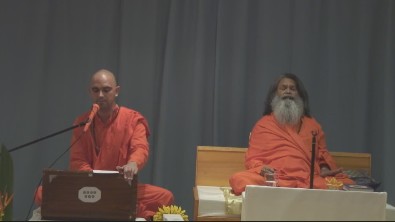
Swamiji introduces MM Swami Jasraj Puri and explaines in great detail what means Mahamandaleshwar and Akkhara. Ashram: A means welcome, Shram means work. Ashram means: Come to work here on your body, mind, consciousness and realisation. Space is the endless glory of God. We don't know where is the beginning or the end. We are limited. The endless space is like a mother, the cosmic consciousness. Between space and consciousness is Yoga shakti. Yoga is balancing, harmonising and uniting. God is manifested in the form of vibration, sound, resonance - OM - Everything comes from that and merges in that. Yogis are meditating on that. The aim of human life is to help, to serve, to support others and selfrealisation. The human life is a precious diamant but we will not get it again and again. Translation of the bhajan: Sadho bhai ab kyu karo the moro. Recorded in Melbourne, Australia.
Enjoy
22:05 - 23:12 (67 min)
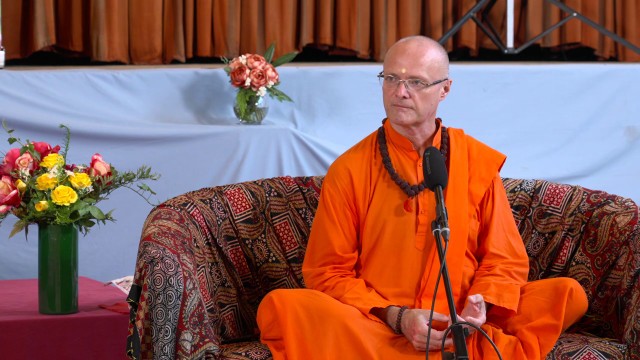
A closing satsang reflecting on the essence of spiritual practice during a summer seminar.
"You know what the best food is? First, when you are hungry, they say hunger is the best cook. Second, the best meal is when you don't have to cook or wash the dishes."
"If you have so many stones in your pocket, you will go down. See this symbolically. If you believe and think that some crystal will save your life and change your destiny, what are we doing? We are believing that that stone is much stronger than Mahāprabhujī."
The lecturer addresses the assembly, weaving personal anecdotes from his decades with Gurudev into teachings on discernment. He critiques an over-reliance on rituals, numbers, and external objects like crystals, emphasizing instead the supreme power of mantra, guru, and inner confidence. Key themes include navigating collective influences, distinguishing real practice from distraction, and cultivating the unwavering, urgent devotion exemplified in a story about Paramahaṁsa Rāmakṛṣṇa. The talk concludes with an emphasis on satsang as a vital support.
Filming location: Vép, Hungary
Gurudev sees our past and future
23:20 - 0:36 (76 min)
A satsang discourse on the guru's grace, destiny, and the power of surrender.
"Even the guru can change destiny, because there is no higher law than the guru’s law."
"Since the day I told Swāmījī, 'I surrender, do what you want,' I am in peace."
A speaker, likely a senior disciple, addresses the gathering following morning prayers. He discusses the validity of Vedic sciences like astrology (Jyotish) but emphasizes the supreme power of the guru's grace to alter destiny, illustrating this with a traditional parable about a guru changing the fate of two royal children. He shares personal anecdotes of learning to obey the guru's guidance, concluding that true peace comes from complete surrender to the guru's will, allowing him to manage one's life and mitigate karma.
Filming location: Strilky, Czech Republic
American
Australian