
European
How can we become a good yoga teacher?
0:20 - 1:40 (80 min)
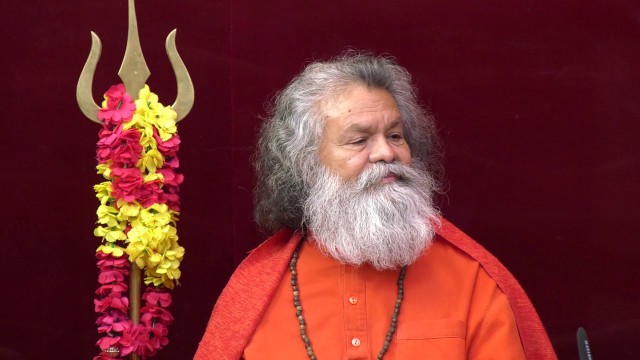
Evening satsang with Vishwaguruji from Strilky Ashram, Czech Republic. Practising Bari Khatu Pranam and Sarva hitta asanas led by Vidya. All Yoga in Daily Life yoga teachers has some years practising behind them. A person must learn many years to become a doctor. A person also must learn many years to become a good teacher. Lifelong we are learning and practising yoga. Yoga practise checks your body and mind. To become a real yoga teacher we need a Guru. Nowadays children are not under the control of the parents. There are yoga teachers who have no proper knowledge of yoga. We can get energy from all of our koshas. The story about a king and a man who became a friend of a wild horse. People who know about Jyotish tell that Shiva will come
Awakening of the peace and compassion within us
1:45 - 2:30 (45 min)
A satsang on awakening compassion and peace, led by Paramahamsa Swamiji Maheshwarananda.
"Within you is the bliss of the ocean. Within you is the fountain of joy. Kill this little 'I' and lead a divine life."
"Fear is a seed, fear is a root, fear is the cause, fear is the origin of all our negative qualities."
Swamiji delivers a discourse on the divine qualities within, focusing on overcoming fear as the root of anger, attachment, and suffering. He explains how fear leads to negative cycles, contrasting them with the peace found in spiritual knowledge and selfless living. The talk includes Vedic peace prayers, reflections on karma, and a parable about sacrifice, concluding with a call to awaken compassion.
Filming location: Auckland, New Zealand
God is the father of all creatures
2:35 - 3:41 (66 min)
An evening satsang on spiritual practice, mantra, and devotion.
"Spirituality is a very rich food, which is not easy to digest. Junk food you can digest easily, but it is not healthy."
"Getting a mantra from the master is not only, 'Oh, I have a mantra, and I will eat my mokṣa.' You have to put it in the field—the field of the heart."
The speaker leads a satsang, using a parable about two men receiving a seed to illustrate the need to actively cultivate a mantra with devotion. He discusses the nature of God, the importance of purifying the heart, and the role of the Guru. The talk includes a recitation of a poet's praise for Mahaprabhuji and addresses questions from attendees on topics like managing family illness, expectations, and generational tragedy.
Forgiveness, Kindness and Mercy
3:45 - 4:55 (70 min)
A satsang discourse on mercy as the root of dharma and the awakening of inner spiritual talents.
"Dayā dharam kā mūla hai, pāpa mūla abhimāna. Tulsī dayā na chhoḍīye, jab laga ghaṭame prāṇa." ("The root of dharma is mercy, the root of sin is ego. Tulsī, never abandon mercy as long as there is life in your body.")
"The best talent which can make us happy and free without fear—is to be merciful."
The lecturer leads a morning satsang, exploring the central teaching from Tulsīdās that mercy (dayā) is the foundation of righteousness. He explains how ego is the root of sin and illustrates mercy through stories, including one of a thief in the ashram being allowed to steal. The talk covers related inner talents like forgiveness (kṣamā) and compassion (karuṇā), warns against negative talents like anger, and emphasizes practice (abhyāsa) and awakening awareness through Guru's grace, concluding with an explanation of a devotional bhajan.
Filming location: USA
Practicing of the system 'Yoga in Daily Life', Level 1 - Part 2
5:00 - 6:04 (64 min)
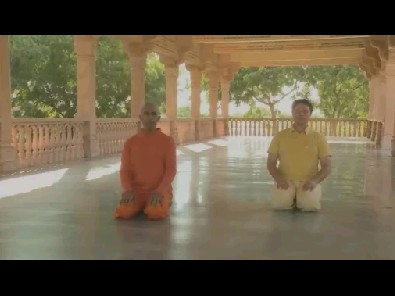
A guided morning yoga class from the Yoga in Daily Life system.
"Relax your whole body from the toes to the top of the head and from the top of the head to the toes."
"Prepare yourself for practicing prāṇāyāma, the breath technique... Breathe twenty times only through your left nostril."
An instructor leads a comprehensive session from the Om Vishwadeep Gurukul ashram. The practice begins with deep relaxation in Ānanda Āsana, followed by a series of gentle stretches, spinal twists, and core exercises like Pavanamuktāsana, all coordinated with conscious breathing. The class transitions to seated postures for spinal extension and flexion, concludes with guided relaxation and a round of Nāḍī Śodhana prāṇāyāma, and ends with a closing mantra.
Filming location: Jadan, Rajasthan, India
For meditation we need calmness
6:10 - 7:11 (61 min)
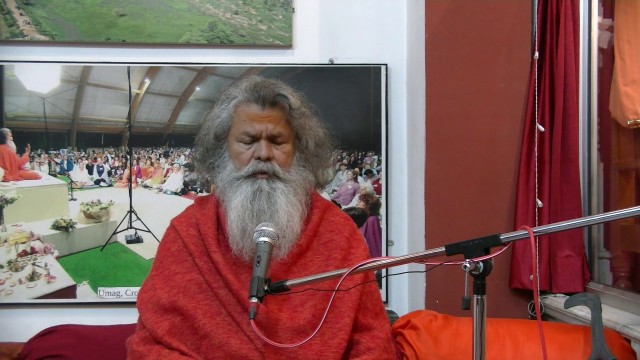
A spiritual discourse on the prerequisites for true meditation and self-realization.
"If you are restless and you meditate, then you become even more restless."
"Mokṣa only can give Gurudev... And that guru is not what we are thinking, could be only in physical form."
A teacher addresses a gathering, explaining that discipline and a pure, guru-focused devotion are essential to overcome restlessness and attain meditation. He uses stories of Ramakrishna, Vivekananda, and a parable about a bamboo surrendering to God to illustrate the necessity of grace and surrender. The talk covers the pitfalls of ego, the levels of consciousness, and briefly touches on the yogic science of chakras and sacred sounds.
Filming location: Jaipur, Rajasthan, India
Mastering the subtle energies
7:15 - 7:56 (41 min)
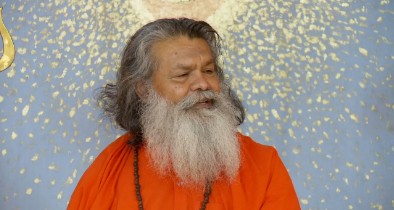
Satsang with Vishwaguru Mahamandaleshwar Paramhans Swami Maheshwarananda, Strilky Ashram, Czech Republic. Yoga is a practical path. If we should survive in this kaliyuga to reach Brahmagyana we need to practice. Our modern age is governed by the material life. The scientific system of Yoga in Daily Life should be practiced systematically and every day. Along side the well being of the physical body, we need to practice inner yoga, in order to harmonize the emotions and subtle energies. That comes through practicing mantra, prayer, concentration exercises. We should renounce to be able to go higher.
Around the world - Yoga Class of Level 3, Zagreb, CRO
8:00 - 8:59 (59 min)
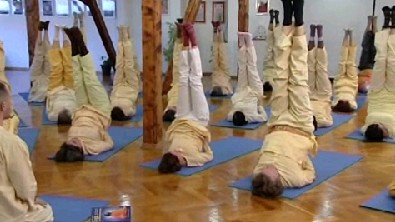
Yoga in Daily Life Class of Level 3 at Sri Devpuriji Ashram, Zagreb, Croatia, January 2011
Yoga in Daily Life: The Fifth Level
9:05 - 9:43 (38 min)
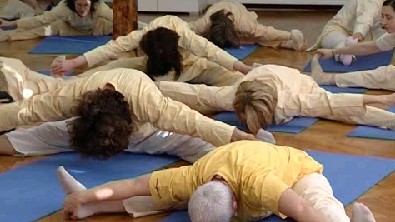
A fifth-level "Yoga in Daily Life" class focused on asana practice and breath awareness.
"Everything we practice in yoga has its purpose, and if we ask ourselves why, we must receive an answer. That is why we say that yoga is the science of the body, mind, spirit, and soul."
"Āsanas do not act only on the body. They are also a correction of our behavior; they act on our consciousness; they affect our entire being."
An instructor guides students through a detailed session, beginning with relaxation in Ānandāsana and emphasizing the purpose behind each alignment detail for reducing stress. The class progresses through a series of asanas including Pavanamuktāsana, Marjari Āsana, Paścimottānāsana, Upaviṣṭha Koṇāsana, Jānu Śīrṣāsana, and Mṛgāsana, with continuous focus on diaphragmatic breathing, mindful movement without strain, and the physical and subtle effects of each posture.
Filming location: Zagreb, Croatia
Sri SatGuru Chalisa
9:45 - 9:58 (13 min)
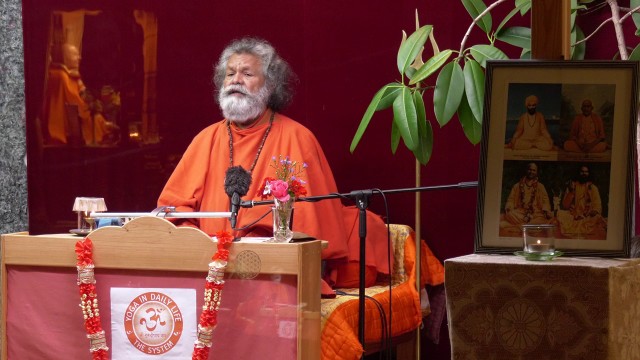
A commentary and translation of the Ātāśrī Satguru Chalīsā, a devotional hymn.
"You are the creator for everyone. You are present outside and inside. You are the Supreme Divine incarnate."
"Those who will read the Satguru Chalīsā... shall concentrate, meditate, and chant His name. Janam maraṇa bhava dukha mithi... You will be free from the fear of birth and death."
A speaker provides a line-by-line English translation and explanation of the Satguru Chalīsā's introductory poem and first verses. He describes the Guru as the omnipresent creator and protector, and explains the benefits of reciting the hymn, which include liberation from the cycle of birth and death, the destruction of sins, and the attainment of spiritual perfection and wishes.
Filming location: Strilky, Czech Republic
Vegetarian kitchen in praxis (part 3)
10:00 - 10:53 (53 min)
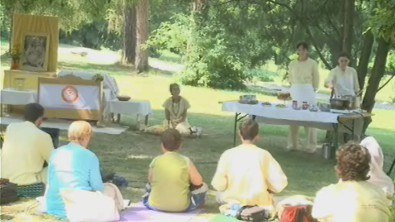
A seminar on health, illness, and vegetarian diet, divided into theoretical discussion and practical advice.
"My answer was that there should be institutional support for mothers: strength, financial support, and social appreciation for being at home, taking care of children, and cooking for their husbands every day."
"Obesity is not from excess, but from deficiency... The main cause, as I mentioned in the beginning, is usually not in the food, but in the psyche."
The event features a couple, the Škvařil family, sharing their experiences and knowledge. The wife opens by emphasizing the foundational role of home-cooked food and a mother's care in establishing lifelong health and vegetarian habits, sharing personal anecdotes and advice. The husband then provides a theoretical background, discussing definitions of health, psychosomatic connections, and the benefits of aligning diet with natural cycles like fasting periods. The wife concludes with a practical demonstration of preparing a gentle spelt porridge, followed by a Q&A session addressing topics like vegetarian bodybuilding and diet for eyesight.
Filming location: Strilky, Czech Republic
Taste of the Divine Nectar
11:00 - 12:03 (63 min)
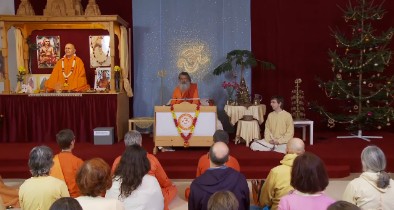
Satsang with Vishwaguru Swami Maheshwarananda, Strilky Ashram, Czech Republic. Yoga is a sattvic, pure practice. There is no harm in it - instead there is harmony of body, mind and soul. Yoga in Daily Life is a complete system. When a soul comes to this Earth as a human it has two aims: to clean the karma and try to create good karma. When we treat other creatures with mercy we create good karma and at the same time clean our negative karma. This is a real human quality.
Love and Spirituality
12:10 - 13:16 (66 min)
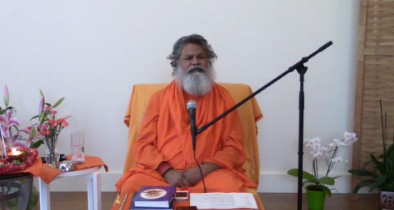
A spiritual discourse on achieving immortality and the essence of a spiritual life.
"Spirituality is 24 hours. Whatever we do should be pure: eating, drinking, behaviour, working, relations, etc."
"Human life is the chance. This is the last milestone where we can come to the absolute, or immortality, or God consciousness, or oneness with God."
A spiritual teacher addresses an audience, explaining the concept of soul immortality versus physical impermanence and the human opportunity to break the cycle of rebirth. He defines true spirituality as all-encompassing purity in action and thought, critiques religious fanaticism and materialism, and shares parables on compassion. The talk concludes with an overview of yogic anatomy, describing nāḍīs (energy channels) and their role in health and consciousness.
Filming location: San Francisco, USA
We are here only temporarily
13:15 - 14:08 (53 min)
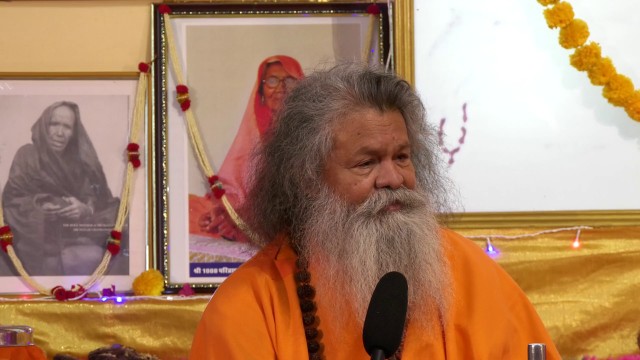
Evening satsang with Vishwaguruji from Jadan Ashram, Rajasthan, India. We came from cosmic. We are born from God. Nowadays there are many problems in families between parents and children or between brothers and sisters. God said to humans that we should love everyone and all other creatures also. The story of Siva and a rakshasa who wanted to learn to dance. We are here in our life only temporary. We should be in the present time. The story of three bhaktas from Gujarat who want to go to the Ganga. After death, everybody goes to one God. Bhajan singing.
Sanatana Dharma
13:20 - 14:19 (59 min)
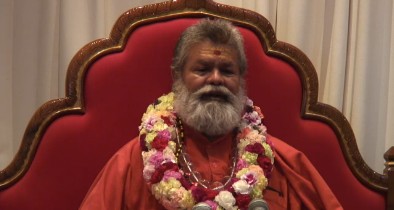
A Christmas satsang discourse on the eternal principles of Sanātana Dharma.
"Sanātana Dharma is that which is balancing, harmonizing, and keeps one in the oneness or unity; that is Sanātana Dharma."
"God says that every living being is my essence, my light, myself. This is Sanātana."
A spiritual teacher addresses a gathering during the Christmas season, explaining Sanātana Dharma as the universal, eternal religion underlying all creation. He describes it as the divine consciousness that balances the universe and dwells within all beings. The talk connects this principle to major religious figures, emphasizing the sacred feminine and the shared struggles of divine incarnations like Krishna and Jesus to illustrate universal spiritual truths. He concludes with seasonal blessings and a call for compassion and service.
Filming location: Wellington, New Zealand
Vaccinate or not vaccinate?
14:25 - 14:55 (30 min)
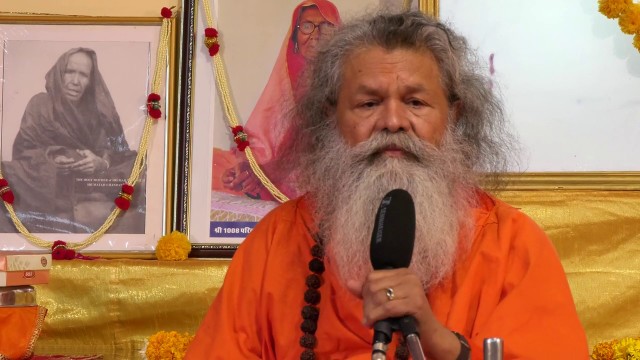
A spiritual discourse on religious festivals, health, and contemporary life.
"From there, all festivals—so they were for Rāma, Sītā, and his brother Lakṣmaṇa."
"And now, what is it? We all now have a time. We had our Dīvālīs, and now we have the Christians, what we call Christmas."
The speaker, referred to as Satguru Swāmījī, begins by discussing the spiritual significance of Diwali, linking it to Bhagavān Rāma and the symbolism of light. He then broadens the talk to encompass other faiths like Christianity and Islam, praising their devotion. The discourse shifts to modern concerns about food purity and health, where he strongly advocates for COVID-19 vaccination based on his positive personal experience, while repeatedly stating he does not wish to force anyone.
Filming location: Jadan, Rajasthan, India
Christmas is the festival of Unity
15:00 - 15:55 (55 min)
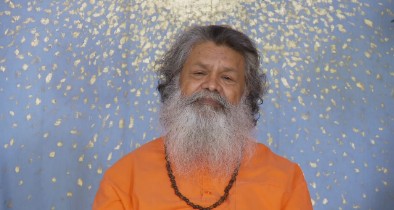
A satsang on the essence of Christmas and universal spirituality.
"Hundreds of thousands of people don't know. Rare people know rare."
"Christmas for us is a message of the spiritual incarnation, the incarnation of love, incarnation of the light, incarnation of the peace."
He presents Christmas as a universal message of love, light, and oneness, contrasting it with religious ignorance that leads to conflict. Through personal anecdotes, illustrative stories, and spiritual commentary, he emphasizes that true worship involves seeing God in all, respecting every culture and incarnation, and embodying love and humility in daily life.
Filming location: Strilky, Czech Republic
Part 1: The Role of Yoga and Meditation in Improving Quality of Life for Cancer Patients
16:00 - 17:07 (67 min)
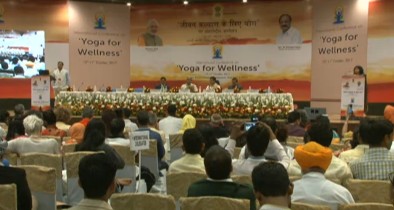
A medical lecture on the role of yoga and meditation as supportive care for cancer patients.
"We must note which specific yogic and meditative techniques were used, as these vary widely."
"Please do not give false hope that cancer will be cured... If a practitioner claims that prāṇāyāma, dhyāna, and some Ayurvedic herbs... can cure cancer, they are committing a grave sin against society."
A doctor from AIIMS Delhi presents a detailed analysis of scientific studies on yogic interventions for cancer patients, emphasizing they are complementary to standard treatments like chemotherapy. He strongly warns against practitioners falsely claiming yoga can cure cancer, shares data on benefits for quality of life and stress, and proposes a large-scale research trial combining yoga, meditation, and herbal products for cancer prevention and care.
Filming location: Delhi, India
Theory and Practice: The Two Horses of Realization
17:15 - 17:41 (26 min)
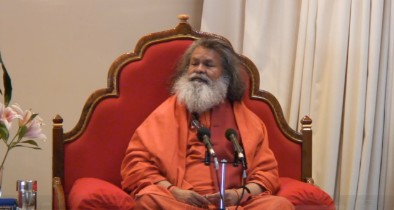
A spiritual discourse on integrating theory and practice for realization.
"Tons of theory are nothing compared with a gram of practice."
"Whatever good we do in the world is our meditation. Whatever good we do is our prayer."
The speaker explores the essential relationship between theoretical knowledge and practical application, using analogies like cars and mountain climbing. He distinguishes between passive and active meditation, framing selfless service, parenting, and creative work as forms of active meditation that constitute one's dharma. The talk also covers handling emotional disturbances, the karmic consequences of action and inaction, and the wisdom of non-reaction and forgiveness, concluding with practical advice for self-inquiry.
Filming location: Wellington, New Zealand
Christmas is the festival of Unity
18:40 - 19:35 (55 min)
A satsang on the essence of Christmas and universal spirituality.
"Hundreds of thousands of people don't know. Rare people know rare."
"Christmas for us is a message of the spiritual incarnation, the incarnation of love, incarnation of the light, incarnation of the peace."
He presents Christmas as a universal message of love, light, and oneness, contrasting it with religious ignorance that leads to conflict. Through personal anecdotes, illustrative stories, and spiritual commentary, he emphasizes that true worship involves seeing God in all, respecting every culture and incarnation, and embodying love and humility in daily life.
Filming location: Strilky, Czech Republic
Christmas satsang in Strilky
19:40 - 19:50 (10 min)
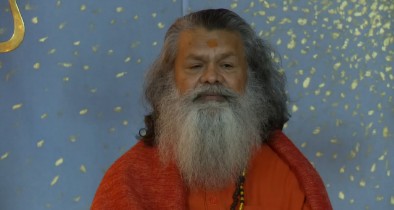
A Christmas satsang reflecting on the spiritual meaning of the holiday.
"The blessing is always the blessing; the blessing is immortal."
"Satyam eva jayate—truth alone triumphs."
The lecturer leads a spiritual gathering on Christmas Eve, contemplating divine presence and the removal of negative karma. He reflects on the birth of Jesus as a unifying force for peace and non-violence, contrasting divine power with negative āsurī śakti. He urges attendees to honor the day in a sāttvic mood, advocating for vegetarianism and non-violence as a way to receive blessings, and concludes with blessings in the names of Jesus, Holy Mary, and Alakporidzhi Siddhapita.
Filming location: Strilky, Czech Republic
Theory and Practice: The Two Horses of Realization
19:55 - 20:21 (26 min)
A spiritual discourse on integrating theory and practice for realization.
"Tons of theory are nothing compared with a gram of practice."
"Whatever good we do in the world is our meditation. Whatever good we do is our prayer."
The speaker explores the essential relationship between theoretical knowledge and practical application, using analogies like cars and mountain climbing. He distinguishes between passive and active meditation, framing selfless service, parenting, and creative work as forms of active meditation that constitute one's dharma. The talk also covers handling emotional disturbances, the karmic consequences of action and inaction, and the wisdom of non-reaction and forgiveness, concluding with practical advice for self-inquiry.
Filming location: Wellington, New Zealand
Forgiveness, Kindness and Mercy
20:25 - 21:35 (70 min)
A satsang discourse on mercy as the root of dharma and the awakening of inner spiritual talents.
"Dayā dharam kā mūla hai, pāpa mūla abhimāna. Tulsī dayā na chhoḍīye, jab laga ghaṭame prāṇa." ("The root of dharma is mercy, the root of sin is ego. Tulsī, never abandon mercy as long as there is life in your body.")
"The best talent which can make us happy and free without fear—is to be merciful."
The lecturer leads a morning satsang, exploring the central teaching from Tulsīdās that mercy (dayā) is the foundation of righteousness. He explains how ego is the root of sin and illustrates mercy through stories, including one of a thief in the ashram being allowed to steal. The talk covers related inner talents like forgiveness (kṣamā) and compassion (karuṇā), warns against negative talents like anger, and emphasizes practice (abhyāsa) and awakening awareness through Guru's grace, concluding with an explanation of a devotional bhajan.
Filming location: USA
Only the One is the truth
21:40 - 22:53 (73 min)
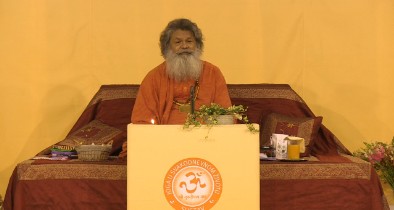
Evening satsang with Vishwaguruji from weekend seminar in Zagreb, Croatia. There are two kinds of karma. Selfish acts will finish very soon. Unselfish karma is what you are doing for the sake of everyone. Only the One is the truth, this world is like a dream. Our spiritual journey is very important, although there could be difficult situations in life. Keep on with your mantra.
Forgiveness, Kindness and Mercy
23:00 - 0:10 (70 min)
A satsang discourse on mercy as the root of dharma and the awakening of inner spiritual talents.
"Dayā dharam kā mūla hai, pāpa mūla abhimāna. Tulsī dayā na chhoḍīye, jab laga ghaṭame prāṇa." ("The root of dharma is mercy, the root of sin is ego. Tulsī, never abandon mercy as long as there is life in your body.")
"The best talent which can make us happy and free without fear—is to be merciful."
The lecturer leads a morning satsang, exploring the central teaching from Tulsīdās that mercy (dayā) is the foundation of righteousness. He explains how ego is the root of sin and illustrates mercy through stories, including one of a thief in the ashram being allowed to steal. The talk covers related inner talents like forgiveness (kṣamā) and compassion (karuṇā), warns against negative talents like anger, and emphasizes practice (abhyāsa) and awakening awareness through Guru's grace, concluding with an explanation of a devotional bhajan.
Filming location: USA
American
Australian