
European
How can we become a good yoga teacher?
1:00 - 2:20 (80 min)
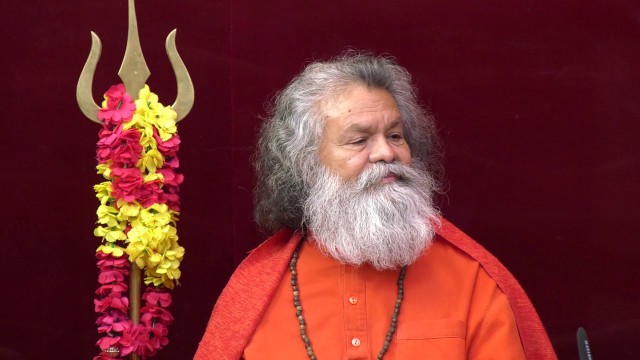
Evening satsang with Vishwaguruji from Strilky Ashram, Czech Republic. Practising Bari Khatu Pranam and Sarva hitta asanas led by Vidya. All Yoga in Daily Life yoga teachers has some years practising behind them. A person must learn many years to become a doctor. A person also must learn many years to become a good teacher. Lifelong we are learning and practising yoga. Yoga practise checks your body and mind. To become a real yoga teacher we need a Guru. Nowadays children are not under the control of the parents. There are yoga teachers who have no proper knowledge of yoga. We can get energy from all of our koshas. The story about a king and a man who became a friend of a wild horse. People who know about Jyotish tell that Shiva will come
Forgiveness, Kindness and Mercy
2:25 - 3:35 (70 min)
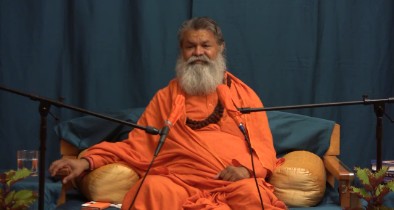
A satsang discourse on mercy as the root of dharma and the awakening of inner spiritual talents.
"Dayā dharam kā mūla hai, pāpa mūla abhimāna. Tulsī dayā na chhoḍīye, jab laga ghaṭame prāṇa." ("The root of dharma is mercy, the root of sin is ego. Tulsī, never abandon mercy as long as there is life in your body.")
"The best talent which can make us happy and free without fear—is to be merciful."
The lecturer leads a morning satsang, exploring the central teaching from Tulsīdās that mercy (dayā) is the foundation of righteousness. He explains how ego is the root of sin and illustrates mercy through stories, including one of a thief in the ashram being allowed to steal. The talk covers related inner talents like forgiveness (kṣamā) and compassion (karuṇā), warns against negative talents like anger, and emphasizes practice (abhyāsa) and awakening awareness through Guru's grace, concluding with an explanation of a devotional bhajan.
Filming location: USA
Only the One is the truth
3:40 - 4:53 (73 min)
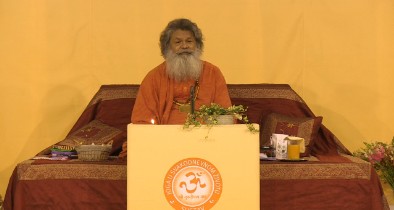
Evening satsang with Vishwaguruji from weekend seminar in Zagreb, Croatia. There are two kinds of karma. Selfish acts will finish very soon. Unselfish karma is what you are doing for the sake of everyone. Only the One is the truth, this world is like a dream. Our spiritual journey is very important, although there could be difficult situations in life. Keep on with your mantra.
Human being is miraculous - Yoga Practice
5:00 - 6:32 (92 min)
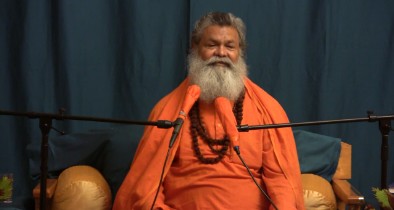
Morning program with Vishwaguruji from Alexandria, Virginia, USA. Folded hands awaken our awareness about real human qualities. Vishwaguruji starts leading practice with remembering: what makes us human?
Theory and Practice: The Two Horses of Realization
6:40 - 7:06 (26 min)
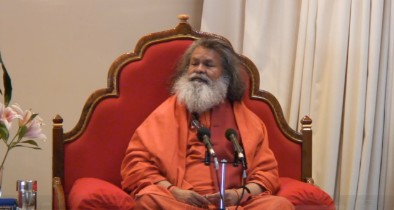
A spiritual discourse on integrating theory and practice for realization.
"Tons of theory are nothing compared with a gram of practice."
"Whatever good we do in the world is our meditation. Whatever good we do is our prayer."
The speaker explores the essential relationship between theoretical knowledge and practical application, using analogies like cars and mountain climbing. He distinguishes between passive and active meditation, framing selfless service, parenting, and creative work as forms of active meditation that constitute one's dharma. The talk also covers handling emotional disturbances, the karmic consequences of action and inaction, and the wisdom of non-reaction and forgiveness, concluding with practical advice for self-inquiry.
Filming location: Wellington, New Zealand
Mastering the subtle energies
7:10 - 7:51 (41 min)
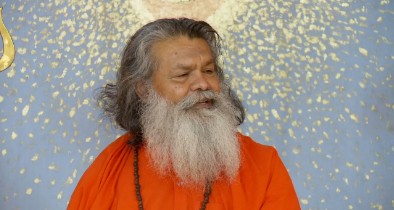
Satsang with Vishwaguru Mahamandaleshwar Paramhans Swami Maheshwarananda, Strilky Ashram, Czech Republic. Yoga is a practical path. If we should survive in this kaliyuga to reach Brahmagyana we need to practice. Our modern age is governed by the material life. The scientific system of Yoga in Daily Life should be practiced systematically and every day. Along side the well being of the physical body, we need to practice inner yoga, in order to harmonize the emotions and subtle energies. That comes through practicing mantra, prayer, concentration exercises. We should renounce to be able to go higher.
Awakening of the peace and compassion within us
7:55 - 8:40 (45 min)
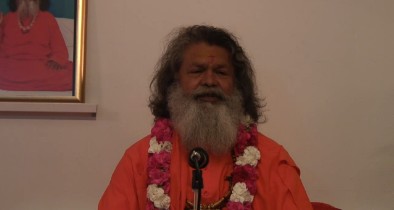
A satsang on awakening compassion and peace, led by Paramahamsa Swamiji Maheshwarananda.
"Within you is the bliss of the ocean. Within you is the fountain of joy. Kill this little 'I' and lead a divine life."
"Fear is a seed, fear is a root, fear is the cause, fear is the origin of all our negative qualities."
Swamiji delivers a discourse on the divine qualities within, focusing on overcoming fear as the root of anger, attachment, and suffering. He explains how fear leads to negative cycles, contrasting them with the peace found in spiritual knowledge and selfless living. The talk includes Vedic peace prayers, reflections on karma, and a parable about sacrifice, concluding with a call to awaken compassion.
Filming location: Auckland, New Zealand
Christmas is the festival of Unity
8:45 - 9:40 (55 min)
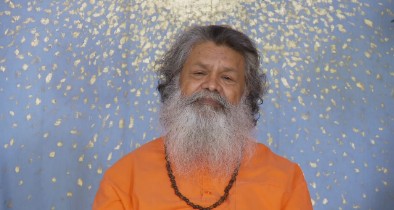
A satsang on the essence of Christmas and universal spirituality.
"Hundreds of thousands of people don't know. Rare people know rare."
"Christmas for us is a message of the spiritual incarnation, the incarnation of love, incarnation of the light, incarnation of the peace."
He presents Christmas as a universal message of love, light, and oneness, contrasting it with religious ignorance that leads to conflict. Through personal anecdotes, illustrative stories, and spiritual commentary, he emphasizes that true worship involves seeing God in all, respecting every culture and incarnation, and embodying love and humility in daily life.
Filming location: Strilky, Czech Republic
Sanatana Dharma
9:45 - 10:44 (59 min)
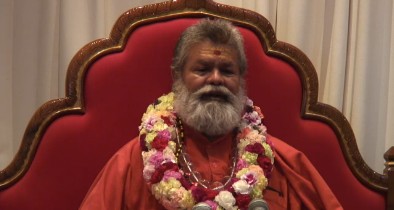
A Christmas satsang discourse on the eternal principles of Sanātana Dharma.
"Sanātana Dharma is that which is balancing, harmonizing, and keeps one in the oneness or unity; that is Sanātana Dharma."
"God says that every living being is my essence, my light, myself. This is Sanātana."
A spiritual teacher addresses a gathering during the Christmas season, explaining Sanātana Dharma as the universal, eternal religion underlying all creation. He describes it as the divine consciousness that balances the universe and dwells within all beings. The talk connects this principle to major religious figures, emphasizing the sacred feminine and the shared struggles of divine incarnations like Krishna and Jesus to illustrate universal spiritual truths. He concludes with seasonal blessings and a call for compassion and service.
Filming location: Wellington, New Zealand
Real Knowledge Is Self-Realization
10:50 - 11:36 (46 min)
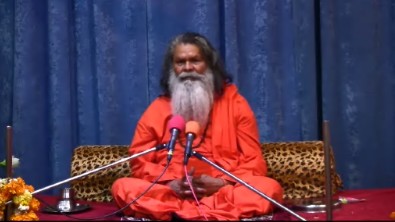
A spiritual discourse on immortality, ego, and dharma following the Maha Kumbh Mela.
"We all who speak, we never got that nectar. And we don’t know if we will get it. We didn't see it. But we speak as if it is there."
"Kill this little 'I', this little ego, and lead a divine life. If someone tells you something, you are so offended. How?"
The lecturer delivers a webcast satsang, reflecting on the timeless spiritual truths revealed during the Kumbh Mela. He explains that immortality (amrita) is found within through self-realization, not in external search, and that the primary obstacle is the ego. The talk covers the nature of time, the purpose of spiritual practice, and one's dharma—including service, environmental protection, and non-violence in thought and deed—concluding with blessings.
Filming location: Jadan, Rajasthan, India
For meditation we need calmness
11:40 - 12:41 (61 min)
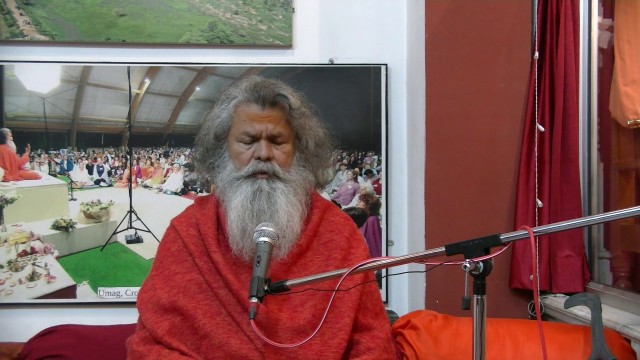
A spiritual discourse on the prerequisites for true meditation and self-realization.
"If you are restless and you meditate, then you become even more restless."
"Mokṣa only can give Gurudev... And that guru is not what we are thinking, could be only in physical form."
A teacher addresses a gathering, explaining that discipline and a pure, guru-focused devotion are essential to overcome restlessness and attain meditation. He uses stories of Ramakrishna, Vivekananda, and a parable about a bamboo surrendering to God to illustrate the necessity of grace and surrender. The talk covers the pitfalls of ego, the levels of consciousness, and briefly touches on the yogic science of chakras and sacred sounds.
Filming location: Jaipur, Rajasthan, India
Christmas satsang in Strilky
12:45 - 12:55 (10 min)
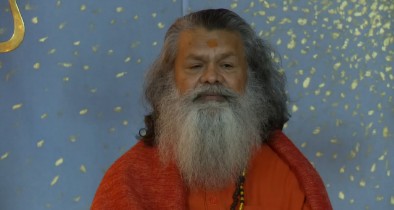
A Christmas satsang reflecting on the spiritual meaning of the holiday.
"The blessing is always the blessing; the blessing is immortal."
"Satyam eva jayate—truth alone triumphs."
The lecturer leads a spiritual gathering on Christmas Eve, contemplating divine presence and the removal of negative karma. He reflects on the birth of Jesus as a unifying force for peace and non-violence, contrasting divine power with negative āsurī śakti. He urges attendees to honor the day in a sāttvic mood, advocating for vegetarianism and non-violence as a way to receive blessings, and concludes with blessings in the names of Jesus, Holy Mary, and Alakporidzhi Siddhapita.
Filming location: Strilky, Czech Republic
Bhakti
13:00 - 13:48 (48 min)
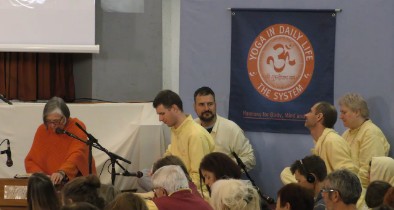
Evening satsang from Weekend Seminar in Vep, Hungary. If there is bhakti - devotion - in the heart, practice is succesful and spirituality grows.
Live webcast from Jadan
13:10 - 14:10 (60 min)
Evening satsang with Vishwaguruji from Jadan Ashram, Rajasthan, India.
Taste of the Divine Nectar
13:55 - 14:58 (63 min)
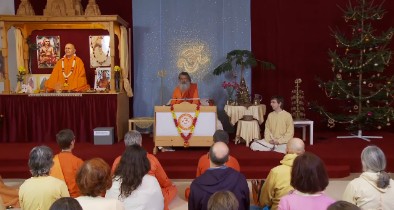
Satsang with Vishwaguru Swami Maheshwarananda, Strilky Ashram, Czech Republic. Yoga is a sattvic, pure practice. There is no harm in it - instead there is harmony of body, mind and soul. Yoga in Daily Life is a complete system. When a soul comes to this Earth as a human it has two aims: to clean the karma and try to create good karma. When we treat other creatures with mercy we create good karma and at the same time clean our negative karma. This is a real human quality.
Around the world - Yoga for children CRO
16:00 - 16:08 (8 min)
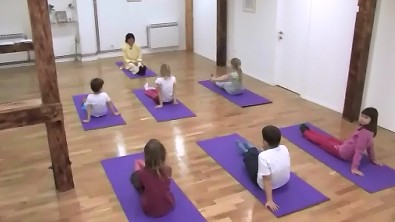
A yoga class for children, focusing on mindful movement, self-observation, and breathwork.
"You can repeat it silently three times. It is certain to manifest."
"There is no competition with others, no comparison like in other sports about who is better at something."
An instructor guides children through a session that begins with setting a personal intention (saṅkalpa) and body awareness. The class includes physical postures, described through alignment cues and animal-inspired movements (āsanas), and prepares for breathing practice (prāṇāyāma). The instructor reflects on the joy of witnessing the children's progress and the personal rejuvenation found in teaching.
Filming location: Croatia
Part 1: The Practice of Śalabhāsana and Complementary Āsanas
16:15 - 17:14 (59 min)
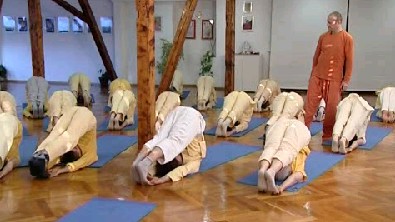
A detailed yoga class instruction covering śalabhāsana, sarvāṅgāsana, and prāṇāyāma.
"Śalabhāsana, being a backward bend that requires strong muscles, works very well on our self-confidence. It strengthens the sense of power and vitality."
"In this posture, simply allow one subtle, extended exhalation. This posture works on unburdening the heart, so less pumping is needed to nourish the brain."
An instructor guides students through a sequence of āsanas, including śalabhāsana (locust pose) variations, sarvāṅgāsana (shoulderstand), and halāsana (plow pose), explaining their physical and energetic benefits. The session incorporates preparatory poses, counterposes, and detailed alignment cues, concluding with instructions for Bhastrikā prāṇāyāma and a collective Oṁ chant.
Filming location: Zagreb, Croatia
Bhakti
17:20 - 18:08 (48 min)
Evening satsang from Weekend Seminar in Vep, Hungary. If there is bhakti - devotion - in the heart, practice is succesful and spirituality grows.
The River of Selfless Service
18:15 - 18:47 (32 min)
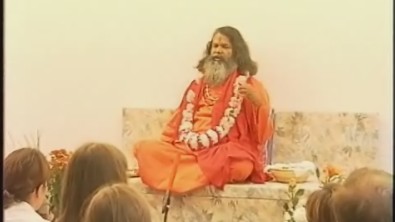
A satsang discourse on karma yoga, selfless service, and spiritual practice.
"Work is the beauty of life, but this work should be positive, selfless service."
"All that he did is for himself, for his soul, for his liberation."
The lecturer addresses ashram residents, praising their recent karma yoga efforts. He explores the nature of selfless service, using the example of Hanuman from the Ramayana to illustrate that all spiritual work ultimately benefits the doer's own soul. He outlines the threefold path of svādhyāya (self-study), manan (contemplation), and abhyāsa (practice), urging attendees to overcome personal likes and dislikes to foster inner harmony and continue flowing like a river in service.
Filming location: Zagreb, Croatia
Love and Spirituality
18:55 - 20:01 (66 min)
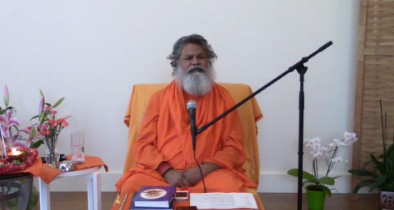
A spiritual discourse on achieving immortality and the essence of a spiritual life.
"Spirituality is 24 hours. Whatever we do should be pure: eating, drinking, behaviour, working, relations, etc."
"Human life is the chance. This is the last milestone where we can come to the absolute, or immortality, or God consciousness, or oneness with God."
A spiritual teacher addresses an audience, explaining the concept of soul immortality versus physical impermanence and the human opportunity to break the cycle of rebirth. He defines true spirituality as all-encompassing purity in action and thought, critiques religious fanaticism and materialism, and shares parables on compassion. The talk concludes with an overview of yogic anatomy, describing nāḍīs (energy channels) and their role in health and consciousness.
Filming location: San Francisco, USA
Theory and Practice: The Two Horses of Realization
20:05 - 20:31 (26 min)
A spiritual discourse on integrating theory and practice for realization.
"Tons of theory are nothing compared with a gram of practice."
"Whatever good we do in the world is our meditation. Whatever good we do is our prayer."
The speaker explores the essential relationship between theoretical knowledge and practical application, using analogies like cars and mountain climbing. He distinguishes between passive and active meditation, framing selfless service, parenting, and creative work as forms of active meditation that constitute one's dharma. The talk also covers handling emotional disturbances, the karmic consequences of action and inaction, and the wisdom of non-reaction and forgiveness, concluding with practical advice for self-inquiry.
Filming location: Wellington, New Zealand
Forgiveness, Kindness and Mercy
20:35 - 21:45 (70 min)
A satsang discourse on mercy as the root of dharma and the awakening of inner spiritual talents.
"Dayā dharam kā mūla hai, pāpa mūla abhimāna. Tulsī dayā na chhoḍīye, jab laga ghaṭame prāṇa." ("The root of dharma is mercy, the root of sin is ego. Tulsī, never abandon mercy as long as there is life in your body.")
"The best talent which can make us happy and free without fear—is to be merciful."
The lecturer leads a morning satsang, exploring the central teaching from Tulsīdās that mercy (dayā) is the foundation of righteousness. He explains how ego is the root of sin and illustrates mercy through stories, including one of a thief in the ashram being allowed to steal. The talk covers related inner talents like forgiveness (kṣamā) and compassion (karuṇā), warns against negative talents like anger, and emphasizes practice (abhyāsa) and awakening awareness through Guru's grace, concluding with an explanation of a devotional bhajan.
Filming location: USA
God is the father of all creatures
21:50 - 22:56 (66 min)
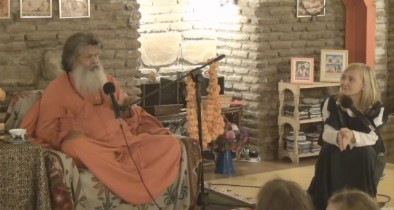
An evening satsang on spiritual practice, mantra, and devotion.
"Spirituality is a very rich food, which is not easy to digest. Junk food you can digest easily, but it is not healthy."
"Getting a mantra from the master is not only, 'Oh, I have a mantra, and I will eat my mokṣa.' You have to put it in the field—the field of the heart."
The speaker leads a satsang, using a parable about two men receiving a seed to illustrate the need to actively cultivate a mantra with devotion. He discusses the nature of God, the importance of purifying the heart, and the role of the Guru. The talk includes a recitation of a poet's praise for Mahaprabhuji and addresses questions from attendees on topics like managing family illness, expectations, and generational tragedy.
Only the One is the truth
23:00 - 0:13 (73 min)
Evening satsang with Vishwaguruji from weekend seminar in Zagreb, Croatia. There are two kinds of karma. Selfish acts will finish very soon. Unselfish karma is what you are doing for the sake of everyone. Only the One is the truth, this world is like a dream. Our spiritual journey is very important, although there could be difficult situations in life. Keep on with your mantra.
American
Australian