
European
Awakening of muladhar
0:15 - 0:57 (42 min)
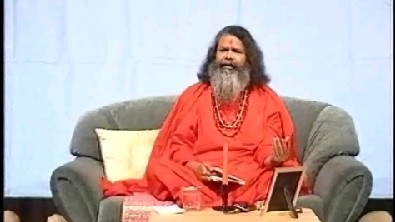
A lecture on the Mūlādhāra chakra, karma, and associated yoga practices.
"Prārabdha, or karma prārabdha, first your destiny is created, and then your body."
"The awakening of the Kuṇḍalinī means wisdom. You become very wise, you become self-confident."
The speaker delivers an in-depth explanation of the root (Mūlādhāra) energy center, linking it to one's karma, destiny, and foundational consciousness. He describes its symbolism—the red color, four-petaled lotus, elephant, and coiled serpent representing past karmas—and clarifies the nature of a true Kuṇḍalinī awakening. The session includes practical guidance, with demonstrators showing postures like Bhujaṅgāsana and Śalabhāsana to activate and regulate this chakra.
Filming location: Croatia
Yoga is the science of being Human
1:05 - 1:37 (32 min)
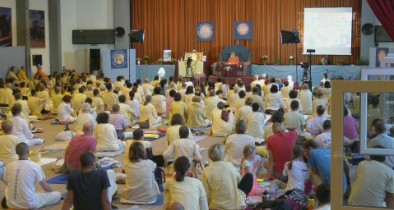
A spiritual discourse on Kriya Yoga, discipline, and avoiding pitfalls on the path.
"In every system, in every approach, and in every life, we need that discipline. That is why Patañjali always... states that yoga begins with discipline and continues by following discipline."
"Therefore, the Muslims are very good. They do not dream like that. They are very clear. They say 'Allah,' and that is all."
Swami Avadhutji addresses practitioners during an anushthana, emphasizing the strict, disciplined path of Kriya Yoga as the sure method. He warns against neglecting practice, against those who teach without mastery or realization, and specifically against the spiritual pitfall of visionary "dreaming" about deities and angels. He defines true religion as realizing the relation between the individual soul and the Supreme, criticizes both religious and scientific fanaticism, and advises students to study the chakras properly from authentic sources.
Filming location: Vép, Hungary
When The Light Comes - Darkness Disappears
1:45 - 2:10 (25 min)
A spiritual discourse on the five sheaths (kośas) and the obstacles of attachment.
"In the vijñānamaya kośa, when there is attachment interspersed with 'my' and 'thy,' then this love among brothers or friends changes."
"Cintā (worry) and Tṛṣṇā (longing), both, have occupied this castle of our kośas... they will destroy the whole palace."
Swami Ji explores how subtle attachments within the layers of self, from the physical to the bliss sheath, distort relationships and create suffering. He illustrates this with a parable of two brothers and a mango, showing how unconscious bias fractures unity. The talk emphasizes the need for viveka (discernment) and concludes by advocating for surrender at a spiritual shelter to dissolve worry and desire.
We have to become united in Oneness
2:15 - 3:32 (77 min)
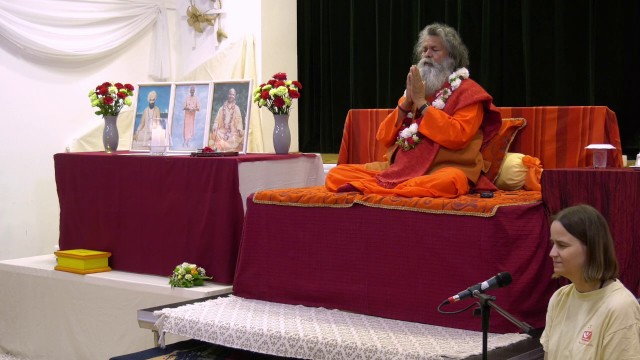
Evening program with Vishwaguruji from Szeged, Hungary. We have our destiny in which it is written when and where we are. The story of a boat in the ocean and a bird. It is in our fate that we want to reach God. We are like a bird coming and going. Life is only temporary. Every living creature has its fate and life. Become one with all. At the end, a drop of water arrives at the ocean and becomes one with it. When we die, our soul goes from the body, which is like a stone falling down. Some of us go towards the pure Light and others come back again. There is only one door when we leave our bodies. Nowadays children don't accept the advice of their parents. Don't kill anyone and don't speak negative words. Practising AUM chanting, bhramari pranayama and some simple asanas.
Rama and Hanuman
3:40 - 4:56 (76 min)
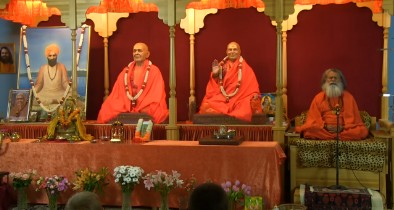
A spiritual discourse on the significance of the full moon, the science of fasting, and a teaching story about Hanuman.
"The full moon is a symbol of completeness. Pūrṇamadaḥ, pūrṇamidaṃ... We are Pūrṇa, perfect."
"One poet said, 'The thread of love doesn't break with some misunderstanding. When it is broken, the thread you can't join anymore back.'"
The speaker begins by explaining the moon's influence on nature and human physiology, advocating for fasting on full moon days for spiritual and physical health, including specific dietary recommendations. The talk then transitions into a detailed narrative from the Ramayana, focusing on Hanuman's unwavering devotion and a lesson on ego. The story describes how Sita's moment of doubt and Hanuman's subsequent pride were gently corrected by Lord Rama, culminating in the revelation of Rama and Sita residing in Hanuman's heart.
Filming location: Vienna, Austria
A human should not kill
5:00 - 5:25 (25 min)
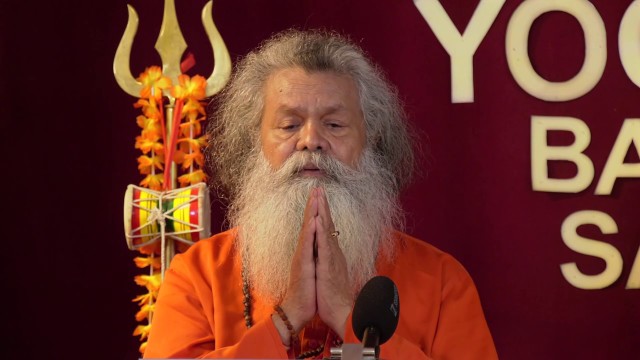
Evening satsang from Strilky Ashram, Czech Republic. Introduction of Mahamandaleshwar Swami Vivekpuriji. Yoga in Daily Life is a system for everyone. Yoga was brought by Bhagwan Shiva for people to reach God. Nowadays many people eat meat and do similar bad things. People should not kill. But you already know and follow this. You should not eat meat. Because of an illness I cannot find the words but I am with you and I am very happy that you are not negative. The bhajans are very important, they tell people what is good and what is not.
The Three Auspicious Times and the Path of Yoga
5:30 - 6:27 (57 min)
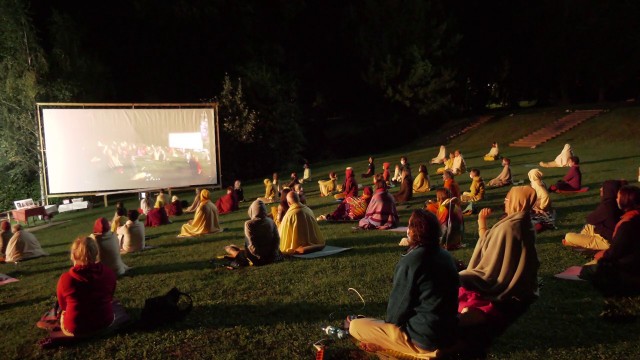
A spiritual discourse on auspicious times, the guru principle, and the foundational practices of yoga.
"The first is in the morning, from before sunrise until half an hour after the sun rises. This is known as Brahma-muhūrta."
"Yoga is that balance, harmony, courage, and our consciousness within."
A spiritual teacher addresses a gathering, first explaining the three most auspicious times for prayer (morning, midday, and sunset). He then discusses the omnipresence of the guru principle in all forms of learning and divinity, before guiding the audience through the core elements of yoga practice. This includes the importance of the physical body, a detailed explanation and demonstration of basic prāṇāyāma techniques for purifying the energy channels, and the progression through āsanas, prāṇāyāma, and meditation towards self-realization.
Filming location: Strilky, Czech Republic
Never eat meat so you become pure
6:35 - 7:41 (66 min)
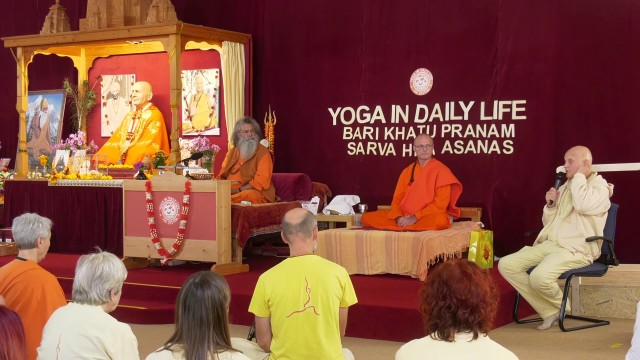
A satsang on spiritual purity, focusing on vegetarianism and lifestyle.
"You are all very, very pure people. Maybe some are not, yes. But it is very, very… if you can call yourself like this: no mean and no meat."
"This is a Kali Yuga now, and you know what is a Kali Yuga. And in Kali Yuga, it is all black. All have always your dress and everything. You see men only black."
A spiritual teacher addresses a gathering, emphasizing the importance of a pure, vegetarian lifestyle and expressing concern over dietary lapses. He uses the metaphor of stepping on a needle in a beautiful place to describe impurity entering a pure environment and discusses the prevalence of black clothing in the current age. Several disciples then contribute, offering scientific, psychological, ethical, and practical perspectives on vegetarianism, linking diet to consciousness, brain function, and spiritual progress.
Filming location: Strilky, Czech Republic
Understand and follow your Guruji
7:45 - 8:42 (57 min)
Morning Satsang from Yoga Summer Retreat from Vep, Hungary. Our path and exercises were designed to help us reach Self-realization. There are commercialized ways of anusthan but the result is not for sure. You should follow and understand the instruction of your Guruji, otherwise, you will go with empty hands. Best place for learning is at the feet of Gurudev. The relation between Atma, Jivatma and Jiva. You will get the light again when Jiva goes again into the heart.
Follow the words of the Guru continuously
8:50 - 9:44 (54 min)
Evening satsang with Vishwaguruji from Jadan Ashram, Rajasthan, India. Swami Sudarsanpuri speaks some words about Guru vakya and Guru seva. We should find the correct way to the seva and the practice. There are many people in Europe and India also who are very disciplined and practise very seriously. Many people from many countries would like to follow Yoga in Daily Life. There are many great saints and Gurus in India. They all are very good. It is very good when families are living together and love children very much. The first Guru was Bhagavan Siva. The story of Siva Parvati and a merchant. Husband and wife should be one. Vishwaguruji organized the next day's work in the Ashram.
The world needs Yoga in Daily Life
9:50 - 10:54 (64 min)
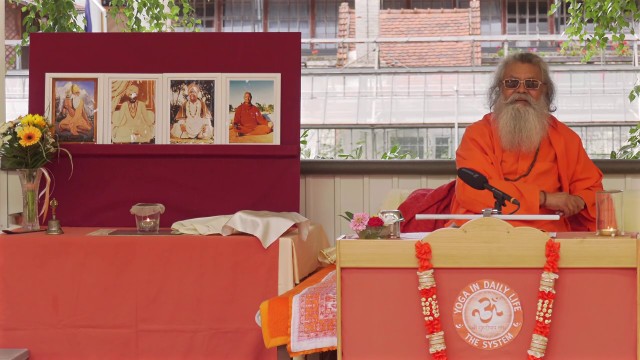
A spiritual gathering at a sacred ashram featuring discourses and personal testimonies.
"You know that you are here from where you were placed. Do you know from how many different places you had to travel?"
"I asked Mahāprabhujī, 'Please, she is this silver girl.' I know that she has some blocks in her face, in her destiny. But I asked Mahāprabhujī, please, just remove it."
A speaker describes the holiness and history of the grove, noting visits from gurus. A disciple then shares his spiritual journey to Swāmījī, recounting miraculous events like the stopping of rain. Another disciple, Joseph, testifies to the healing power of prāṇāyāma after a brain cyst and details his work using yogic techniques to help athletes, including an Olympic swimmer, achieve gold medals. The themes are the necessity of a living guru, the power of blessing, and applying yoga in daily life.
Filming location: Strilky, Czech Republic
Practicing of the system 'Yoga in Daily Life', Level 1 - Part 5
11:00 - 12:06 (66 min)
A guided yoga session from the "Yoga in Daily Life" system at a desert retreat.
"This centre is intended to be a yoga retreat and a spiritual centre. Its purpose is to serve humanity, to protect the environment through an ecological way of life, to offer spiritual seekers a path to find the light of spirituality through yoga."
"The book consists of eight levels. All levels include physical exercises, breath exercises, mental exercises, concentration techniques, relaxation and meditation techniques."
An instructor leads a comprehensive practice from Level One, beginning with a welcome to the ashram and its lineage. The session includes Oṁ chanting, deep relaxation (Śavāsana), instruction in the full yoga breath, and a series of āsanas performed lying, sitting, and standing. The practice concludes with Prāṇāyāma (Nāḍī Śodhana) and final Oṁ chanting, aiming to balance the body and mind.
Filming location: Jadan, Rajasthan, India
Take God in your heart
12:10 - 13:31 (81 min)
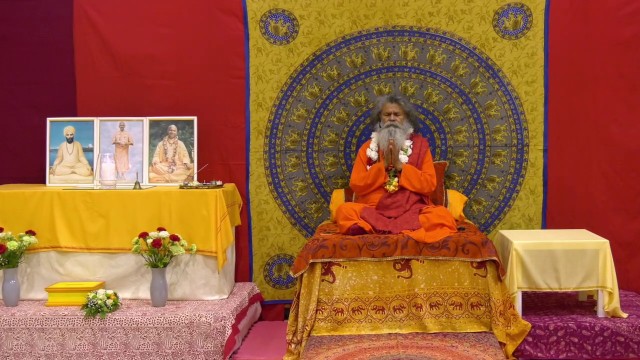
Evening satsang with Vishwaguruji from Szeged, Hungary. The blessings of the Gurus and Rishis are like a passport to move with. Sri Alakhpuriji lived in the time of Shiva. We all know the name of the one who brought the fire. Take God in your heart, do not say bad things about others. Practising Ashwini mudra, AUM chanting and bhramari pranayama.
The Eternal Dharma and the Tale of the Priest and the Dog
13:35 - 14:17 (42 min)
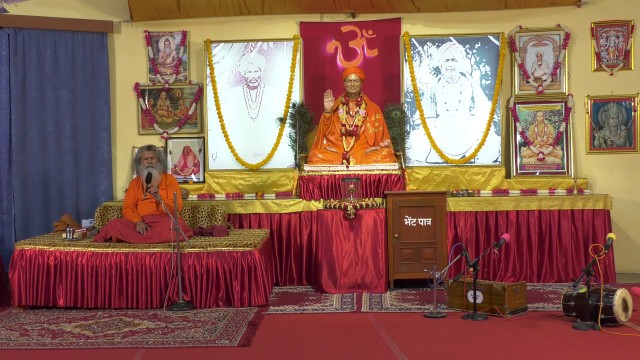
A spiritual discourse and parable on Sanātana Dharma and karma.
"You know, when I go to Australia, New Zealand, Fiji, etc., the people who come are all from Bhārat, India. All is that all."
"Bhagavān, God, who is God, keeps his people in such a way that God says, 'I am below you, but you children are in front of me, sit down.'"
The speaker delivers a wide-ranging discourse, touching on the origins and spread of Sanātana Dharma from India, interspersed with personal travel anecdotes and observations on other faiths. The talk culminates in a parable about a priest who unjustly beats a dog, leading to a divine court where the dog speaks, illustrating the karmic consequences of harming living beings.
Filming location: Jadan, Rajasthan, India
Satsang with Vishwaguruji
14:25 - 15:08 (43 min)
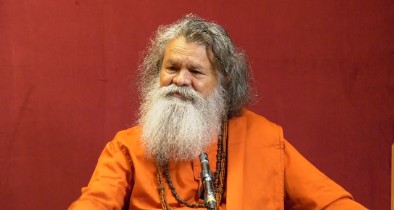
Satsang in honor of 15th year anniversary of Sri Holy Guruji Hindu Dharmsamrat Paramhans Sri Swami Madhavanand's Mahasamadhi, commemorated in Vienna.
Our relationship with the Guru
15:15 - 15:55 (40 min)
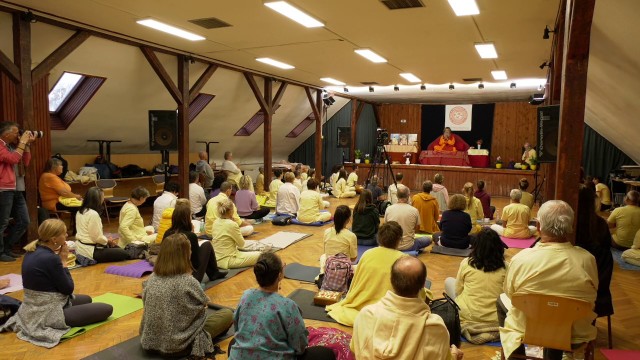
A spiritual discourse on the guru lineage and the nature of truth in the current age.
"Paramparā means one after another. So when that will sit, given here to sit, it’s not that you come and sit down. It will be when our Gurujī said, 'I am going now,' and he gives this place now."
"So in your life, I wish you should be very great and practice, practice, practice. Always only heart, and in the heart is a very little, tiny, tiny something, like a light."
The lecturer addresses a gathering on the 30th anniversary of his mission. He traces the spiritual lineage (paramparā) from Bhagavān Śiva through the Satya Yuga to the present gurus, including Śrī Devpurījī, Mahāprabhujī, and his own guru, Swami Madhavānand. He explains his role in this succession and discusses the loss of universal truth in the Kali Yuga, urging disciples toward spiritual practice rooted in the heart. The talk blends history, analogy, and personal reflection.
Filming location: Debrecen, Hungary
Find God within
16:00 - 16:52 (52 min)
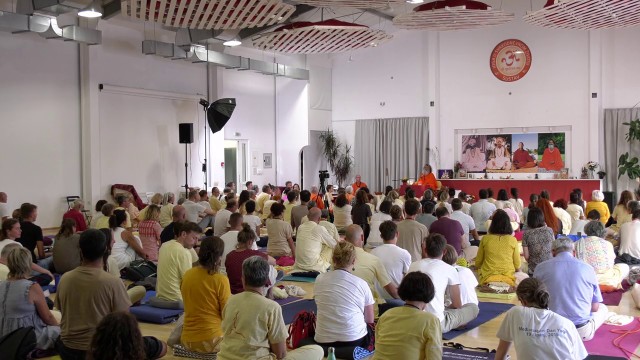
Evening satsang with Vishwaguruji from Rijeka Ashram, Croatia. Nowadays, people lose their teeth quickly.We should get back to nature again. There are many things in nature that can improve the health of teeth as well. Violin music and singing for the soul. We must find God within ourselves. The story of an American practitioner and the very beginning of the OM Ashram.
Enjoy the movement!
17:00 - 18:13 (73 min)
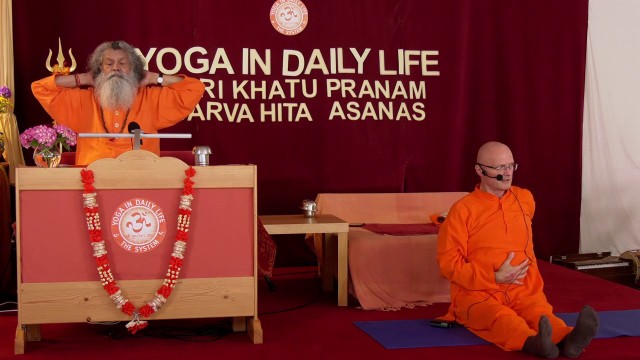
Morning satsang from Strilky Ashram, Czech Republic. Practising Sarva Hitta Asanas and pranayama with M. M. Swami Vivekpuriji.
Good and bad destiny and karma
18:20 - 19:06 (46 min)
A spiritual discourse on destiny, karma, and religious tradition, incorporating stories and teachings.
"Someone has such a, what we call, good luck, so it comes in your hands... but what you have in yourself, no one can take away. They cannot take your destiny."
"Sanātana Dharma is declared as a living religion, and other religions are dead religions. I would not say death, but finished."
The lecturer leads an evening satsang, exploring the concept of destiny through the lens of karma and consciousness. He narrates a lengthy, illustrative story about the poet Kalidasa, from shepherd to prince to scholar, to demonstrate destiny's unpredictable nature. The talk expands into a comparative discussion of world religions, asserting the perpetual living tradition of Sanātana Dharma in contrast to others he describes as concluded.
Filming location: Australia
Marriage has its proper time and order
19:10 - 20:49 (99 min)
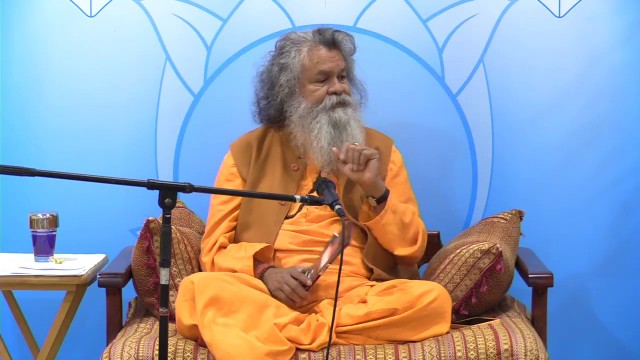
Evening satsang with Vishwaguruji from Sydney Ashram, Australia. Bhajan singing and explanation. Swami Jasraj Puri introduces our Masters and our parampara and their Ashrams and that territory of India. Indian people know many bhajans. There are many languages in India. Everything has its proper time to do. Marriage also has its proper time. In India, a boy and a girl should marry only if the family and a pandit also agreed with that. If you married in a church you should be faithful your whole life to your partner. Nowadays many people leave their partner and it brings many problems for children. The story of a boy and a girl who loved each other but they had a problem with the bread. Practising some simple exercises and bhramari pranayama.
Prayer before eating
20:55 - 21:47 (52 min)
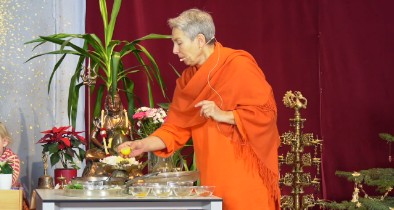
A cooking demonstration and spiritual discourse on the sanctity of food.
"It is said that animals eat animals, and for humans, there is vegetation: the fruits which are falling from the trees, the herbs, the vegetables."
"And therefore, we are not worshiping or saying mantras to eat the meat... when we offer and we take with prayer to God, 'You gave us this food,' so until we did not pray or say thanks, that was not your food."
Swamiji begins by demonstrating how to prepare Panchkuta, a dried vegetable mix from Rajasthan, detailing its ingredients and cooking process. This leads into a broader discussion on food as a sacred source of life, contrasting human and animal nourishment. He emphasizes the importance of prayer before eating, referencing the goddess Annapūrṇā, and explores themes of humility, non-violence, and spiritual practice, concluding with a mantra and blessings for a holy Christmas time.
Filming location: Strilky, Czech Republic
Om Ashram
21:50 - 21:59 (9 min)
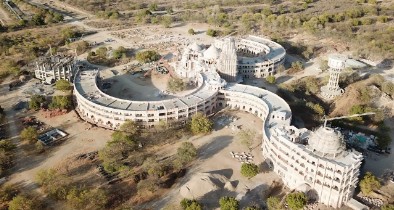
A promotional video about the Omkara Mahavira, a large-scale world peace monument and humanitarian complex under construction in Rajasthan.
"Since 1993, this structure has been under construction for the welfare of humanity, the protection of animals and nature, for teaching yoga, meditation, and philosophy."
"To bring this vision to full fruition, it needs everybody’s contribution. You are not a drop in the ocean. You are the entire ocean in a single drop."
The video details the vision of yogi Paramahamsa Swami Maheshvarananda to build the world's largest Om symbol, which will contain 108 residential compartments. It highlights the existing, operational facets of the site including a free school and college, a hospital, and a large artificial lake for water conservation. The narrative connects this to the global activities of the "Yoga in Daily Life" system, such as tree planting and animal shelters, framing the entire project as a holistic effort for peace, health, and environmental revival. It concludes with a call for donations to complete the monument.
Filming locations: Jhadan, Rajasthan, India.
Around the world - Opening of new YIDL center in Murska Sobota, Slovenia
22:00 - 22:42 (42 min)
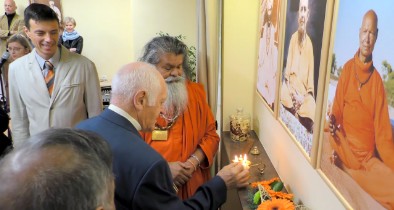
A ceremonial opening for a new yoga ashram in Slovenia, featuring addresses and spiritual teachings.
"Yoga is not specific to one country or one religion; yoga is universal."
"Yoga means balance, harmony, and unity... Yoga is a bright future for mankind, if they will use it."
Local representatives welcome guests and present symbolic gifts of bread, salt, and water. Swami Dayal Puri and the Indian Ambassador to Slovenia give speeches, celebrating the ashram's founding and explaining the ancient, universal science of yoga. The teachings cover yoga's origins in Shiva, its role in modern life for health and inner peace, and the importance of daily practice and willpower. The event concludes with Sanskrit mantras.
Filming locations: Murska Sobota, Prekmurje, Slovenia.
We all will come to oneness
22:50 - 23:29 (39 min)
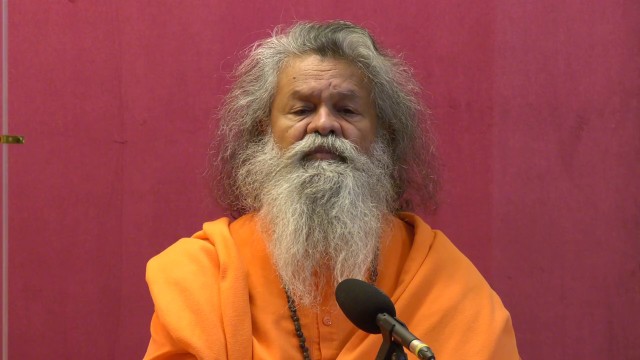
A satsang discourse on spiritual equality, service, and the soul's journey.
"Everyone, without exception, is equal in the eyes of our Gurujī, Mahāprabhujī."
"And when this ātmā, the soul, will go, then it is completely there. There is nothing; there is only one."
The lecturer addresses the community, emphasizing that all disciples—regardless of background or role—should be included in practices like pūjā. He teaches that service and respect form a spiritual family, illustrates oneness with an ocean metaphor for the soul, and shares an anecdote about Holy Gurujī and Mahāprabhujī to illustrate humble service.
Filming location: Vienna, Austria
The Unity of Humanity
23:35 - 0:06 (31 min)
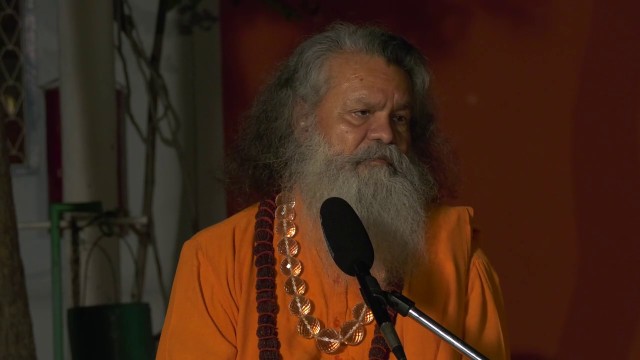
A spiritual discourse on universal unity and transcending human divisions.
"Does it matter which color, or which countries are this? We should now understand that God is everywhere."
"When we will die... There is nothing. Is that we are all? We are all."
A speaker addresses an audience, weaving together observations on geography, human migration, and history—often with factual inaccuracies and conflations of places like India, Australia, and Austria—to ultimately argue that national and religious identities are superficial. The core message is that all humans are fundamentally the same and should love one another, as all distinctions dissolve in death and before God. The talk concludes with a blessing for peace and brotherhood among all present.
Filming location: Jadan, Rajasthan, India
American
Australian