
European
The wisdom of the bhajans
0:00 - 0:21 (21 min)
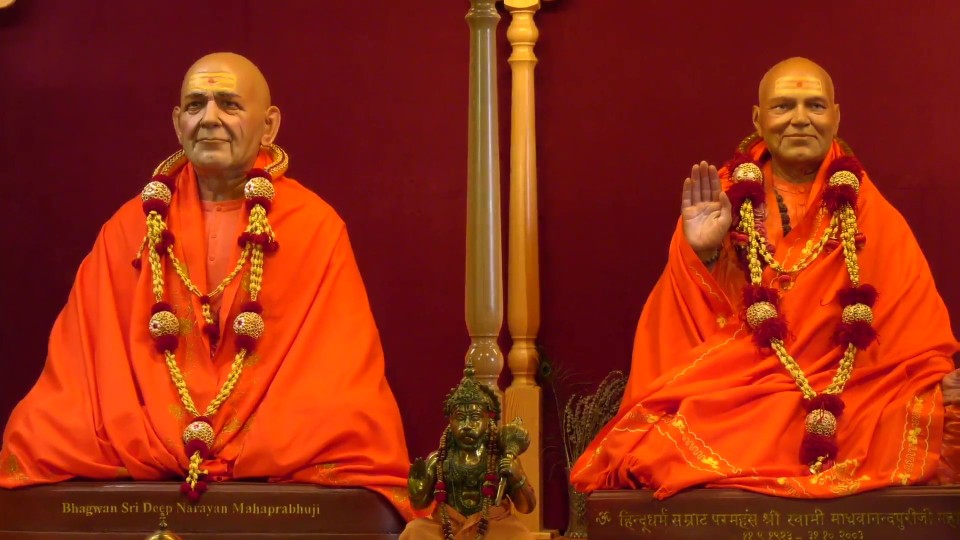
A satsang gathering focused on learning and understanding devotional bhajans.
"It is very good, beautiful bhajans are. Very good, but it is real because some people can understand, and many others, they like something is something, but we don't know the words about this."
"Gurujī Merā, my Gurū Dev. He gave me the Amara, which means the Unsterblichkeit, immortality... He came first to give me these herbs, so to speak, the immortality."
A speaker leads a session on the meaning of bhajans, emphasizing the need to understand the lyrics beyond just singing. They propose that the singer should explain each word. The session includes a detailed, bilingual (German and English) explanation of a specific bhajan dedicated to Gurudev, describing the gift of immortality and liberation from worldly attachments.
Filming location: Vienna, Austria
The drop returns to the ocean
0:25 - 0:39 (14 min)
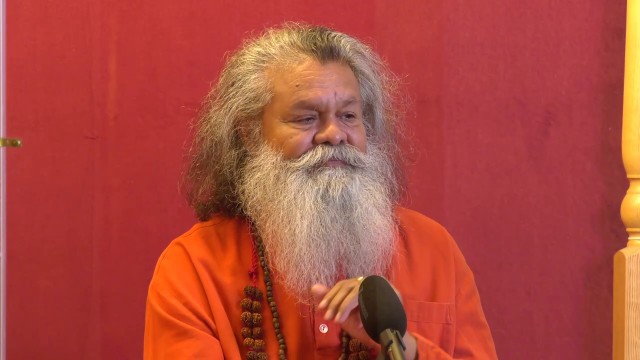
A spiritual talk on the practice of Brahmari pranayama and the nature of human life.
"Brahmari is very great. It is for the soul. And the whole brain—the whole brain—and it comes out the other side."
"Practice is where we are practicing, really, really... These Brahmari practices and these few things must be very, very, very good, everything."
A teacher addresses a gathering, offering guidance on the correct, pressure-free method for the humming bee breath (Brahmari), warning against overly long sessions. He shares personal reflections on inconsistent practice due to travel, then expands into broader themes of impermanence, using metaphors of birth, death, and a drop returning to the ocean to illustrate the soul's journey and the pursuit of purity.
Filming location: Vienna, Austria
The wisdom of the bhajans
0:45 - 1:06 (21 min)
A satsang gathering focused on learning and understanding devotional bhajans.
"It is very good, beautiful bhajans are. Very good, but it is real because some people can understand, and many others, they like something is something, but we don't know the words about this."
"Gurujī Merā, my Gurū Dev. He gave me the Amara, which means the Unsterblichkeit, immortality... He came first to give me these herbs, so to speak, the immortality."
A speaker leads a session on the meaning of bhajans, emphasizing the need to understand the lyrics beyond just singing. They propose that the singer should explain each word. The session includes a detailed, bilingual (German and English) explanation of a specific bhajan dedicated to Gurudev, describing the gift of immortality and liberation from worldly attachments.
Filming location: Vienna, Austria
The drop returns to the ocean
1:10 - 1:24 (14 min)
A spiritual talk on the practice of Brahmari pranayama and the nature of human life.
"Brahmari is very great. It is for the soul. And the whole brain—the whole brain—and it comes out the other side."
"Practice is where we are practicing, really, really... These Brahmari practices and these few things must be very, very, very good, everything."
A teacher addresses a gathering, offering guidance on the correct, pressure-free method for the humming bee breath (Brahmari), warning against overly long sessions. He shares personal reflections on inconsistent practice due to travel, then expands into broader themes of impermanence, using metaphors of birth, death, and a drop returning to the ocean to illustrate the soul's journey and the pursuit of purity.
Filming location: Vienna, Austria
Gurudev is for all of us
1:30 - 1:51 (21 min)
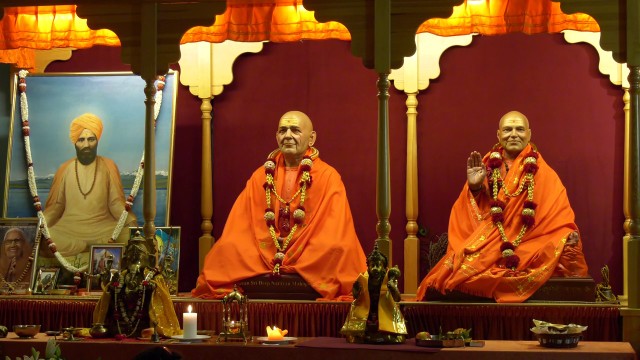
A spiritual discourse on unity, humility, and conduct within a community.
"Humans and our heart—we should be, and that is the best one, and that should have to be so."
"I'm not that God, but I'm only a servant, and a servant is for all."
A spiritual teacher addresses a gathering, emphasizing the oneness of the heart beyond physical or cultural differences. He discusses the need for humility, encouraging long-time attendees to make space for newcomers, and shares parables about compassion and containing anger. A listener interjects to agree and seek clarification on a practical ritual, to which the teacher responds by reiterating the core message of openness and inclusion.
Filming location: Vienna, Austria
Bhajans from Rijeka
1:55 - 2:23 (28 min)
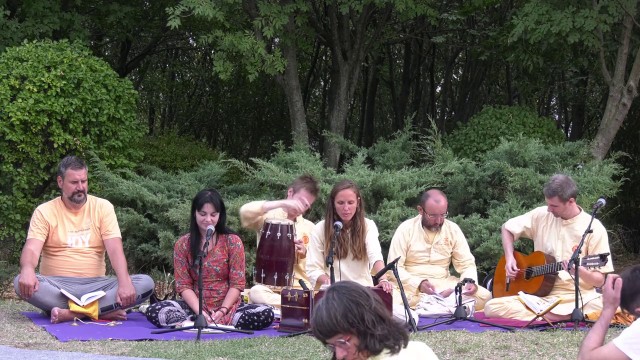
Evening satsang with Vishwaguruji from Rijeka Ashram, Croatia.
We should not be selfish
2:30 - 3:56 (86 min)
A satsang gathering featuring a discourse and personal testimony on spiritual practice.
"Yoga is the work on yourself. Remember this. That is the essence of the essence of the essence."
"We are all sitting in one big ferry. The Gurudev is the captain... Those who sit in it will come out of the ocean to the shore."
Brahmānanda Swāmījī opens the session by introducing Dr. Śānti, a long-time disciple, to share her experiences. Dr. Śānti speaks about the nature of satsang, analyzes the word "yoga," and stresses the importance of self-work, focus, and surrendering the ego. She shares personal stories, including a parable about a camel and a fox illustrating spiritual friendship, and discusses the challenges of Kali Yuga.
Filming location: Zagreb, Croatia
Opening Address: Yoga for World Peace and Non-Violence
4:00 - 4:07 (7 min)
An opening address for the "Yoga for World Peace and Non-Violence" International Conference in Prague.
"Yoga is not a religion. It represents the original balancing principle that promotes nonviolence and peacefulness."
"To achieve peace in the world, we must start by achieving inner peace ourselves."
A representative of the Czech Hindu Religious Society, Vishwaguru Deep Hindu Mandir, welcomes attendees and explains his organization's role in co-organizing the conference. He honors the spiritual lineage of Swami Madhavanandaji and Swami Maheshvaranandaji, detailing global humanitarian projects and drawing a direct connection between yogic principles like non-violence (ahimsa) and the universal pursuit of peace. The speech emphasizes inner peace as the foundation for world peace.
Filming location: Prague, Czech Republic
Around the world - World peace in your hands
4:15 - 4:18 (3 min)

A promotional video about the Yoga in Daily Life organization and its founder, Paramahaṁsa Svāmī Maheśvarānanda.
"All elements are balanced in a perfect way, and that balancing principle, that is what I call yoga."
"Be the change you want to see."
The video profiles the global humanitarian and spiritual work of Svāmījī, founder of Yoga in Daily Life. It details the organization's reach, its United Nations affiliation, and its practical projects in education, healthcare, environmental protection, and interfaith dialogue aimed at fostering inner and world peace.
The Unity of Humanity
4:25 - 4:56 (31 min)
A spiritual discourse on universal unity and transcending human divisions.
"Does it matter which color, or which countries are this? We should now understand that God is everywhere."
"When we will die... There is nothing. Is that we are all? We are all."
A speaker addresses an audience, weaving together observations on geography, human migration, and history—often with factual inaccuracies and conflations of places like India, Australia, and Austria—to ultimately argue that national and religious identities are superficial. The core message is that all humans are fundamentally the same and should love one another, as all distinctions dissolve in death and before God. The talk concludes with a blessing for peace and brotherhood among all present.
Filming location: Jadan, Rajasthan, India
Awakening energies in our body
5:00 - 6:10 (70 min)
Morning satsang with Vishwaguruji from Brisbane Ashram, Australia. Only 10 percent of the energies in our body are active. Exercise with the hands for awakening energies in the body. Meditation and breath technics to purify the energy.
In the bliss of bhajans
6:15 - 7:26 (71 min)
Bhajans from different ashrams in India
The drop returns to the ocean
7:30 - 7:44 (14 min)
A spiritual talk on the practice of Brahmari pranayama and the nature of human life.
"Brahmari is very great. It is for the soul. And the whole brain—the whole brain—and it comes out the other side."
"Practice is where we are practicing, really, really... These Brahmari practices and these few things must be very, very, very good, everything."
A teacher addresses a gathering, offering guidance on the correct, pressure-free method for the humming bee breath (Brahmari), warning against overly long sessions. He shares personal reflections on inconsistent practice due to travel, then expands into broader themes of impermanence, using metaphors of birth, death, and a drop returning to the ocean to illustrate the soul's journey and the pursuit of purity.
Filming location: Vienna, Austria
The living God
7:50 - 8:48 (58 min)
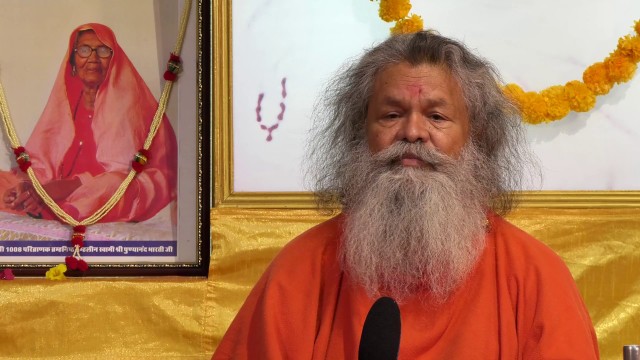
Evening satsang from Jadan Ashram, Rajasthan, India. Science is developing, which is good. Yoga is the science of the human being.The story of the professor who met a yogi while walking in the park. Where can we find God? Have you seen God? According to the teachings of Sanatana Dharma and Yoga, God lives here among us. Everyone has seen God. Each and every one of us is the living God, just like the ocean water is present in the raindrop. The same life is in all living beings. That is why we should not kill animals.
Without Gurudev we cannot be successful
8:55 - 9:52 (57 min)
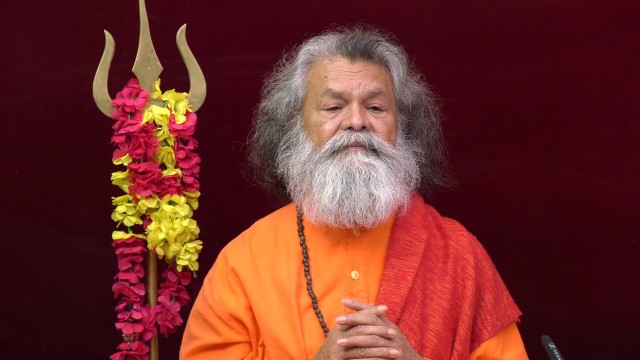
An evening satsang and yoga practice session on the necessity of the guru.
"Yoga has existed since the beginning of the Satya Yuga. It accompanies us through all ages and is present in every era."
"Gurū sa bina kārya na jaisā... Without Gurudeva, whatever we want to achieve cannot be done without Gurudeva."
A spiritual teacher addresses a global audience, explaining the eternal nature of yoga and the essential role of a true guru (Gurudeva) for spiritual success, emphasizing that self-effort alone cannot cross the ocean of worldly existence. He references a bhajan by Mahāprabhujī and discusses the soul's journey. The session transitions into a guided yoga practice led by Swami Umapuri, beginning with deep relaxation (Ānanda āsana) and proceeding through gentle stretches and torsion exercises for the spine and joints, concluding with a collective "Om" and peace chants.
Filming location: Bari Khatu, Rajasthan, India
The sounds of the bhajans are the light of God
10:00 - 10:54 (54 min)
Evening satsang with Vishwaguruji from Strilky Ashram, Czech Republic. Bhajan singing. It is the time when we should be alert in ourselves. Humans are developed very much in science and in spirituality too. God gave us everything in our body and our soul. We should worship everybody and everything. We should be humble to everybody. No war np fighting. The sounds of the bhajans are the light of God. Bhajan singing.
Feel the inner peace
11:00 - 12:06 (66 min)
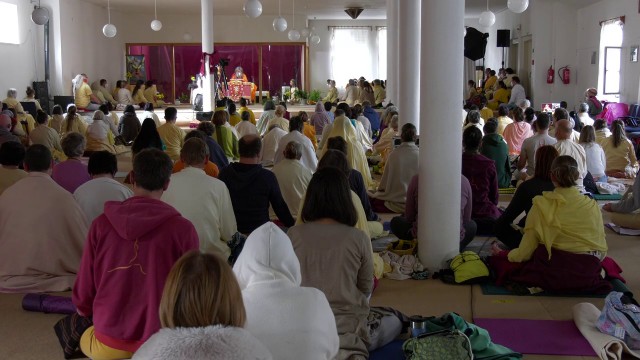
Morning satsang with Vishwaguruji from Strilky Ashram, Czech Republic. Relaxation in a sitting position and meditation. Relaxation in lying position. Practicing Bari Khatu Pranam.
Gurudev is the servant of everyone
12:10 - 12:58 (48 min)
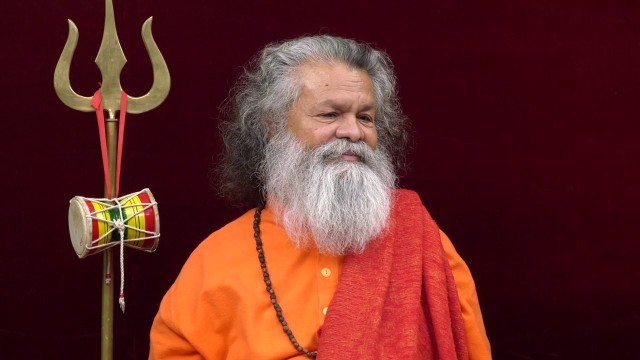
An evening satsang on humility, divine grace, and the guru-disciple relationship.
"Be very humble towards all, and you should bow down to them. Do not say, 'I am great,' and go."
"Guru is the Sākṣāt, the real life living with us, Parabrahma... Mokṣa mūlaṁ gurur kṛpā—liberation will be when we are at the feet of the Gurudev."
Paramhans Swami Maheshwarananda addresses a global audience, weaving personal anecdotes, analogies from nature, and teachings from his lineage. He emphasizes humility, stating that God provides for all creatures, and explores the guru's role as the embodiment of the divine and the source of liberation, concluding with traditional Sanskrit prayers.
Filming location: Strilky, Czech Republic
Control your energy and mind
13:05 - 14:08 (63 min)
A spiritual discourse on the human journey and the five sheaths (kośas), following a tree-planting ceremony.
"The tree gives shade and fruit to everybody. Rain falls equally for everybody. The river flows for everybody, and the sun shines for everybody."
"Yoga is the science of humans... we have to go through Annamaya Kośa, Prāṇamayakośa, Manomayakośa, etc."
Swami Maheshwarananda (Viśva Gurujī) addresses an audience in Samobor, beginning with reflections on the symbolic planting of eleven trees. He expounds on the soul's journey through various life forms, the balancing principles of the sun and moon within yogic physiology, and the path of spiritual evolution through the five sheaths—from the physical body (Annamaya Kośa) to the bliss sheath (Ānandamaya Kośa). He emphasizes mastering the restless mind (Manomaya Kośa) as key to overcoming suffering and progressing toward higher consciousness.
Filming location: Croatia
Awakening energies in our body
14:15 - 15:25 (70 min)
Morning satsang with Vishwaguruji from Brisbane Ashram, Australia. Only 10 percent of the energies in our body are active. Exercise with the hands for awakening energies in the body. Meditation and breath technics to purify the energy.
We should not be selfish
15:30 - 16:56 (86 min)
A satsang gathering featuring a discourse and personal testimony on spiritual practice.
"Yoga is the work on yourself. Remember this. That is the essence of the essence of the essence."
"We are all sitting in one big ferry. The Gurudev is the captain... Those who sit in it will come out of the ocean to the shore."
Brahmānanda Swāmījī opens the session by introducing Dr. Śānti, a long-time disciple, to share her experiences. Dr. Śānti speaks about the nature of satsang, analyzes the word "yoga," and stresses the importance of self-work, focus, and surrendering the ego. She shares personal stories, including a parable about a camel and a fox illustrating spiritual friendship, and discusses the challenges of Kali Yuga.
Filming location: Zagreb, Croatia
Practicing of the system 'Yoga in Daily Life', Level 3 - Part 1
17:00 - 18:00 (60 min)
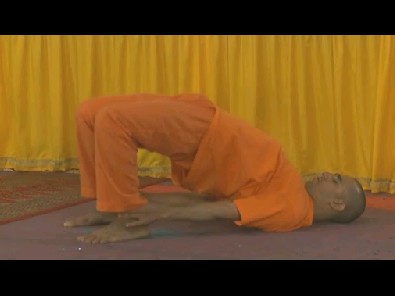
Practicing of the system "Yoga in Daily Life", Level 3 - Part 1, in Om Vishwa Deep Gurukul Swami Maheshwaranand Ashram, Jadan, Rajasthan, India on 27th of October 2009.
Without Gurudev we cannot be successful
18:05 - 19:02 (57 min)
An evening satsang and yoga practice session on the necessity of the guru.
"Yoga has existed since the beginning of the Satya Yuga. It accompanies us through all ages and is present in every era."
"Gurū sa bina kārya na jaisā... Without Gurudeva, whatever we want to achieve cannot be done without Gurudeva."
A spiritual teacher addresses a global audience, explaining the eternal nature of yoga and the essential role of a true guru (Gurudeva) for spiritual success, emphasizing that self-effort alone cannot cross the ocean of worldly existence. He references a bhajan by Mahāprabhujī and discusses the soul's journey. The session transitions into a guided yoga practice led by Swami Umapuri, beginning with deep relaxation (Ānanda āsana) and proceeding through gentle stretches and torsion exercises for the spine and joints, concluding with a collective "Om" and peace chants.
Filming location: Bari Khatu, Rajasthan, India
The wisdom of the bhajans
19:10 - 19:31 (21 min)
A satsang gathering focused on learning and understanding devotional bhajans.
"It is very good, beautiful bhajans are. Very good, but it is real because some people can understand, and many others, they like something is something, but we don't know the words about this."
"Gurujī Merā, my Gurū Dev. He gave me the Amara, which means the Unsterblichkeit, immortality... He came first to give me these herbs, so to speak, the immortality."
A speaker leads a session on the meaning of bhajans, emphasizing the need to understand the lyrics beyond just singing. They propose that the singer should explain each word. The session includes a detailed, bilingual (German and English) explanation of a specific bhajan dedicated to Gurudev, describing the gift of immortality and liberation from worldly attachments.
Filming location: Vienna, Austria
We need real dedication
19:35 - 20:33 (58 min)
Evening Satsang with Vishwaguruji from Jadan Ashram, Rajasthan, India. There are two kinds of people living separately or in the family. Orange dress means renunciation. The story about two brothers one of them was studied and the other lived a spiritual life alone in a forest. There are two kinds of bhava. One is where there is some wish and the other has no wish. Birds know that there is their child in the eggs. Swami Haripuri speaks about his daily life and his spiritual experiences in different Ashrams.
The wisdom of the bhajans
20:40 - 21:01 (21 min)
A satsang gathering focused on learning and understanding devotional bhajans.
"It is very good, beautiful bhajans are. Very good, but it is real because some people can understand, and many others, they like something is something, but we don't know the words about this."
"Gurujī Merā, my Gurū Dev. He gave me the Amara, which means the Unsterblichkeit, immortality... He came first to give me these herbs, so to speak, the immortality."
A speaker leads a session on the meaning of bhajans, emphasizing the need to understand the lyrics beyond just singing. They propose that the singer should explain each word. The session includes a detailed, bilingual (German and English) explanation of a specific bhajan dedicated to Gurudev, describing the gift of immortality and liberation from worldly attachments.
Filming location: Vienna, Austria
Just be humble and give
21:05 - 21:51 (46 min)
A satsang on global unity, human conduct, and healing the planet.
"Morning, when I wake up, I see my eyes open, and what I said, 'I am what?' Human. Human."
"We have destroyed the earth. All is for Mother Earth. Whatever we are bringing, all that is happening, why not we give some good?"
He laments humanity's destructive impact on Mother Earth, criticizing violence, pollution, and a disconnect from natural ways. He calls for a return to humility, oneness, and prayer, urging listeners to mentally offer peace and compassion to all beings through mantra and a heartfelt connection to the planet.
Filming location: Vienna, Austria
We come and go
21:55 - 22:41 (46 min)
A spiritual talk and community address in a holy place after a long absence.
"After a long time, we are again here—nearly about three years or a little more. We were all very much thinking about when we would come here for our practice, yoga, etc."
"The memory, the memory remains... But they are gone. Their body is gone. But they remain. What? Their name. Their name. And this name remains forever."
Swami Maheshvaranandji addresses a gathering, reflecting on the long-awaited return to a sacred location and honoring the legacy of devotees like Krishnananda. He discusses the eternal nature of the Guru's name, the human journey from animal-like origins to spiritual awareness, and offers guidance on diet, dress, and the importance of practice for health and spiritual growth. The talk includes personal observations and calls for communal participation.
Filming location: Vép, Hungary
The Divali Festival
22:45 - 23:04 (19 min)
A spiritual discourse reflecting on Diwali, divine grace, and devotional narratives.
"From there, from there, this day, the day we see, this Dīvālī, with this Dīvālī, so in the whole world, it was with all the people."
"Now someone has said, and he has done, Rādhā. So Rādhā is there. Rādhā is a devotee, his disciple. She is not his wife."
In a satsang, a speaker offers a contemplative and stream-of-consciousness talk centered on the festival of Diwali. The narrative weaves together references to Lord Śiva, Viṣṇu, Rāma, and Kṛṣṇa, exploring themes of divine presence, grace, and devotion. The talk includes reflections on Rukmiṇī and Rādhā's relationship with Kṛṣṇa, and draws a parallel to Christian practice, all culminating in chants of "Om Rām Rām."
Filming location: Jadan, Rajasthan, India
The Unity of Humanity
23:10 - 23:41 (31 min)
A spiritual discourse on universal unity and transcending human divisions.
"Does it matter which color, or which countries are this? We should now understand that God is everywhere."
"When we will die... There is nothing. Is that we are all? We are all."
A speaker addresses an audience, weaving together observations on geography, human migration, and history—often with factual inaccuracies and conflations of places like India, Australia, and Austria—to ultimately argue that national and religious identities are superficial. The core message is that all humans are fundamentally the same and should love one another, as all distinctions dissolve in death and before God. The talk concludes with a blessing for peace and brotherhood among all present.
Filming location: Jadan, Rajasthan, India
Humans are very good and not good at the same time
23:45 - 0:19 (34 min)
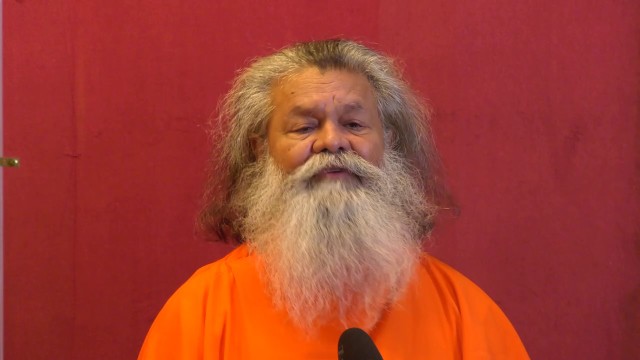
A spiritual discourse on the essence of satsaṅg and universal consciousness.
"Sat and saṅg, these two come together; that's enough. Always try to see yourself."
"Life is one. They don't understand, but we know, humans, we know. That's good, yes, very good. But that life, whether it is a human or an ant, is okay."
A spiritual teacher delivers an extemporaneous talk, exploring the meaning of true company (satsaṅg) and the singular life force in all beings. He uses parables, including one about a skeptic and God on a Himalayan rock face, and reflections on human nature versus animals to illustrate the unity of existence and the importance of non-violence. The discourse includes devotional singing.
Filming location: Vienna, Austria
American
Australian