
European
Morning Yoga practice, Umag, Croatia (5/9)
0:00 - 1:31 (91 min)
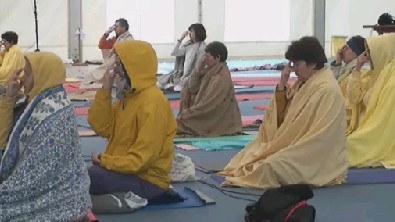
Morning Yoga practice from the international Yoga retreat Umag, Croatia on 29th of September 2010.
Yoga is a science
1:35 - 2:54 (79 min)
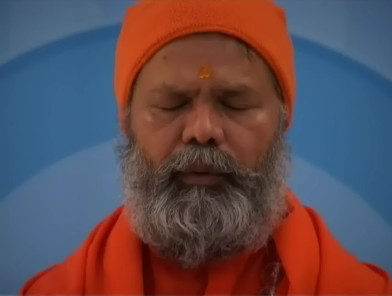
A spiritual lecture on Kuṇḍalinī, chakras, and the purpose of human life.
"Yoga is the science of body, mind, consciousness, and soul. Yoga without spirituality is like a body without a soul."
"Chakra is that which is purifying our body, mind, and consciousness. Chakra has to be purified through practice of mantra, prayers, or some yogic kriyās. Then the kuṇḍalinī will awake."
The teacher continues a multi-day seminar, delving into the nature of human consciousness through the lens of Kuṇḍalinī energy and the chakra system. He explains the five layers of the body (kośas), the persistence of karma using an analogy of salt in water, and the symbolism of the Mūlādhāra chakra—its red color, lotus imagery, and four petals representing the four aims of life: dharma, artha, kāma, and mokṣa. The discourse expands into themes of universal love, friendship, and living in the world with detachment, like a lotus in water.
Filming location: Australia
Part 1: The Practice of Śalabhāsana and Complementary Āsanas
3:00 - 3:59 (59 min)
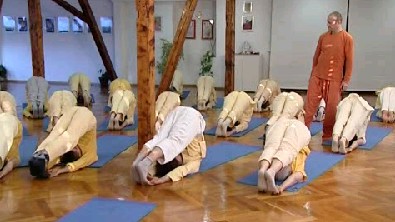
A detailed yoga class instruction covering śalabhāsana, sarvāṅgāsana, and prāṇāyāma.
"Śalabhāsana, being a backward bend that requires strong muscles, works very well on our self-confidence. It strengthens the sense of power and vitality."
"In this posture, simply allow one subtle, extended exhalation. This posture works on unburdening the heart, so less pumping is needed to nourish the brain."
An instructor guides students through a sequence of āsanas, including śalabhāsana (locust pose) variations, sarvāṅgāsana (shoulderstand), and halāsana (plow pose), explaining their physical and energetic benefits. The session incorporates preparatory poses, counterposes, and detailed alignment cues, concluding with instructions for Bhastrikā prāṇāyāma and a collective Oṁ chant.
Filming location: Zagreb, Croatia
Around the world - Yoga Class of Level 6, Zagreb
4:05 - 5:06 (61 min)
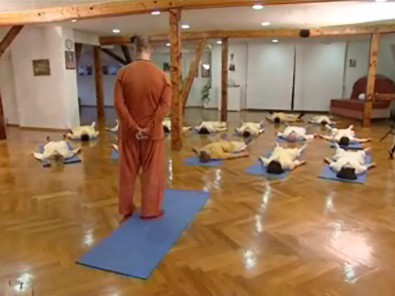
Yoga in Daily Life Class of Level 6 at Sri Devpuriji Ashram, Zagreb, Croatia.
Vegetarian cooking lesson 11, Kadhi soup, Okra and chapatis
5:00 - 5:14 (14 min)

A cooking demonstration on preparing Marwa-style gāṭṭā kadhi, chapati, and regional vegetables.
"When I was thinking about how to explain or show the gāṭṭā... it came to my mind that it is like the attachment of this world. When we touch the besan dough, it sticks very quickly. Then we use the oil of wisdom, which gets rid of the attachment."
"The Marwa kitchen has very, very delicious food—spicy, tasty, healthy, and very natural. The people living there eat only regional food. They know the leaves and fruits growing in their area."
The speaker guides viewers through making kadhi with chickpea flour dumplings (gāṭṭā), using the sticky dough as a metaphor for worldly attachment. The process includes preparing the dough with yogurt and spices, boiling and testing the gāṭṭā, and making chapati. The talk highlights regional Marwa cuisine, mentioning local ingredients like guṇḍā and the health benefits of bitter gourd, which is promised for a future lesson.
Filming location: Vép, Hungary
Live webcast from Strilky
5:00 - 6:30 (90 min)
Morning satsang from Strilky Ashram, Czech Republic.
Experiences of bhaktas about Vishwaguruji
5:00 - 6:09 (69 min)
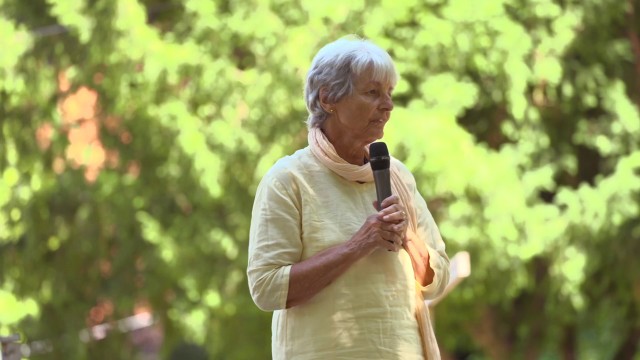
Morning satsang from Strilky Ashram, Czech Republic. "Yesterday, the topic was karma yoga, and I realized that for me, this has been the main form of yoga for the past twenty years. It is a very practical way to submit ourselves to the Supreme. Swamiji and his successor, Swami Avatarpuriji, are the way for us. " "Holi Guruji always said: One in all and all in one. For me, the starting point was a book about the relationship between the Master and his disciple. Then a strong desire arose in me to find an original, genuine Indian Guru. The next day, I saw a poster at the university announcing a lecture by an original, genuine Indian Guru." "I went to the next seminar every time. At the second seminar, I asked Swami ten questions, and he gave me the task of establishing a yoga center." Swami Avatarpuri leads the mansik puja to Gurudeva. Swami Avatarpuri leads the mansik puja to Gurudeva.
How to overcome the obstacles of practicing
5:20 - 6:38 (78 min)
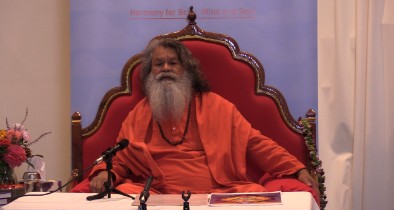
A spiritual discourse on the chakra system, focusing on the Maṇipūra chakra and the journey of self-mastery.
"My first master was my father, who imparted immense knowledge in a simple way. Through his instruction, I found my path."
"Strive for oneness, purity, without blemish. Do not stain your body."
Swami Maheśvarānand leads a satsang, weaving teachings on the manipura (navel) chakra with personal stories from his childhood and path to sannyas. He explains the symbolic animals and deities within each chakra, the role of the guṇas (qualities), and the necessity of a guru's guidance. The talk emphasizes practical discipline, advocating for specific prāṇāyāma techniques like Kapālabhāti and Bhastrikā to awaken inner energy, and concludes with a blessing.
Filming location: Wellington, New Zealand
You are free to choose good or bad
6:45 - 7:29 (44 min)
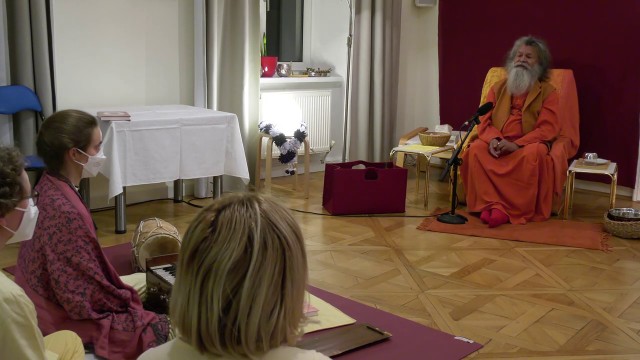
Evening satsang with Vishwaguruji from Linz, Austria. An instrument is a simple construction, but it can give very beautiful sounds. Our body is also like an instrument. We are free to do good or bad things. From our childhood we can develop in good or bad direction also. The story of a tiger baby who mixed among the sheeps. Everybody should know why we shouldn't to eat meat. Bhajan singing.
Yoga Nidra or bhajan singing is like meditation
7:35 - 8:50 (75 min)
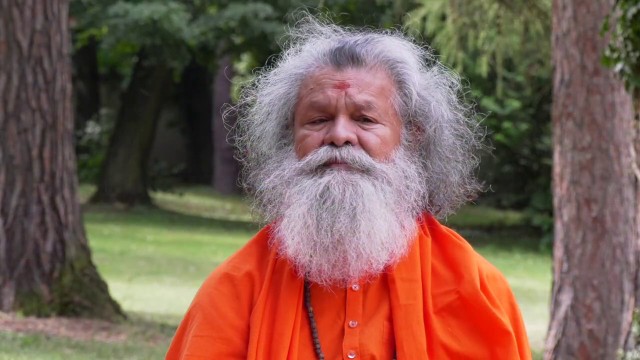
Morning satsang with Vishwaguruji from Strilky Ashram, Czech Republic. Singing bhajan Yogi jano ki Yoga Nidra. Bhajans sometimes are like meditation. We are awakened but in that state, it is very good to do yoga nidra or sing bhajans. There is a difference between yogi and rogi. The story of a great yogi and a young girl in Jaipur. The other story of an Italian professor and Vishwaguruji. The story of why Vishwaguruji changed the name of savasana to anandasana. Practising relaxation and bhramari pranayama.
Anahat Chakra
8:55 - 10:50 (115 min)

Public lecture about Anahat chakra in Zagreb Croatia in April 2007.
Around the world - Practice in Ukraine
11:00 - 11:50 (50 min)
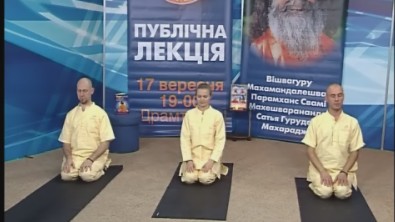
A guided yoga practice session from the Yoga in Daily Life system.
"Physical relaxation leads to spiritual relaxation. Relaxation is an important element for the proper practice of yogic exercises."
"Ānanda Āsana translates as 'the posture of bliss.' Observe how bliss flows throughout your entire body."
An instructor leads a comprehensive sequence of postures (āsanas), breathwork (prāṇāyāma), and relaxation. The practice begins and ends with Ānanda Āsana for deep relaxation, and includes abdominal breathing, spinal twists, stretches, and joint mobility exercises while lying, sitting, and standing. The session concludes with a final relaxation and a moment of gratitude.
Filming location: UK
Shivaratri Satsang with Vishwaguruji
11:55 - 12:30 (35 min)
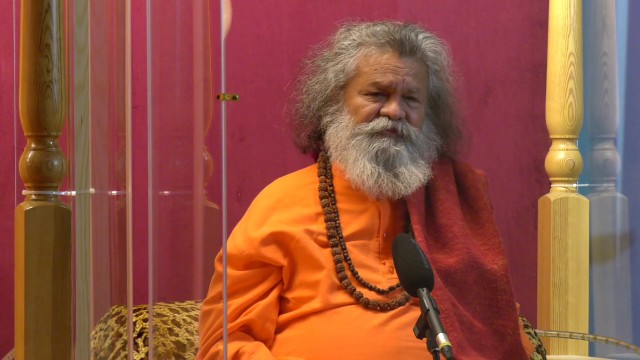
A spiritual discourse on the unity of consciousness, the elements, and the nature of the guru.
"And so it is that we are never separate. We are always with one and one and one."
"You are all guru. Guru means who is giving us. What means giving us? Training, etc."
An elder teacher addresses a gathering, weaving together cosmological concepts of Śiva and Śakti, the five elements, and the pervasive presence of the ātmā (soul). He explains fundamental oneness using the metaphor of a drop merging with the ocean, and expansively defines the guru as any source of knowledge, from a parent to a driving instructor. The talk touches on comparative religion, personal anecdotes, and concludes with an invitation for future meditation.
Filming location: Vienna, Austria
Karma and koshas
12:35 - 13:31 (56 min)
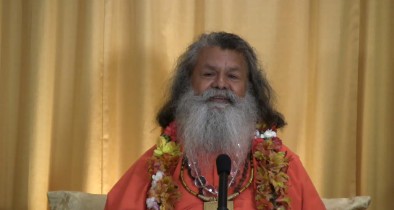
A spiritual discourse on the soul's journey, karma, and the five sheaths of being.
"When this all went back to the astral world, it was not easy... All the time in the astral world, the certain situation of the karma, the destiny, is going on."
"God has given the humans that 'I give you the freedom. Now I liberate you.' But there is a 'but.' Whatever you will do again, you have to face the karma."
A spiritual teacher delivers a satsang, explaining the cycle of birth, death, and karma across the astral and mortal worlds. He uses parables, like walking through a coal mine, to illustrate the challenges of human life and the consequences of action. The talk introduces the first two of the five kośas (sheaths), focusing on the physical (annamaya) and energy (prāṇamaya) bodies, emphasizing proper nourishment and life force.
Filming location: Alexandria, USA
Live webcast from Strilky
13:30 - 15:00 (90 min)
Evening satsang from Strilky Ashram, Czech Republic.
Purnima satsang
13:35 - 14:29 (54 min)
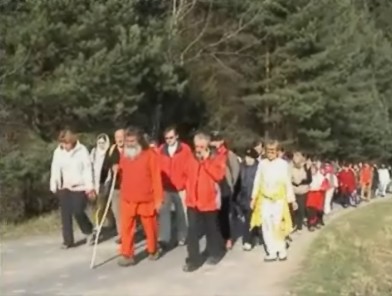
Swamiji in Sliac.
Questions and answers from Debrecen
14:35 - 15:15 (40 min)
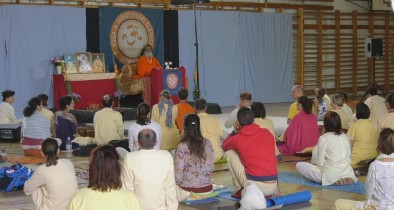
A satsang addressing practical yogic living and dietary discipline.
"If you really want to do your yoga sādhānā, then, first control over your tongue, the test. You will see that 90% of all difficulties in your body will disappear."
"Yoga begins with discipline. Atha yoga anuśāsana."
Swami Satyananda Saraswati answers questions from attendees, first offering advice on starting a yogic farm community in Hungary. He then delivers a core teaching on foundational spiritual practice, emphasizing strict dietary control (limited intake, no snacking, avoidance of processed foods and alcohol) as the primary step for health, discipline, and preparing for meditation. He expands on the importance of satsang, prāṇāyāma, and consuming local, organic, seasonal foods, using soy cultivation and an anecdote about Australian milk regulations as cautionary examples.
Filming location: Debrecen, Hungary
Bhajan evening in the Jadan Ashram
15:30 - 16:09 (39 min)
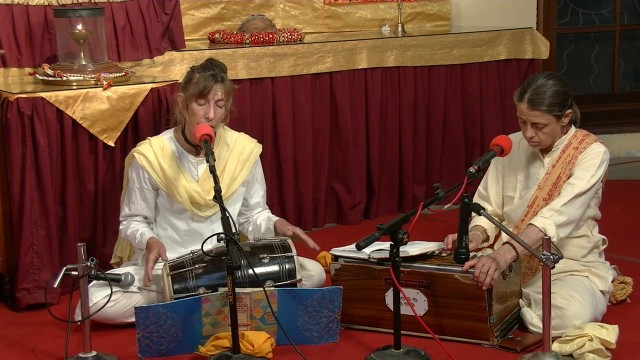
Evening satsang from Jadan Ashram, Rajasthan, India. Bhajan singing.
Bhajan singing in the Jadan Ashram
16:15 - 17:33 (78 min)
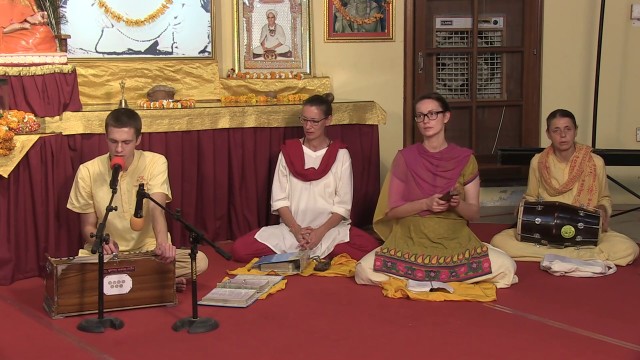
Evening satsang with Vishwaguruji from Jadan Ashram, Rajasthan, India. Bhajan singing evening.
Bhajan evening in Jadan Ashram
17:40 - 18:02 (22 min)
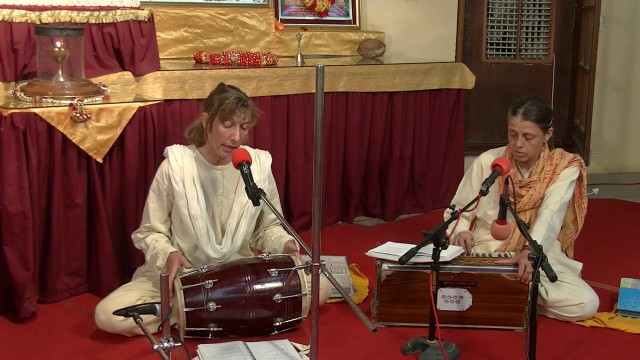
Evening satsang with Vishwaguruji from Jadan Ashram, Rajasthan, India. Bhajan singing.
Bhajan evening from Jadan Ashram
18:10 - 18:47 (37 min)
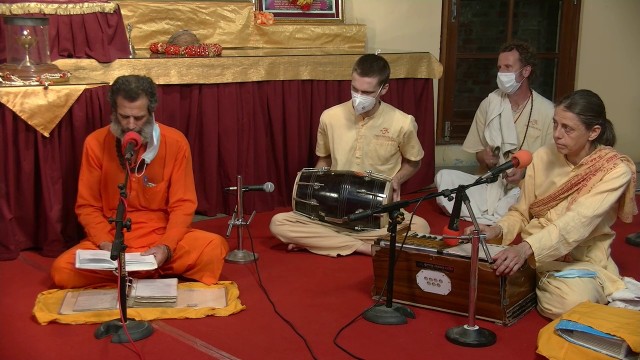
Evening satsang with Vishwaguruji from Jadan Ashram, Rajasthan, India. Bhajan singing.
Our heart is very great
18:55 - 19:28 (33 min)
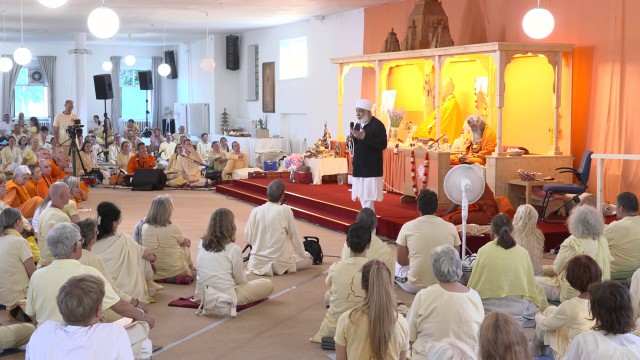
A satsang discourse on the universal sound of Om and the spiritual practice of surrender.
"In India, a name changes with region. In North India, you have Rāma. In Middle India, it becomes Rāma. In South India, it becomes Rāmaṇ."
"The easiest option is to let go, put it down, and allow the mind to become peaceful. The happiest thing is simply to let it be, to release it calmly and let it flow."
A speaker first explains the universality of Om, linking it to the words 'Amen' and 'Amin', and discusses his work promoting Indian traditional sciences in European parliaments. Swami Maheshvaranand then shares a teaching story about a restless monkey to illustrate how surrendering thoughts leads to peace, emphasizing meditation and devotion to the Guru.
Filming location: Strilky, Czech Republic
Muladhara chakra. Part one.
19:35 - 20:07 (32 min)
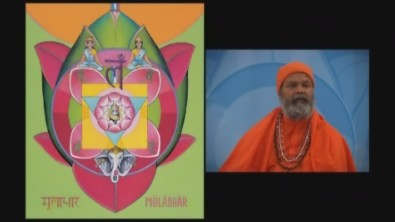
A spiritual discourse on the necessity of a guru and the symbolism of the Mūlādhāra chakra.
"Yoga without spirituality is a body without a soul. A part of yoga requires a master."
"Your being in this world is more needed than you think. Therefore, never think that you want to die now."
Swami Anand Arun explains the essential role of a spiritual guide (guru), using analogies like learning to drive. He then details the Mūlādhāra (root) chakra, describing its red color, earth element, and the lotus as a symbol for living in the world with detachment. He emphasizes serving others with love and wisdom, urging attendees to be a light for others.
Filming location: Brisbane, Australia
Yoga is a science
20:15 - 21:34 (79 min)
A spiritual lecture on Kuṇḍalinī, chakras, and the purpose of human life.
"Yoga is the science of body, mind, consciousness, and soul. Yoga without spirituality is like a body without a soul."
"Chakra is that which is purifying our body, mind, and consciousness. Chakra has to be purified through practice of mantra, prayers, or some yogic kriyās. Then the kuṇḍalinī will awake."
The teacher continues a multi-day seminar, delving into the nature of human consciousness through the lens of Kuṇḍalinī energy and the chakra system. He explains the five layers of the body (kośas), the persistence of karma using an analogy of salt in water, and the symbolism of the Mūlādhāra chakra—its red color, lotus imagery, and four petals representing the four aims of life: dharma, artha, kāma, and mokṣa. The discourse expands into themes of universal love, friendship, and living in the world with detachment, like a lotus in water.
Filming location: Australia
How to overcome the obstacles of practicing
21:40 - 22:58 (78 min)
A spiritual discourse on the chakra system, focusing on the Maṇipūra chakra and the journey of self-mastery.
"My first master was my father, who imparted immense knowledge in a simple way. Through his instruction, I found my path."
"Strive for oneness, purity, without blemish. Do not stain your body."
Swami Maheśvarānand leads a satsang, weaving teachings on the manipura (navel) chakra with personal stories from his childhood and path to sannyas. He explains the symbolic animals and deities within each chakra, the role of the guṇas (qualities), and the necessity of a guru's guidance. The talk emphasizes practical discipline, advocating for specific prāṇāyāma techniques like Kapālabhāti and Bhastrikā to awaken inner energy, and concludes with a blessing.
Filming location: Wellington, New Zealand
Prana and pranayam
23:05 - 23:52 (47 min)
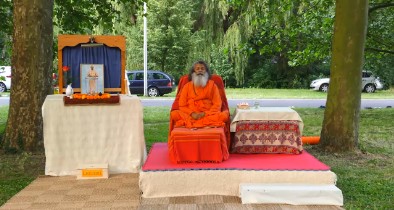
A spiritual discourse on prāṇāyāma and the interconnectedness of life, addressing modern pollution.
"To pollute the earth is a sin. It means you pollute Mother Earth."
"The most dangerous pollution is in the human mind. And that mind is so polluted, and of course, everyone is proud of that—how much my mind is polluted."
Swami Madhavan Ji delivers an evening talk, beginning with the science of breath (Pūrak, Rechak, Kumbhak) and the sacredness of Sanskrit. He expands the theme to describe a profound chain of pollution: of the Earth, our physical bodies through toxins, and finally our minds through negative thoughts. He presents yoga and prāṇāyāma as the essential science to purify these layers, explaining how breathwork balances the Ida and Pingala nadis and burns away karmic impurities, ultimately leading to unity with Brahman.
Filming location: Vép, Hungary
American
Australian