
European
Yoga in Daily Life - exercise program
0:00 - 1:29 (89 min)

Morning Yoga exercise according to system Yoga in Daily Life from Mahaprabhudeep Ashram, Strilky, Czech Republic.
We are a part of God
1:35 - 2:45 (70 min)
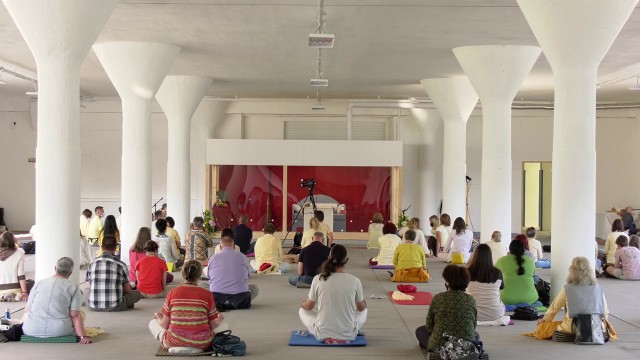
A spiritual discourse on the unity of yoga and the soul's journey.
"Yoga is not only physical, for the physical body, or just breath and concentration, etc. Yoga is very far-reaching."
"I said, your soul, your ātmā in you is your God."
A teacher addresses a gathering, explaining that all forms of yoga are one and that practice is a lifelong endeavor. He describes the soul's cyclical journey through 8.4 million life forms, the divine nature within each person, and the ultimate aim of merging with the cosmic consciousness. He concludes with a practical morning ritual, encouraging attendees to affirm "I am human" upon waking.
Filming location: Slovenia
Purnima satsang
2:50 - 3:44 (54 min)
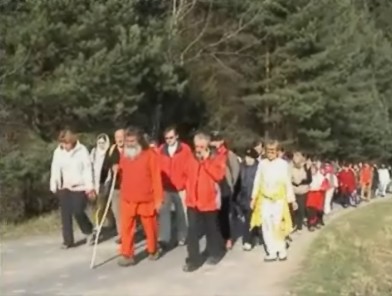
Swamiji in Sliac.
Influence of karmas on the soul
3:50 - 4:40 (50 min)
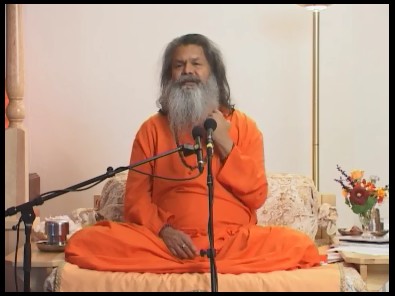
Morning lecture from the weekend seminar in Vienna, Austria with translation in English.
How to overcome the obstacles of practicing
4:45 - 6:03 (78 min)
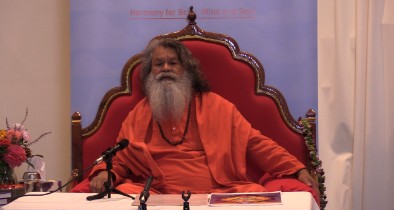
A spiritual discourse on the chakra system, focusing on the Maṇipūra chakra and the journey of self-mastery.
"My first master was my father, who imparted immense knowledge in a simple way. Through his instruction, I found my path."
"Strive for oneness, purity, without blemish. Do not stain your body."
Swami Maheśvarānand leads a satsang, weaving teachings on the manipura (navel) chakra with personal stories from his childhood and path to sannyas. He explains the symbolic animals and deities within each chakra, the role of the guṇas (qualities), and the necessity of a guru's guidance. The talk emphasizes practical discipline, advocating for specific prāṇāyāma techniques like Kapālabhāti and Bhastrikā to awaken inner energy, and concludes with a blessing.
Filming location: Wellington, New Zealand
The Effect of Karma on the Soul
6:10 - 6:51 (41 min)
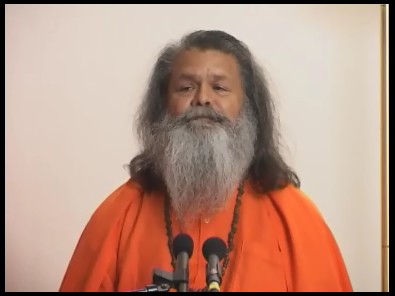
A spiritual discourse exploring karma and liberation through two illustrative stories.
"The soul in this cobra was a great bhakta, a dedicated scholar. But he did not yet renounce his goal... he has gone through his karma, and now it is time for him to be granted Mokṣa, liberation."
"If someone slaps you, then you are to blame, not the other who slaps you... You were there, that is how it is. Therefore, accept what happens."
The speaker narrates two parables to explain the effect of karma on the soul. The first describes how the sage Mahāprabhujī liberated the soul of an old cobra, revealing it was a former devotee working through its karma. The second tells of Saint Sagramdās, who encounters a camel bearing the karma of a cruel tax collector. Through these stories, the discourse emphasizes that beings reap the consequences of their actions across lifetimes, and that selfless service (Sevā) is the supreme path to lightening one's karmic burden.
Filming location: Vienna, Austria
Detachment and Liberation
6:55 - 8:06 (71 min)
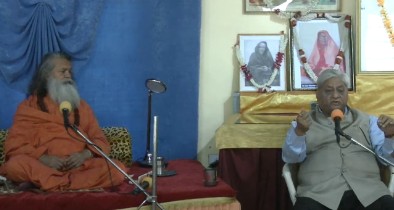
A satsang featuring a discourse by scholar Śrī Gulābjī Kothārī on spiritual life and householder duties.
"Today is a very auspicious day, a holy day, a divine day, a day full of colour and happiness."
"The basic aim of life is... everybody should prosper and have a good life. But once it is over at 50, you are moving towards the society, then you move towards... the path has changed to enlightenment."
Swami Maheshvarananda introduces the visiting scholar Śrī Gulābjī Kothārī to the ashram gathering. Gulābjī delivers an extensive talk on integrating spiritual practice with worldly life, framing existence within the Vedic puruṣārthas (dharma, artha, kāma, mokṣa). He explains the journey of the soul, the importance of living in the present, and details a cosmology where food (annam) and the elements (Agni and Soma) link human life to the universe. A significant portion addresses the dynamics of married life (Gṛhasthāśrama), described as a 25-year period where complementary masculine and feminine principles unite for creation and spiritual growth. The session concludes with a question-and-answer segment where Gulābjī and Swamiji discuss challenges to family life in the modern West, emphasizing traditional gender roles.
Filming location: Jadan, Rajasthan, India
Mind and chakras
8:10 - 8:35 (25 min)
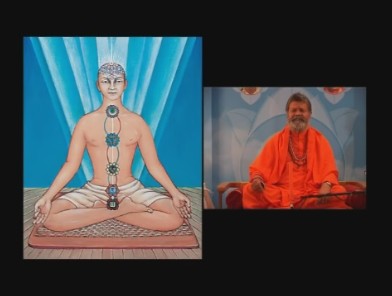
A lecture on the nature of the mind, subconscious impressions, and yogic philosophy.
"Our senses are mostly connected to and work with the consciousness, the awakened state."
"The mind is that principle which functions between the conscious and subconscious, pendling up and down."
The teacher provides a detailed explanation of how sensory impressions become stored desires in the subconscious, using the analogy of an unfulfilled ice cream craving manifesting in a dream. He describes the mind as a pendulum between conscious and subconscious levels, warning against blocking mental energy and instead advocating for directing it through self-discipline. The talk expands into the relationship between emotion, intellect, consciousness, and the nadis (Ida, Pingala, Sushumna), linking psychological concepts to the chakra system and the dormant energy of kundalini.
Filming location: Brisbane, Australia
Yoga is a science
8:40 - 9:59 (79 min)
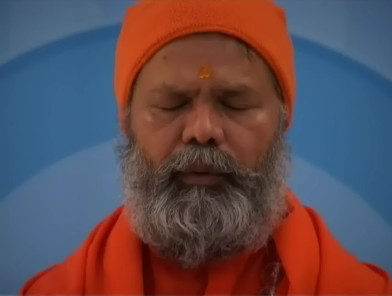
A spiritual lecture on Kuṇḍalinī, chakras, and the purpose of human life.
"Yoga is the science of body, mind, consciousness, and soul. Yoga without spirituality is like a body without a soul."
"Chakra is that which is purifying our body, mind, and consciousness. Chakra has to be purified through practice of mantra, prayers, or some yogic kriyās. Then the kuṇḍalinī will awake."
The teacher continues a multi-day seminar, delving into the nature of human consciousness through the lens of Kuṇḍalinī energy and the chakra system. He explains the five layers of the body (kośas), the persistence of karma using an analogy of salt in water, and the symbolism of the Mūlādhāra chakra—its red color, lotus imagery, and four petals representing the four aims of life: dharma, artha, kāma, and mokṣa. The discourse expands into themes of universal love, friendship, and living in the world with detachment, like a lotus in water.
Filming location: Australia
Prana and pranayam
10:05 - 10:52 (47 min)
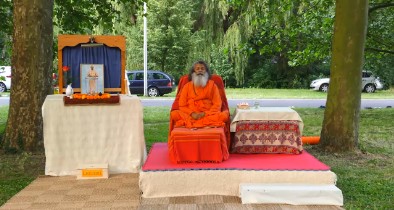
A spiritual discourse on prāṇāyāma and the interconnectedness of life, addressing modern pollution.
"To pollute the earth is a sin. It means you pollute Mother Earth."
"The most dangerous pollution is in the human mind. And that mind is so polluted, and of course, everyone is proud of that—how much my mind is polluted."
Swami Madhavan Ji delivers an evening talk, beginning with the science of breath (Pūrak, Rechak, Kumbhak) and the sacredness of Sanskrit. He expands the theme to describe a profound chain of pollution: of the Earth, our physical bodies through toxins, and finally our minds through negative thoughts. He presents yoga and prāṇāyāma as the essential science to purify these layers, explaining how breathwork balances the Ida and Pingala nadis and burns away karmic impurities, ultimately leading to unity with Brahman.
Filming location: Vép, Hungary
Around the world - Khatu pranam
11:00 - 11:34 (34 min)
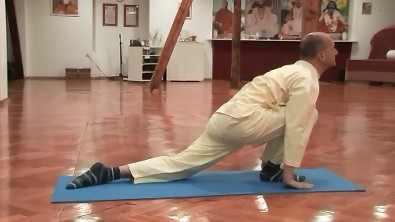
The story of Sri Mahaprabhuji and Khatu Pranam exercise. Produced by Sri Devpuriji Ashram in Zagreb, Croatia. Partially subtitled in Engish.
Questions and answers from Debrecen
11:40 - 12:20 (40 min)
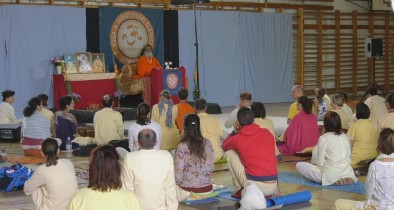
A satsang addressing practical yogic living and dietary discipline.
"If you really want to do your yoga sādhānā, then, first control over your tongue, the test. You will see that 90% of all difficulties in your body will disappear."
"Yoga begins with discipline. Atha yoga anuśāsana."
Swami Satyananda Saraswati answers questions from attendees, first offering advice on starting a yogic farm community in Hungary. He then delivers a core teaching on foundational spiritual practice, emphasizing strict dietary control (limited intake, no snacking, avoidance of processed foods and alcohol) as the primary step for health, discipline, and preparing for meditation. He expands on the importance of satsang, prāṇāyāma, and consuming local, organic, seasonal foods, using soy cultivation and an anecdote about Australian milk regulations as cautionary examples.
Filming location: Debrecen, Hungary
Muladhara chakra. Part one.
12:25 - 12:57 (32 min)
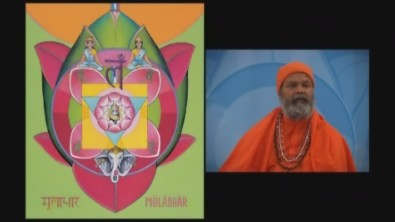
A spiritual discourse on the necessity of a guru and the symbolism of the Mūlādhāra chakra.
"Yoga without spirituality is a body without a soul. A part of yoga requires a master."
"Your being in this world is more needed than you think. Therefore, never think that you want to die now."
Swami Anand Arun explains the essential role of a spiritual guide (guru), using analogies like learning to drive. He then details the Mūlādhāra (root) chakra, describing its red color, earth element, and the lotus as a symbol for living in the world with detachment. He emphasizes serving others with love and wisdom, urging attendees to be a light for others.
Filming location: Brisbane, Australia
Swamijis lecture about Mahaprabhuji
13:00 - 13:12 (12 min)
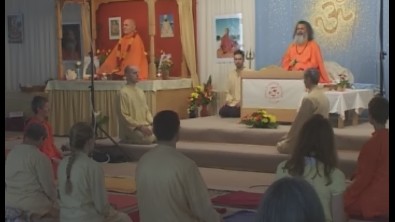
A spiritual guide introduces the sacred sites of the Khattu region and the Khaṭu Praṇām practice.
"The Śrī Vijñāna Dīpa Gītā... was spoken by Mahāprabhujī under that banyan tree."
"When we say Khaṭu Praṇām, our salutation automatically goes to Mahāprabhujī—to those heels on which Mahāprabhujī walked."
The speaker describes Khattu as the primary residence of Bhagavān Śrī Dīp Nārāyaṇa Mahāprabhujī, highlighting specific holy sites like the banyan tree and the Dhūnī of Devapurījī. He traces the spiritual lineage from the Himalayas to Khattu and explains the purpose of the Khaṭu Praṇām, a sequence of ten movements, as a salutation that connects practitioners to this spiritual energy. He concludes with a critique of teachers who incorrectly instruct the practice.
Filming location: Khatu, Rajasthan, India
Pride is an ego trap
13:15 - 14:34 (79 min)
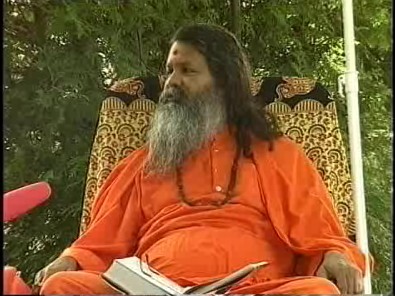
Lecture from Vep, Hungary, 2001
How to be happy
14:40 - 15:27 (47 min)
Evening satsang from Jadan Ashram with some electric failures but good sound. Sadhvi Shanti remembers her Sannyas Diksha in Kailash Ashram 20 years ago. Thursday is the day, dedicated to the Guru, the masters. The bhajan -OM Brahma Shiva Alakha Anadi- composed by Holy Guruji, describes the Guru lineage of Yoga In Daily Life. A short story about judgment and another one about contentment are giving us a practical understanding how to be happy and developing acceptance.
Bhajan evening in Jadan Ashram
15:30 - 16:12 (42 min)
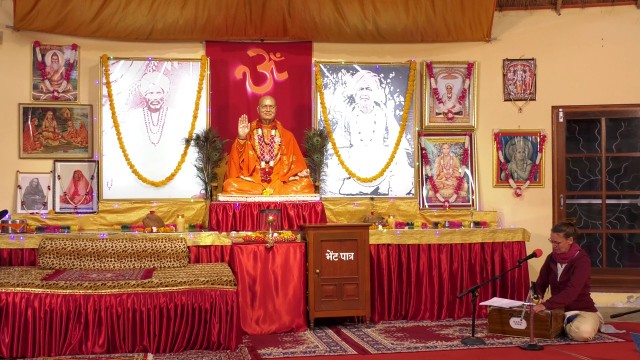
Evening satsang from Jadan Ashram, Rajasthan, India. Bhajan singing
Bhajan singing from Jadan Ashram
16:20 - 17:06 (46 min)
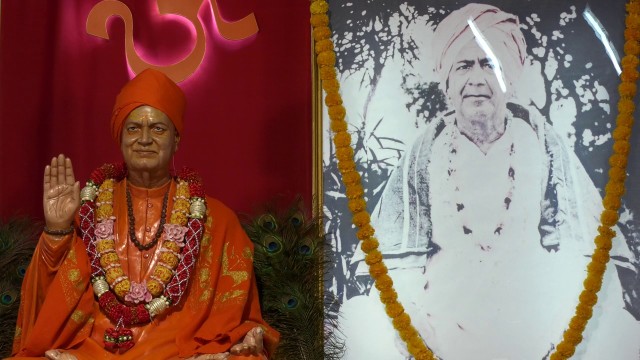
Evening satsang with Vishwaguruji from Jadan Ashram, Rajasthan, India.
Bhajan evening in Strilky Ashram
17:10 - 17:56 (46 min)
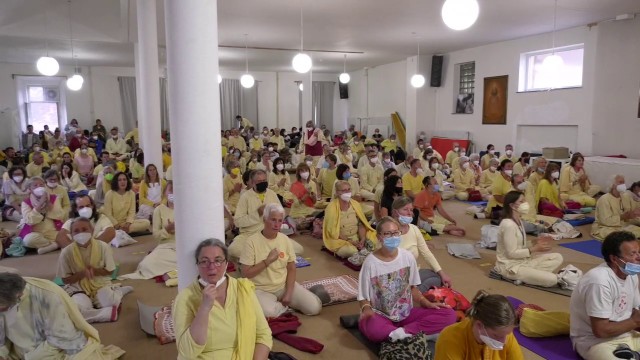
Evening satsang with Vishwaguruji from Strilky Ashram, Czech Republic. Bhajan singing.
Bhajans from Slovenska Vas
18:00 - 18:44 (44 min)
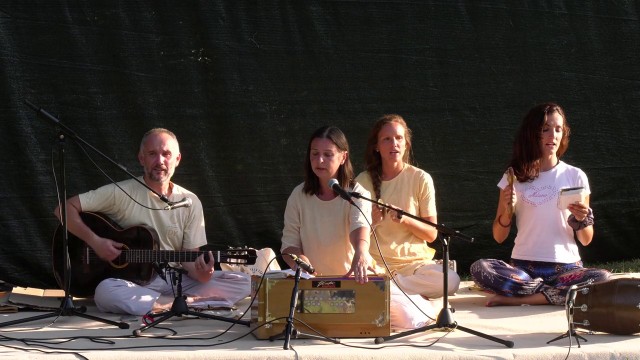
Evening satsang from Slovenska Vas, Slovenia.
Pollution
18:50 - 19:51 (61 min)
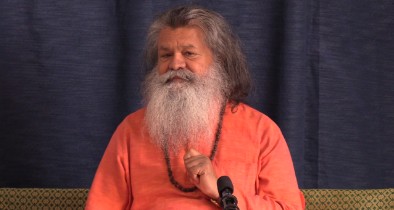
A spiritual discourse on the five sheaths (kośas) and the impact of nourishment.
"Jaisā khāī annā, vaisā rahe man—what kind of nourishment or food you are eating—like that will turn your mind."
"So first is the physical nourishment, Annamaya Kośa... What kind of food you will eat, like that will be your mentality."
Swami Ji explains the five layers of human existence, beginning with the food sheath (Annamaya Kośa). He emphasizes how diet shapes one's energy, mind, and consciousness, weaving in critiques of modern food systems, historical anecdotes about pre-industrial community life, and cautionary tales about arguing with a spiritual master. The talk uses the symbol of the crocodile in the Svādhiṣṭhāna chakra to represent destructive emotions.
Filming location: Auckland, New Zealand
How to overcome the obstacles of practicing
19:55 - 21:13 (78 min)
A spiritual discourse on the chakra system, focusing on the Maṇipūra chakra and the journey of self-mastery.
"My first master was my father, who imparted immense knowledge in a simple way. Through his instruction, I found my path."
"Strive for oneness, purity, without blemish. Do not stain your body."
Swami Maheśvarānand leads a satsang, weaving teachings on the manipura (navel) chakra with personal stories from his childhood and path to sannyas. He explains the symbolic animals and deities within each chakra, the role of the guṇas (qualities), and the necessity of a guru's guidance. The talk emphasizes practical discipline, advocating for specific prāṇāyāma techniques like Kapālabhāti and Bhastrikā to awaken inner energy, and concludes with a blessing.
Filming location: Wellington, New Zealand
Yoga is a science
21:20 - 22:39 (79 min)
A spiritual lecture on Kuṇḍalinī, chakras, and the purpose of human life.
"Yoga is the science of body, mind, consciousness, and soul. Yoga without spirituality is like a body without a soul."
"Chakra is that which is purifying our body, mind, and consciousness. Chakra has to be purified through practice of mantra, prayers, or some yogic kriyās. Then the kuṇḍalinī will awake."
The teacher continues a multi-day seminar, delving into the nature of human consciousness through the lens of Kuṇḍalinī energy and the chakra system. He explains the five layers of the body (kośas), the persistence of karma using an analogy of salt in water, and the symbolism of the Mūlādhāra chakra—its red color, lotus imagery, and four petals representing the four aims of life: dharma, artha, kāma, and mokṣa. The discourse expands into themes of universal love, friendship, and living in the world with detachment, like a lotus in water.
Filming location: Australia
Detachment and Liberation
22:45 - 23:56 (71 min)
A satsang featuring a discourse by scholar Śrī Gulābjī Kothārī on spiritual life and householder duties.
"Today is a very auspicious day, a holy day, a divine day, a day full of colour and happiness."
"The basic aim of life is... everybody should prosper and have a good life. But once it is over at 50, you are moving towards the society, then you move towards... the path has changed to enlightenment."
Swami Maheshvarananda introduces the visiting scholar Śrī Gulābjī Kothārī to the ashram gathering. Gulābjī delivers an extensive talk on integrating spiritual practice with worldly life, framing existence within the Vedic puruṣārthas (dharma, artha, kāma, mokṣa). He explains the journey of the soul, the importance of living in the present, and details a cosmology where food (annam) and the elements (Agni and Soma) link human life to the universe. A significant portion addresses the dynamics of married life (Gṛhasthāśrama), described as a 25-year period where complementary masculine and feminine principles unite for creation and spiritual growth. The session concludes with a question-and-answer segment where Gulābjī and Swamiji discuss challenges to family life in the modern West, emphasizing traditional gender roles.
Filming location: Jadan, Rajasthan, India
American
Australian