
European
The Space of Practice
0:00 - 1:01 (61 min)
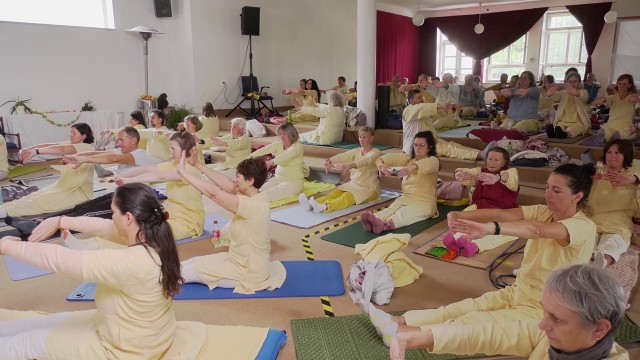
A guided yoga and meditation session focusing on awareness and spinal health.
"For life and death, two square meters is enough."
"That is the beauty of yoga, Kāla and Deśa. And for that, we need a Guru to lead us through time and space and make us update and upgrade."
An instructor leads a group through a series of āsanas including Pavanamuktāsana, Bhujaṅgāsana preparation, Bhuñamānāsana, and Meru Ākhara Āsana. The practice emphasizes the principles of stretching and rotating the spine, correcting kyphosis, and cultivating body awareness. The teacher integrates philosophical teachings on time, space, and the need for a guide, alongside practical benefits for the back, shoulders, and digestion.
Filming location: Strilky, Czech Republic
Part 1: The Divine Chambers of Being
1:05 - 2:14 (69 min)
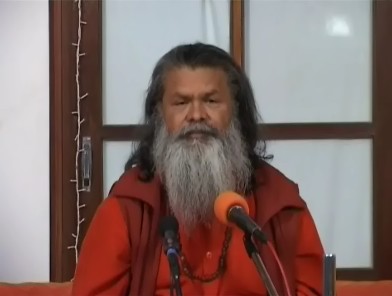
A spiritual discourse on the five sheaths (kośas) and the purification of the physical body.
"Jaisā khāyegā anna, vaisā rahegā mana. (As is the food you eat, so will be your mind.)"
"Hinduism is based on non-violence, Ahiṃsā. The statement 'Ahiṃsā Paramo Dharma' was spoken by Pitā Mahābhīṣma after the Mahābhārata battle."
Swami Maheshwarananda (Swamiji) leads a satsang focusing on the annamaya kośa, the food sheath. He explains how diet influences the mind through the three guṇas (qualities), stressing the importance of sāttvic food and the principle of non-violence. He shares a cautionary tale of a sādhu whose mind was corrupted after unknowingly eating food provided by a thief, illustrating the spiritual impact of nourishment. The discourse also touches on cultural preservation, meditation practices, and concludes with a bhajan.
Filming location: Jadan, Rajasthan, India
Guru is the first
2:20 - 2:56 (36 min)
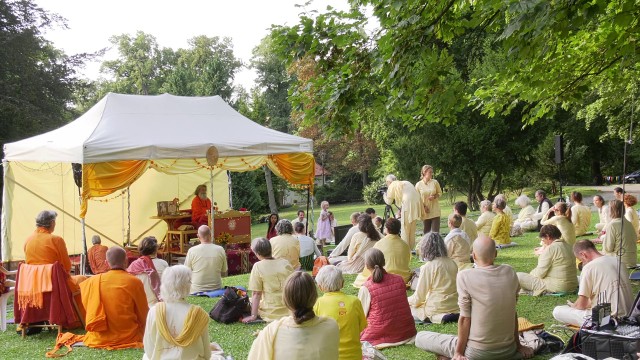
A spiritual discourse on the continuity of sādhanā and the centrality of the Guru.
"Your sādhanā was very beautiful, very good. Many experienced beautiful powers, feelings, and even incarnations. Yes, we should continue this until the end of our life."
"Holy Gurujī, our Swamījī Madhavānandajī Bhagavān, he always said that Seva is all the time with us. We are going, as all goes, to the Cosmic Self."
A teacher addresses students after a spiritual retreat, using the metaphor of a stone creating eternal ripples in a pond to describe the lasting impact of their practice. He emphasizes selfless service (Seva) and explains the Guru's paramount importance, stating all spiritual activities must follow devotion to the Guru. The talk covers the meaning of mantra, the significance of the prayer mala, and outlines the traditional four stages of life (āśramas).
Filming location: Strilky, Czech Republic
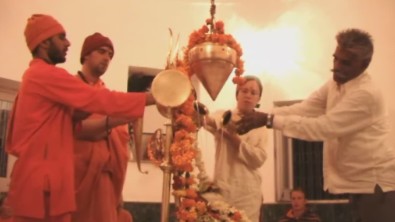
Around the world - Shivaratri at Jadan Ashram
3:00 - 3:07 (7 min)
Around the world - Yoga against backpain SLO
3:15 - 3:51 (36 min)

A lecture on spinal anatomy, common causes of back pain, and a concise daily yoga routine.
"The most common among all these incorrect postures is this one... we sit every day like this for eight hours at the computer at work."
"One āsana, and ten minutes. Ten minutes. Now you all have to admit that you have ten minutes."
A medical professional delivers a detailed educational talk, explaining spinal structure, the biomechanics of injury from poor posture and lifting, and the development of acute versus chronic pain. He then introduces a preventative ten-minute yoga sequence, demonstrated by an assistant named Lena, which includes stretching, twisting, and strengthening exercises like the cat pose, emphasizing mindful movement to alleviate and prevent spinal issues.
Filming location: Slovenia
Around the world - Yoga against backpain
3:55 - 4:01 (6 min)
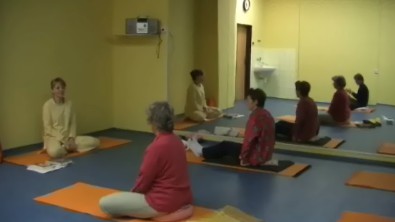
Report about yoga classes organized specifically to address people with backpain from Prague.
Around the world - Yoga for senior HU
4:05 - 4:27 (22 min)
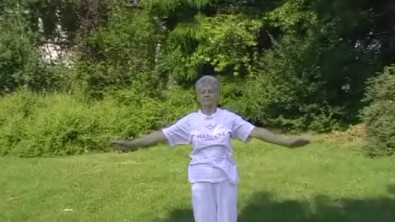
Yoga Asanas, Pranayam and meditation presented by 78 years old Hack Antalne and her expirences with practising Yoga in daily life. Production in August 2010 by Tata YIDL group, Nyergesujfalu, Hungary.
Around the world - Bhajans from India
4:35 - 4:51 (16 min)
Bhajans and pictures from India
Vegetarian cooking lesson 7, Prosa Hungarian cake
5:00 - 5:12 (12 min)

A cooking demonstration for a traditional Hungarian sweet dish called prósa.
"The longest part is the baking, which takes 40 minutes at 200 degrees Celsius."
"This is one of the simplest sweet foods from around the world."
Sándor Szabó from Nyíregyháza demonstrates how to make prósa during an international Yoga in Daily Life seminar. He mixes yogurt with white and brown wheat flour to create a batter, spreads it thinly on an oiled pan, and tops it with brown sugar and plum jam before baking. He explains the dish's origins as simple farmer food and shows the finished, cut-up result.
Filming location: Vép, Hungary
Simple living and higher thinking
5:20 - 6:07 (47 min)
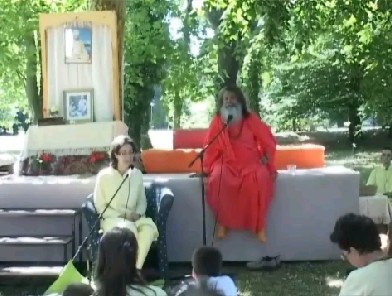
A discourse on Hindu devotional practices and philosophy.
"Why do Indians decorate their gods? The answer is very simple: because we love our God."
"Whatever you are doing for God, you are doing for yourself."
The lecturer addresses devotees, explaining the cultural and spiritual significance of decorating altars and deities as an expression of love and devotion. He explores core Hindu concepts, including the nature of the one supreme God manifesting in many forms, the personal benefits of selfless service and offering, and the importance of cultivating beautiful thoughts and living in the present. The talk weaves together scripture, personal anecdote, and metaphor to illustrate these principles.
Filming location: Vép, Hungary
Anahata chakra
6:15 - 7:01 (46 min)
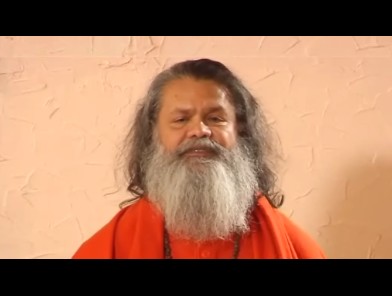
A spiritual discourse on meditation, chakra awakening, and contentment.
"Yoga in Daily Life around the world is doing miraculous work. A lot of work is done towards the protection of the environment, the protection of animals, and supporting poor people."
"When the Anāhata Chakra is pure, then we call it the holy heart. The holy heart means the divine consciousness awakens in your heart."
Swami Paramadvaiti addresses practitioners at a Yoga in Daily Life center, discussing the organization's charitable work before delving into spiritual teachings. He explains the three principles of sound, light, and energy within all phenomena, detailing the awakening of the heart chakra (Anāhata) and the resulting state of supreme contentment (Śāntoṣa). The talk includes a poetic analogy on spiritual wealth and concludes with a practical, step-by-step guided meditation technique focusing on breath and light.
Filming location: Prague, Czech Republic
The Pearl of Everlasting Bliss
7:05 - 7:26 (21 min)
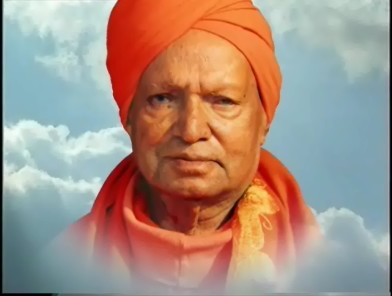
A biographical tribute to the life and legacy of Hindu saint Paramahaṁsa Śrī Svāmī Madhavānandajī.
"My eyes filled with tears, and I fell to my knees. I knew I had found the everlasting light of my life. I was home at last."
"All humans belong to one religion, and that is humanity... ahiṃsā paramo dharma: non-violence is the highest religion."
The narrative chronicles the spiritual journey of Swami Madhavānandaji, from his childhood in Rajasthan and transformative meeting with his guru, Bhagavān Śrīdīp Nārāyaṇa Mahāprabhujī, to his life of devotion, teaching, and global service. It details his initiation, his work establishing ashrams, and his teachings on non-dualism and universal love, culminating in his Mahāsamādhi in 2003 and the continuation of his lineage through his disciple, Swami Māheśvarānandajī.
Filming location: Rajasthan, India; Kathu Ashram, India; Bola Guda Ashram, India; Nepal
We have to become one
7:30 - 9:04 (94 min)
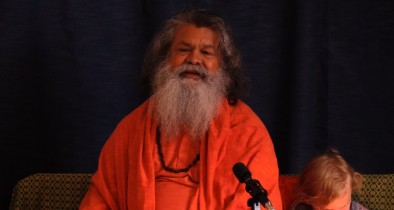
Evening satsang with Vishwaguruji from Auckland, New Zealand. There are many things in the space. We should stop our attachment. Great yogis do not attach to anything and to anybody. Break from the attachment and join to God. Nothing is mine. Explanation of bhadzsan Chidananda Rupam Sivoham Sivoham. Sometimes we can not understand wisdom. Shiva means only space. He is everywhere in everything and nowhere. Explanation of bhadzsan Ragupati Raghava Raj Ram. One in all and all in one. Explanation of bhadzsan Sabda Sanehi Mhari Jatra. A story or a poem can help you to understand knowledge. The knowledge what we have we should understand, realize and give further. Chakras are the major stations in our body. The Earth connected to the Sun. The system of elements and chakras in our body.
Ayurveda - The science of life
9:10 - 10:56 (106 min)
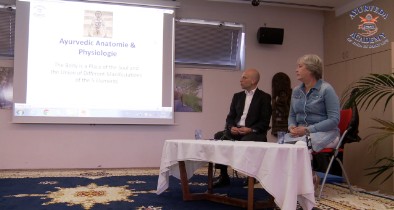
An introductory lecture on the history and scope of Ayurveda.
"Ayurveda is a science that deals with the useful and the harmful, the happy and unhappy life."
"The scope of Ayurveda is to maintain the health of healthy people and to cure those who are afflicted with diseases—two things."
The speaker outlines a lecture on Ayurveda, beginning with its mythological origins from Brahmā through sages like Dhanvantari and its textual compilation in works like the Caraka Saṃhitā. He corrects the notion that it is only 5,000 years old, explaining its vast scope for maintaining health and treating disease, and details its eight traditional branches.
Filming location: Prague, Czech Republic
Around the world - Bhajans from Kailash(2/3)
11:00 - 11:34 (34 min)
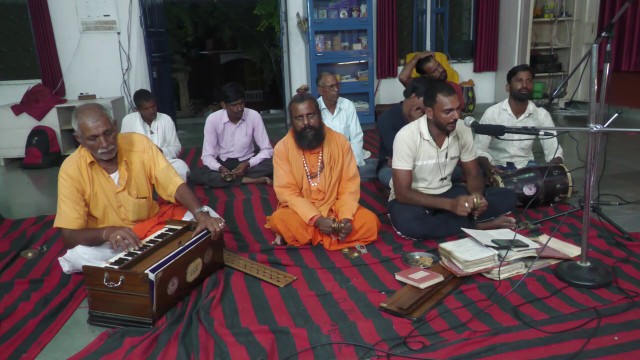
Evening satsang from Kaliash Ashram, Rajasthan, India. Bhajans on the occasion of Sri Devpuriji Mahasamadhi.
Sat sanga
11:40 - 12:07 (27 min)
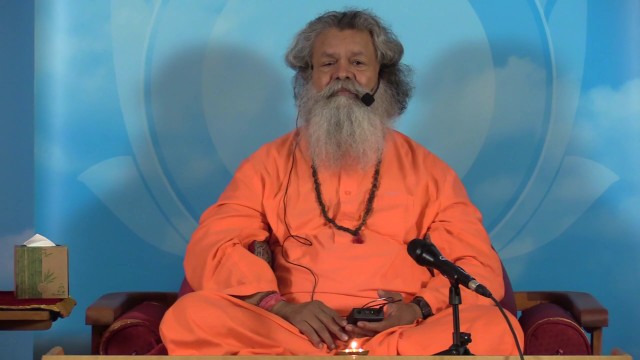
A spiritual discourse on the meaning and power of satsaṅga.
"It was very hard, very hard. I think in your country it was also, no? It was very much."
"Sat means truth. Satsaṅga, truth. Each and every word should be such that we should know the truth."
The lecturer addresses a gathering, reflecting on the global difficulties of the past years, including pandemic-related travel disruptions. He explores the concept of satsaṅga, defining "sat" as truth and emphasizing the importance of truthful company and spiritual practice. The talk meanders through themes of guru lineages, the impermanence of the body compared to the lasting nature of one's name, and the unifying principle of truth amidst worldly distinctions.
Filming location: Brisbane, Australia
The Pearl of Everlasting Bliss
12:15 - 12:36 (21 min)
A biographical tribute to the life and legacy of Hindu saint Paramahaṁsa Śrī Svāmī Madhavānandajī.
"My eyes filled with tears, and I fell to my knees. I knew I had found the everlasting light of my life. I was home at last."
"All humans belong to one religion, and that is humanity... ahiṃsā paramo dharma: non-violence is the highest religion."
The narrative chronicles the spiritual journey of Swami Madhavānandaji, from his childhood in Rajasthan and transformative meeting with his guru, Bhagavān Śrīdīp Nārāyaṇa Mahāprabhujī, to his life of devotion, teaching, and global service. It details his initiation, his work establishing ashrams, and his teachings on non-dualism and universal love, culminating in his Mahāsamādhi in 2003 and the continuation of his lineage through his disciple, Swami Māheśvarānandajī.
Filming location: Rajasthan, India; Kathu Ashram, India; Bola Guda Ashram, India; Nepal
Your body is the map of your destiny
12:40 - 13:25 (45 min)
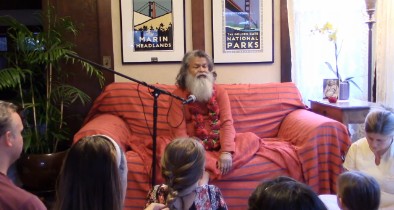
A final evening satsang on destiny, karma, and the possibility of spiritual intervention.
"Destiny is written; it cannot be changed."
"Rekh Parmek Gurudev: your destiny can change only by the guru."
Swami Avatarpuri concludes a program by elaborating on the concepts of janma-bhūmi, karma-bhūmi, and dharma-bhūmi. He narrates the story of Oedipus to illustrate inescapable fate, then explains how destiny is mapped on the human body through lines on the forehead, palms, and fingers. He contrasts the fixed nature of karma with the potential for change through spiritual practice (sādhanā) and, ultimately, the grace of a true guru, who acts as a divine navigator.
Filming location: San Francisco, USA
We all should get oneness
13:30 - 13:46 (16 min)
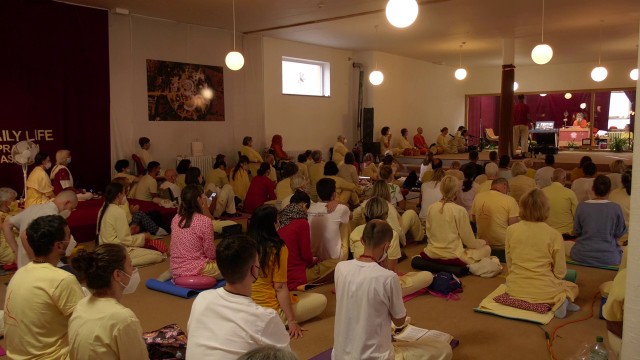
A spiritual discourse on the language of oneness and silence during Guru Purnima.
"The best language is when people from many countries, each with their own language, suddenly all understand."
"Silent means oneness."
A spiritual teacher addresses an international satsang on Guru Purnima, exploring how true communication and unity transcend spoken language. He discusses understanding through sound, vibration, and silence, using examples like music and opera, and contrasts the noisy chaos of worldly festivals with the profound, unifying silence of spiritual gathering.
Filming location: Strilky, Czech Republic
Interview with Vishwaguruji on Lok Sabha
13:50 - 14:20 (30 min)
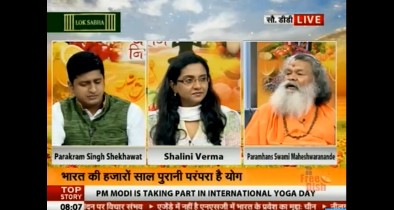
A television panel discussion on International Yoga Day, featuring a host and guests.
"Yoga is the mother of all sciences and arts. It is the science of human origin and evolution to a point where you can overcome the boundaries of space and time."
"Yoga should not be commercial. No. It should be free. A guru gives knowledge to the disciple not because of money or with money, but with blessings."
A host moderates a discussion with senior journalist Gyanendra Bhattaria and Swami Maheshvaranandji on the global celebration of Yoga Day, its origins, and its core principles. The panel addresses the event's scale, the essence of yoga beyond physical postures, the role of a guru, and concerns over commercialization and modern interpretation. The conversation references Prime Minister Narendra Modi's leadership in establishing the day and a live yoga session in Chandigarh.
Filming location: India
Introduction to Jadan Ashram
14:25 - 15:24 (59 min)
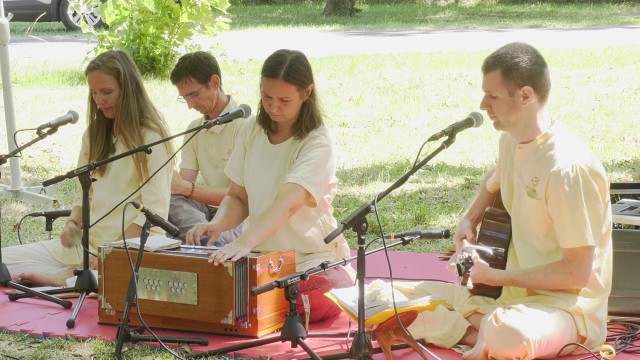
Morning satsang with Vishwaguruji from Vep, Hungary. Swami premanand talks about the special blessing of being together with Gurudeva at Vep. Explaining the significance of the Jadani Ashram. The Jadan Ashram is the embodiment of Gurudeva's plan, the Master's playground. Everyone who comes here will find their way. The practice of Bhramari pranayam.
Bhajan evening in Jadan Ashram
15:30 - 15:52 (22 min)
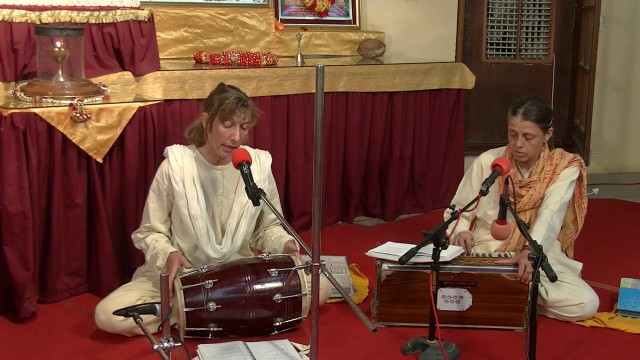
Evening satsang with Vishwaguruji from Jadan Ashram, Rajasthan, India. Bhajan singing.
We can not divide the Love
16:00 - 16:47 (47 min)
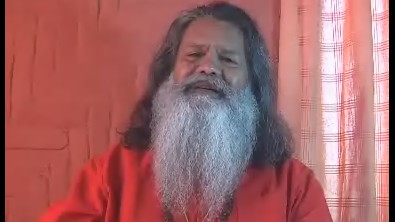
A satsang discourse on the universal and ancient science of yoga.
"Yoga is universal. All the saints and holy incarnations on this planet went through the practice of yoga."
"Yoga means union, harmony, understanding, wisdom. Yoga is the way to God because God Himself practices yoga."
The lecturer addresses spiritual seekers, continuing from a previous talk on yoga postures. He presents yoga as the foundational spiritual science for body, mind, and soul, encompassing all religions and aimed at self-realization. He discusses its origins with Shiva, its role in ending the soul's cycle of suffering, and promotes the "Yoga in Daily Life" system, touching on pranayama, the error of religious division, and the unity of all creation.
Filming location: Nepal
Spiritual festivals
16:50 - 17:23 (33 min)
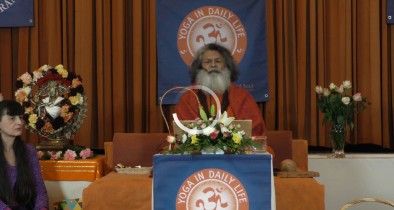
A spiritual discourse on the sacred design of human life and daily practice.
"A human should live life according to what we need only. Making highways and skyscrapers is only for the fulfillment of the ego of human life."
"The great saints around the world designed a good occupation for humans, which keeps their vṛttis in a little peaceful situation while simultaneously upgrading their spirituality. This manifests as different kinds of festivals."
The speaker explains how ancient sages designed a life of sacred observance to cultivate peace and spirituality, critiquing modern materialism and violence. He details the spiritual significance of each day of the week, its associated deity, and practices like chanting the Hanumān Chālīsā on Tuesday or fasting. The talk expands to include monthly and yearly cycles, arguing that this continuous engagement in celebration and worship leaves no room for conflict, ultimately creating a peaceful world.
Filming location: Vép, Hungary
Bhajan singing in the Jadan Ashram
17:25 - 18:43 (78 min)
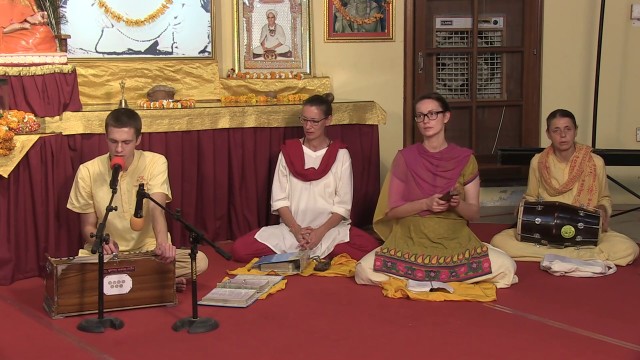
Evening satsang with Vishwaguruji from Jadan Ashram, Rajasthan, India. Bhajan singing evening.
The Pearl of Everlasting Bliss
18:50 - 19:11 (21 min)
A biographical tribute to the life and legacy of Hindu saint Paramahaṁsa Śrī Svāmī Madhavānandajī.
"My eyes filled with tears, and I fell to my knees. I knew I had found the everlasting light of my life. I was home at last."
"All humans belong to one religion, and that is humanity... ahiṃsā paramo dharma: non-violence is the highest religion."
The narrative chronicles the spiritual journey of Swami Madhavānandaji, from his childhood in Rajasthan and transformative meeting with his guru, Bhagavān Śrīdīp Nārāyaṇa Mahāprabhujī, to his life of devotion, teaching, and global service. It details his initiation, his work establishing ashrams, and his teachings on non-dualism and universal love, culminating in his Mahāsamādhi in 2003 and the continuation of his lineage through his disciple, Swami Māheśvarānandajī.
Filming location: Rajasthan, India; Kathu Ashram, India; Bola Guda Ashram, India; Nepal
Detachment and Liberation
19:15 - 20:26 (71 min)
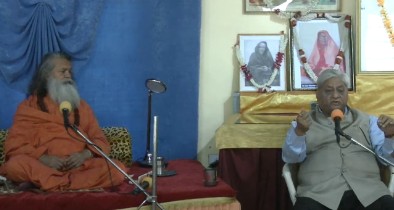
A satsang featuring a discourse by scholar Śrī Gulābjī Kothārī on spiritual life and householder duties.
"Today is a very auspicious day, a holy day, a divine day, a day full of colour and happiness."
"The basic aim of life is... everybody should prosper and have a good life. But once it is over at 50, you are moving towards the society, then you move towards... the path has changed to enlightenment."
Swami Maheshvarananda introduces the visiting scholar Śrī Gulābjī Kothārī to the ashram gathering. Gulābjī delivers an extensive talk on integrating spiritual practice with worldly life, framing existence within the Vedic puruṣārthas (dharma, artha, kāma, mokṣa). He explains the journey of the soul, the importance of living in the present, and details a cosmology where food (annam) and the elements (Agni and Soma) link human life to the universe. A significant portion addresses the dynamics of married life (Gṛhasthāśrama), described as a 25-year period where complementary masculine and feminine principles unite for creation and spiritual growth. The session concludes with a question-and-answer segment where Gulābjī and Swamiji discuss challenges to family life in the modern West, emphasizing traditional gender roles.
Filming location: Jadan, Rajasthan, India
We have to become one
20:30 - 22:04 (94 min)
Evening satsang with Vishwaguruji from Auckland, New Zealand. There are many things in the space. We should stop our attachment. Great yogis do not attach to anything and to anybody. Break from the attachment and join to God. Nothing is mine. Explanation of bhadzsan Chidananda Rupam Sivoham Sivoham. Sometimes we can not understand wisdom. Shiva means only space. He is everywhere in everything and nowhere. Explanation of bhadzsan Ragupati Raghava Raj Ram. One in all and all in one. Explanation of bhadzsan Sabda Sanehi Mhari Jatra. A story or a poem can help you to understand knowledge. The knowledge what we have we should understand, realize and give further. Chakras are the major stations in our body. The Earth connected to the Sun. The system of elements and chakras in our body.
Ayurveda - The science of life
22:10 - 23:56 (106 min)
An introductory lecture on the history and scope of Ayurveda.
"Ayurveda is a science that deals with the useful and the harmful, the happy and unhappy life."
"The scope of Ayurveda is to maintain the health of healthy people and to cure those who are afflicted with diseases—two things."
The speaker outlines a lecture on Ayurveda, beginning with its mythological origins from Brahmā through sages like Dhanvantari and its textual compilation in works like the Caraka Saṃhitā. He corrects the notion that it is only 5,000 years old, explaining its vast scope for maintaining health and treating disease, and details its eight traditional branches.
Filming location: Prague, Czech Republic
American
Australian